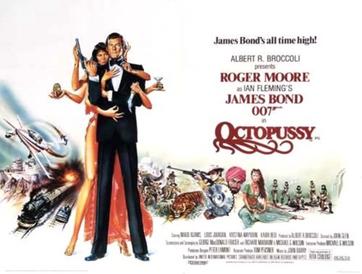
James Bond re-visits the Raj; or, Watching “Octopussy” in 2020

I’ve always been a Bond-o-phile.  I don’t know how old I was when I saw my first James Bond film, or which one it was.  The first one I saw in the theaters was A View to a Kill (hey, I was a kid; I didn’t have the best taste!), and I think I’ve seen every one that’s come out since in the theaters too.  I’ve seen every film at least once.  I haven’t read too many of the novels, sticking pretty much to cinematic Bond.  It’s impossible for me to choose a favorite Bond, villain, female interest, theme song, or simply a movie.  But there are a few that I do hold above the rest.  It’s easy to default to Goldfinger: it set the template for the whole series.  Opening scene with nothing to do with the rest of the plot; menacing villain who likes to monologue about a ridiculous scheme; female interest with suggestive name; henchman with a gimmick; Bond one-upping the villain in a game; and of course, Bond drives an Aston-Martin.  So much of what follows throughout the entire series began with Goldfinger.  No wonder it’s considered by many to be the best.

One of the films, made nearly 20 years later, that follows the Goldfinger template fairly closely, is also usually ranked near the bottom of Bond films.  I am referring to 1983’s Octopussy.  Look back at my list of Bond tropes from last paragraph.  While Pussy Galore may have been a character in Goldfinger, she never had a film named after her.  That is not the case with Octopussy (the character herself).   I don’t recall when I first saw Octopussy; I’m sure I didn’t see in the theaters.  I would’ve been 10 years old when it came out.  And I’m also unclear when I went against the grain and started ranking it near the top of my Bond favorites.  I remember my reasonings were, the Indian setting (ever since I first read Around the World in Eighty Days I’ve had a fascination for the Subcontinent…particularly stories of British India); the villain Kamal Khan, and the fact that Octopussy was older than your typical Bond leading lady….therefore making a better match for an again Roger Moore.  As the years went by, I listened to the critiques and agreed with some of them; yes, the plot is hard to grasp.  So the bad guys are smuggling jewels out of the Soviet Union, but there’s also a circus, an island of women, and a nuclear bomb.  Wait….what?  Still, I maintained the general opinion was wrong; Octopussy was solid James Bond film.

It was with that mindset that I watched Octopussy for the first time in probably over a decade, just last night.  I have on DVD all of the Sean Connery and Roger Moore Bond films.  My wife is not as well-versed in all things Bond as I am; I think our first movie date was to see Casino Royale back in 2006.  To catch her up on the past, I’m pretty sure we rented Octopussy at some point; I know she’s seen it, as Kamal Khan’s dinner invitation to Bond, “Please…the soufflé can’t wait” has become part of our vernacular.  Still, assuming that it was 2007 or 2008 when I showed her Octopussy, that’s still 12 or 13 years ago.  Heck, that’s pre-President Obama.  So much has changed since then!  Would I still staunchly defend the case of Octopussy after that long an absence?  Well…let’s do this by category….

  1. Main Villain 

What worked:

I don’t think it’s essential that you have to have a great villain to have a great Bond film.  The Spy Who Loved Me…true, it gave us Jaws, but he was a henchman. True baddie Stromberg is pretty forgettable.  Menacing, but his scheme was ridiculous (cause World War III and start over under the seas).  And there have been really good villains saddled with bad films; Christopher Walken as Max Zorin in A View to a Kill; Christopher Lee in The Man with the Golden Gun; and most recently, Christoph Walz in Spectre.  Generally, the best Bond films have really memorable villains: Auric Goldfinger, Raoul Silva in Skyfall, and of course, Alec Trevelyan in Goldeneye.  And for me, one of the reasons I love Octopussy is the villain, Kamal Khan, as played by Louis Jourdan.

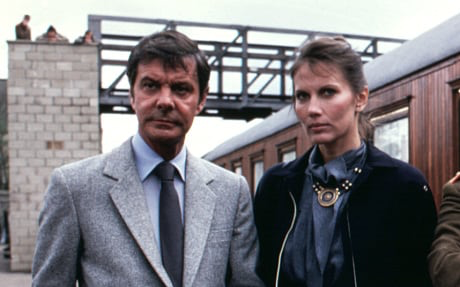
1424045160300

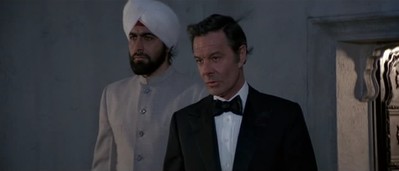
I love this picture.  To me, it sums up everything about Kamal Khan.  Elegant, debonair, controlled, confident, smug.  Kamal’s backstory is pretty much summed up in two different scenes.  At Sotheby’s, the art expert tells Bond he’s typically a seller, not a buyer.  And then when Bond arrives in India, Vijay informs Bond that Kamal is an exiled Afghan prince and a sportsman.  That’s about all we get on Kamal.  And if your complaint is, why is a French actor playing a character who is Afghan…..well, point taken.  But Jourdan plays the character so well!  Pretty much until the Pierce Brosnan films, the Bond villains were not played by the most notable actors (Christoper Lee of course, being an exception).  How familiar are you with the work of Curt Jurgens (The Spy Who Loved Me), Charles Gray (Diamonds are Forever), or Michael Lonsdale (Moonraker)?  That changes in the Brosnan era, when you get actors such as Sean Bean, Sophie Marceau, Robert Carlyle, Jonathan Pryce, and Rosamund Pike all working against 007.  But with Octopussy, we get Louis Jourdan, who already had enjoyed a long career in movies, most notably the 1959 MGM musical Gigi.

Kamal Khan is a different kind of Bond villain.  He’s not a megalomaniac; world conquest is not his goal.  He doesn’t employ a massive, uniformed private army like so many Bond super villains.  His Palace is guarded by local security.  His right hand man is a towering Sikh, Gobinda (more soon to follow).  From what we see, Kamal is fabulously wealthy, lives a life of leisure, and his racket is jewel-smuggling.  He doesn’t have any grand scheme; it’s Soviet general Orlov who has the master plan.  Kamal merely helps him out by providing the connection to Octopussy’s Circus.  Oh, and he has his own team making counterfeit Russian jewelry in his palace.  Kamal really just seems to be in it for money.  Not power, not sex, not control….just to make money.  Heck, when he’s abandoning his Palace near the end of the film, he reveals he has plates to start printing currency.  Quite resourceful!

Some would say this makes Kamal Khan a boring villain.  Anything but!  In my opinion, he is the most smooth, urbane, well-polished villain in the entire canon.  He rarely raises his voice, he is great with a quip, and he just looks SOOO good.  Here’s a short compilation of Kamal speaking.  And while you dwell on that luxurious voice, look at the suits he wears!  A tux, a business suit, two different Nehru collars, an open collar with blazer, and even something appropriate for a safari.  There are other villains who treat Bond to dinner, but I’m not aware of one who so seems at ease as an aristocrat as Kamal Khan.  Then again, he is an exiled Prince; did Bond ever encounter other royalty?

I’ve got much more to talk about than just Kamal Khan, but let me give you a few more reasons why he stands out to me.  For starters, he never monologues to Bond.  The only scene where that might have happened is the dinner, but that’s halfway through the film.  All Kamal does is talk about how Bond will be made to talk.  Maybe it’s because Kamal is not the creator of the scheme, but only an enabler.  Whatever the reason, he doesn’t get the chance to reveal it to Bond.  He also never comes up with outlandish ways to kill Bond.  He sends his henchman Gobinda after him, he hires mercenaries, he leaves Bond to be destroyed in a nuclear blast.  There’s no strapped down to a table with a laser, or fed to sharks.  The only thing that comes close is a hunting party….but it makes for a great action sequence.  It is interesting to me that Kamal Khan is in almost the entire film.  Many Bond villains are seen intermittently.  Often, such as with Blofeld in You Only Live Twice, Bond doesn’t encounter them till in the film’s second half.  That’s not the case with Kamal.  Bond first runs into him in the auction, and then continues to cross his path.  My guess is director John Glen realized what he had with Louis Jourdan, and made milked it for all he was worth!

The last thing I’ll mention about Kamal that I find interesting is….is he gay?  When we first encounter him at Sotheby’s, he has the beautiful Magda with him.  Later, she is at his side when he’s playing backgammon, and she even appears to live in his Palace.  Yet Kamal seems uninterested when Magda sleeps with Bond to get the Faberge egg back.  When he goes to visit Octopussy, on her island of only women, Kamal finds everything mundane.  Lastly, near the end, when Kamal is preparing his exit, Gobinda tells him the noise is “women, selling themselves.”  There’s a bit of detest in his voice and a slight rolling of the eyes.  Are we to believe there is something between Gobinda and Kamal?  As fashionable as Kamal, it wouldn’t be too far-fetched to see him as gay.   Just for speculation.
image

What doesn’t work:

For starters, as wonderful as Louis Jourdan is in the role, Kamal Khan is Afghani.  There’s a long history of this in movies.  Sir Alec Guniness playing King Faisal in Lawrence of Arabia or Yul Brynner playing the King of Siam in The King and I.  This may not have been perceived as a problem in 1983, but watching in 2020, it does bother me.  If Octopussy was made today, I would hope an Afghani actor would play Kamal.

Related to that, there are a couple moments when the script went too far with Kamal.  Dinner at 8 in very formal attire…..perfectly fitting for the character.  Eating stuffed sheep’s head and munching on the eyeball….why?  Maybe it’s truly a delicacy.  It just seemed…well, why give this man, who is the definition of sophistication such a touch?  And then, before the hunt begins, Bond hides in a room in the Palace that has dead humans in it.  Again….why?  Why does Kamal Khan keep dead people?  Perhaps they found out something about him that they weren’t supposed to?  Perhaps it’s to tell the viewers that despite how smooth he is, Kamal is a bad dude.  That could be.  For me though, I don’t think we need to see a savage side to Kamal.  Let him stand on his own as the most gentlemanly of any Bond antagonist.

2. Other Villains

Joining Kamal as the baddy in Octopussy is Soviet General Orlov.  He’s the one with the scheme, and it’s actually a pretty darn good one.  It’s kind of what makes Octopussy work for me.  The Roger Moore films had some pretty over-the-top story lines; rich shipping magnate wants to end life on Earth so everyone can live under the sea (The Spy Who Loved Me); weird guy with droll inflection wants to wipe out life on Earth from space and then breed a master race (Moonraker).  After that, things calmed down with For Your Eyes Only; a real spy story where an underworld crime lord tries to sell a decoder to Soviets.  Everything was realistic, anchored in the Cold War; nothing outlandish.   Octopussy stays with the Cold War, and even though it’s a little more fanciful, it actually makes sense: Orlov wants to detonate a nuclear bomb on a U.S. base in West Germany.  It will be assumed this was an American error, and West Germany will insist on nuclear disarmament.  The Red Army would then be unopposed.  It actually seems like something that could happen.  Now Orlov himself is fine.  Steven Berkoff plays him with the right amount of malevolence.  He snarls, he loses his temper….basically everything a glory-seeking Red Army general would be, as depicted by a Western movie during the Cold War.  Its a stereotype, but it works.  It will always seem a secondary villain to me, like there are in many a Bond film.  Berkoff just isn’t the actor Louis Jourdan was.  I think John Glen felt the same; Orlov meets his demise long before Kamal does.

More interesting, though, is the aforementioned Gobinda.  I actually think he is one of the very best henchmen in the entire James Bond canon. octopussy_s_04_500

You see, Gobinda doesn’t have a gimmick. He doesn’t have metal teeth, he’s not mute (he doesn’t talk much….but he does talk), and he doesn’t have an unusual weapon.  No throwing his hat, here!  His method of intimidation are crushing dice into power….which seems believable by a man as big as him.  Gobinda’s weapons vary from a blunderbuss (okay, that’s a bit weird) to a sword, to a knife, to a rifle.  And he doesn’t have to do it all himself.   When Kamal’s previous attempts to be rid of Bond doesn’t work, he and Gobinda hire mercenaries to attack Octopussy’s island.

I never found Gobinda to be cartoonish; I actually found him menacing.  And Bond really isn’t able to ever beat him.  He finally dispatches him by releasing an antenna on his face, when both are clinging to the top of Kamal’s plane.  Perhaps that’s why Gobinda typically isn’t mentioned on the list of great Bond henchmen; there’s no gimmick.  He’s not a cartoon.  He’s just a really tough, intimidating big man who is more than enough for James Bond to handle.

3.  Bond Women

What Worked:

Octopussy for a Bond film has a relatively low women count.  I know that sounds insane for a film in which there is an island inhabited completely by beautiful women.  But if you go by what women Bond actually has relations with, there are only two.  I guess you can go three if you go with his ally in the pre-credit sequence.  Here’s the thing: none of the women are disposable.  They all play a part in the narrative, none of them meet a tragic end (as often happens when there are multiple Bond girls), and each of them can function on their own, without needing Bond….for the most part.  Yes, Octopussy requires Bond to save her at the end….but we’ll get to that.  And heck, you could say that’s balanced out by the woman in the pre-credit sequence in some Latin American country (I always assumed Cuba but the fact that Bond flies over a crossing area into a different nation makes me wonder); she not only gives Bond his disguise to get into the airplane hangar, she’s the one who rescues him when he’s captured.  So, if Bond does indeed have to save Octopussy at the end, let’s consider it an even trade for he being bailed out by his female companion at the beginning!

Alright, let’s look at the two female leads, starting with Octopussy herself.
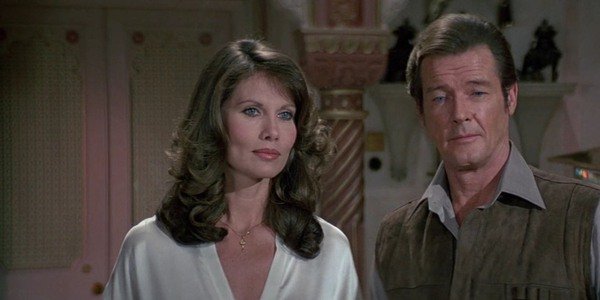
c8e7a271f4b8e5a2a0ca83b81b8cca1742f0b537

So before revisiting Octopussy, I thought the titular character was a great leading lady for James Bond.  The actress Maud Adams was older (at least not in her 20s), and that worked with a Roger Moore who was then in his 50s.  What I didn’t realize till my recent rewatching is….Adams was still 17 years younger than Moore.  I guess that was wishful thinking on my part.  Still, it’s better than a 25 or 30 year age gap.

But there’s more to appreciate about Octopussy than her being somewhat older than a typical Bond girl.  One is her backstory.   Is there a more fantastic storyline in the Bond canon?  She’s the daughter of a rogue agent Bond exposed decades ago.  She respects Bond because he gave her father the option of suicide, rather than public disgrace.  Sort an honor amongst thieves, I suppose.  Octopussy assumed command of her father’s operation and boy, did she run with it!  It’s explained very briefly, but from what we she tells Bond, she revived the cult of the Octopus and took in young women who are roaming around Asia, looking to find themselves.  Octopussy gives them a purpose: in addition to running a jewel-smuggling ring, she also operates a circus.   All the time, the beautiful women reside on her floating island, row her galley, and serve as her security force.  They’re all gorgeous and powerful; her army pretty much takes out Kamal’s security detail, with only minimal help from James Bond.  It’s a story that really deserved much more fleshing out.  Just as Daniel Craig’s Bond recently encountered Blofeld, perhaps a future Bond can reimagine Octopussy, and how she created her own kingdom?  Who wouldn’t want to see Octopussy recruiting her forces and her training program?

So this is what works about Octopussy: closer in age to Bond than the typical Bond girl, her backstory is tremendous, and she (and her forces) really can stand on their own.  Though Kamal does work behind her back, to her face, he is very deferential (and soooo smooth.  Just listen to anytime he says her name; so silky!). When Kamal hires mercenaries to take out Bond, they warn him they “don’t want any trouble with The Woman.”  Octopussy is powerful and respected.  And though Bond does have to rescue her, it’s not like so many scenarios, where the Bond girl is helpless and he has to do everything.  Octopussy’s forces have infiltrated the Monsoon Palace, and she has Kamal at gunpoint.  Kamal being Kamal, he is almost able to talk his way out of it, and then he and Gobinda overpower her.  Yes, Bond has to save the day….but hey, it’s a Bond film.  What did you really expect?  And again, he only saves Octopussy after her own women have pretty much laid out all of Kamal’s goons.  Here’s the scene.   Also pay attention to the shot at 4:07 in the clip.  I’ve always been impressed by the camerawork there: Octopussy fighting the goons, and Kamal walking into the shot, with the camera rising.  You’re seeing it from the perspective of Bond and Q in the balloon.  Director John Glen had worked on as second unit director on previous Bond films, and shots like that show he knew how to frame something.

The other Bond woman (not counting the one in the pre-credit scene) is Magda.

13Magda_

She’s the first one Bond encounters, as she is seen at Kamal’s side at the auction.  Magda is more your typical Bond girl in that she’s young and beautiful.  But there’s more to her than that.  The relationship with Kamal is left unclear.  You might first assume she’s his mistress, but as we see, Kamal seems to take no notice of women.  In addition to being with him at the auction, she’s at his side when he plays backgammon, and later, not only is a guest at dinner but appears to be living at the Monsoon Palace.  She seduces Bond, in order to retrieve a Faberge egg.   And again, Kamal seems to have no problem with Magda being with Bond.  But then in the film’s second half, Magda appears to be working with Octopussy.  She is a costumed performed in the circus, and when Bond (as a clown) pleads that a nuclear bomb will go off, she warns Octopussy that he’ll ruin the whole operation.  We must assume that by “operation”, Magda is only referring to jewel smuggling.  Though she is tied to Kamal, the fact that she’s in the circus with the ticking bomb would have us believe she’s not in on the real plan.  Heck, maybe she really was Kamal’s lover, and he leaving her in the dark about the plan is his way of getting back at her for sleeping with Bond.  Or maybe I’m thinking too much into this.

As the secondary Bond girl, Magda doesn’t need to be well-drawn out.  But she’s definitely different than the typical Bond second girl.  For starters…she doesn’t die, a fate pretty common with secondary Bond girls.  Secondly, she’s a tough one.  Her seducing of Bond to get the egg is followed by her dive from a balcony, using her gown as a rope.  And then in the attack on the Monsoon Palace, we see her laying waste to Kamal’s goons.  And at the point, there’s no doubt why she’s in league with Octopussy; Kamal left her to be blown up!   There’s a moment when Bond in disguise is sneaking around the circus train in East Germany.  Magda clearly spots him…but never says anything.  Why?  Much like all of Octopussy’s plots, this is just one more aspect that you just go “huh”?  Just roll with it and enjoy the film.

Who would’ve thought, a film named Octopussy would actually have some of the most confident, self-reliant, not-in-need of help resourceful women in the entire Bond series?  Octopussy, Magda, the woman in the pre-credit scene, and all of Octopussy’s underlings; Bond may save the title character at the end, but overall, this is a movie where the women can stand on their own!

What didn’t work:

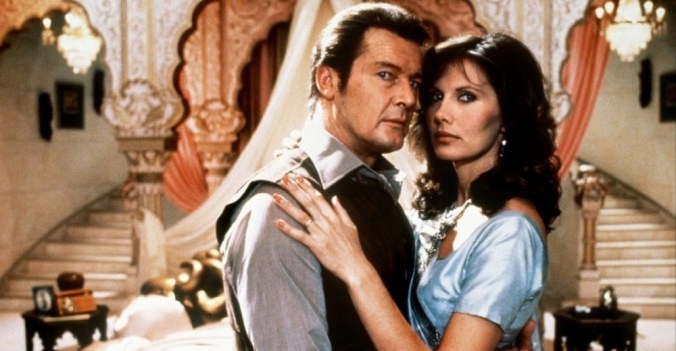
Maybe its because Octopussy doesn’t appear till about halfway through the film, I always feel like her character is underdeveloped.  It’s more than just the backstory.  She welcomes Bond because he gave her father a choice, she tells Kamal not to kill him.  She then offers Bond an opportunity to work with her.  He refuses, she gets all mad and has a tirade over loyalty to Queen and Country, he grabs her, kisses her….and that’s it.  From that point on, Octopussy is now a pawn in Kamal and Orlov’s plot, and then later Kamal’s prisoner in need of rescue.  All that I wrote about before, her backstory, her power….it all sort of goes away when Bond kisses her.
octopussy-header

Look, I get it.  I know that’s the Bond playbook.  The Bond kiss conquers all.  I get it, this is a Bond film made in 1983; we can only expect so much.  But still…..we got such a great backstory on Octopussy; you’d think someone who has built up a crime empire, developed her own business, and has a horde of women all serving her (they literally row a yacht for her!) would be tougher to conquer.   Or if indeed she is a romantic foil for Bond, let it be on her terms.  It just seemed too easy for someone who has done so much, to have all that power and uniqueness melt down for 007.  It also doesn’t help that Maud Adams just isn’t a great actress.  I couldn’t find the love scene on Youtube; the only version I could find was in Spanish so that’s not going to help.  The point is, with a better actress, you might have been able to have more dramatic effect with Octopussy yelling at Bond that she has no country to be loyal to.   Perhaps that was it; with Maud Adams, there was just going to be a limitation in really dramatically developing Octopussy.  Give the backstory and move on.  Still….if ever there was a Bond woman who you wish had more than one film, it’d be Octopussy for me.  I’d love to see more about her operation; you’d have to think 007 would encounter it again sometime.

The other thing that could’ve worked better with the women of Octopussy would’ve been if they hadn’t been all white.  It’s the same thing with Louis Jourdan playing an Afghani character.  Actually…no it’s not.  Jourdan was a French actor playing an Afghani character.  With Octopussy and her proteges, and also Magda at times, you get white women playing at Indian.  They are often dressed in Indian attire…but they’re clearly white.  It’s what you’d call cultural appropriation.  Jourdan is a white actor playing an ethnic role.  But Octopussy is a white character that is trying to act like a cross between a guru and a maharajah.  If you made Octopussy today, you could still have the backstory, you could still have her mentor young white women searching for themselves…but what if Octopussy actually was Indian?  And then, of course, make her more resistant to James Bond’s kiss.  I know, I’m talking of a movie made in 1983.  But if you made a new Octopusssy, that would be an improvement.

4. Bond’s allies

What worked

james bond octopussy retrospective 1983 roger moore vijay amritraj desmond llewellyn mark west strange tales pinewoodIn the Sean Connery James Bonds, 007 is often assisted by CIA counterpart Felix Leiter.  The majority of Connery films take place in the United States (Goldfinger, Diamonds are Forever) or nearby (Dr. No, Thunderball) so Leiter’s presence makes sense.  With Roger Moore, the action is much more worldwide, and so Leiter only appears in the first installment,  Live and Let Die.  Moore’s 007 had a bevy of different allies, and Octopussy gave us one of the very best.

I’m talking about Vijay, played by Indian tennis pro Vijay Armritraj.  Vijay is one of the most likable characters in the entire Bond canon.  His introduction is also one of the most memorable.  As Bond arrives in India, a snake charmer catches his attention by playing the James Bond Theme.  Talk about a self-aware Bond!  Vijay proves quickly to not be an Indian stereotype; he laughs with Bond about his disguise and how he hates snakes.  Vijay drives Bond through a memorable car chase on a Tuk Tuk and delivers him to Q.  His response to anything Bond says is “No problem.”  Like many Bond allies, Vijay does not make through the film.  Thankfully we don’t see it, but it’s implied he’s killed by the thug with the yo-yo saw blade (talk about a ghastly death).  It’s clear to me that director John Glen knew how well-received Vijay would be.  When Bond discovers his death, composer John Barry’s score takes a distinctly melancholy turn.  And in the following scene, when Bond is being chauffeured into East Germany, his driver comments “No problem,” to which Bond winces.  Throughout the cannon, Bond has seen plenty of good men die.  Most often, the character is forgotten by the next scene.  To see Bond grimace when another character uses Vijay’s catchphrase was something different. It’s one thing for a Bond ally to meet a gruesome demise; it’s commonplace in the series.  But to have take such an emotional toll….that was different in Octopussy, a tribute to how good a character Vijay was.

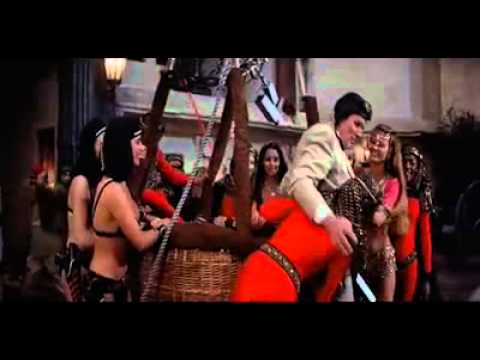
The other major ally in Octopussy is none other than Q.  Octopussy is the film that breaks with the usual Q routine.  Sure, we get the visit to Q’s laboratory, with the insane weapons of silly destruction, and Bond’s childish antics.  And Octopussy, I must say, takes the cake for Bond immaturity.  Just after I got done talking about how much power the women of Octopussy have, this is the film where, in Q’s lab, Bond zooms a camera’s focus on a woman’s cleavage.  You can look the scene up yourself.  But where Q differs in this film is that he plays a role beyond the one gadget scene.  We get Q and Vijay on stake-out duty, while Bond is on Octopussy’s island; it’s Q who is the one who finds Vijay dying.  And of course, we get the scene of Q and Bond in a Union Jack hot air balloon. coming to the rescue at the Monsoon Palace.  As I already mentioned, Octopussy’s forces pretty hold their own.  But when one goon them at gunpoint, it’s Q in a balloon that saves the day.  And who doesn’t like the the old, flustered Q, grumbling as the women fawn all over him?  Call it Q’s finest hour in the whole Bond cannon!
hqdefault

What didn’t work?

ABSOLUTELY NOTHING.  What a perfect trio of allies: the woman who helps Bond in the pre-credit scene (and rescues him, rather than the typical other way around); the very likable Vijay (did ever a Bond ally’s death have such an impact?); and Q getting to do more than just provide gadgets.  And I might add, the gadgets Q does supply are so low-key: a fountain pen that allows Bond to escape from his room in the Monsoon Palace; a watch connected to a video camera; and a hidden microphone in a Faberge egg.  That’s it.    Of course in a film where the villains are shot in the back (Orlov) or killed in a plane crash (Kamal), you really don’t need over-the-top gadgetry.  Anyway, nothing needs improving for Bond’s allies in Octopussy; they’re all perfect.

5.  The Setting

What Worked:

Bond films have been known for their exotic settings.  The Man with the Golden Gun took us to Thailand and Hong Kong.  The Spy Who Loved Me included Egypt and Sardinia.  One place Bond had not been was India.  George MacDonald Fraser, author of the Flashman novels, worked on the story for Octopussy and was the one who brought up India as the setting.  And maybe that’s why I’ve always loved Octopussy; I’ve always been fascinated by India.  And my, does Octopussy give us so much of it.  We have a crowded city bazaar, we’ve got Tuk Tuks, we have sword swallowers and fire breathers.  We’ve got Octopussy’s beautiful floating palace, and the glamour of the hotel Bond stays at.  And it’s all filmed on location, in Udaipur and it looks gorgeous.  For someone who is fascinated by India, Octopussy makes me want to go there.

lake_picchola_udaipur

The real floating palace of Octopussy

But only half of Octopussy takes place in India.  The bomb sequence gives us East Germany.  Just after the credits, we see 009 trying to escape with a counterfeit egg to the British Embassy in East Berlin.  Bond is dropped off at Checkpoint Charlie.  We see the circus train searched at the border as it crosses from East Germany to the West.  Though pretty much every Bond film pre-Pierce Brosnan takes place in the Cold War, never was it depicted at the forefront.  Many a Bond film featured a plot device of goading the US and the Soviet Union into nuclear war….but the action took place in some far-off locale.  From Russia with Love occurs in Turkey and aboard the Orient Express.  The Spy Who Loved Me has Bond working with KGB agent Amasova, but the setting never goes behind the Iron Curtain.  Octopussy, unless I am forgetting something, was the only Bond film where the action is in the Eastern Bloc.  And it’s also one of the few that has a Russian as a villain.  True, General Orlov is acting on his own, to detonate a nuclear bomb on a US Air Force Base.  But his rationale is to create an opportunity for Soviet conquest of Western Europe.  It’s not SPECTRE or someone else trying to bring the Soviets and the US into combat; it’s a Red Army general who is the enemy.  Octopussy stands alone in the Bond canon for not just happening during the Cold War but really depicting the Cold War.

What didn’t work:

Though I loved seeing India in Octopussy in my recent reviewing, there’s much of the depiction that just hasn’t aged well.
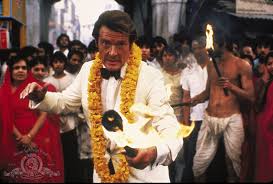
images

The Tuk Tuk street chase is terrific.  But once Bond is on foot, it becomes one stereotype after another.  Mystic who lies on a bed of nails: check.  Guy who breathes fire:  check.  Guy who swallows swords: check.  And it doesn’t stop at the scene.  We know what a gentleman Kamal Khan is; is the only reason he’s munching on a sheep’s eyeball because he’s Afghani and that seems like something an Afghani prince would do?    I understand situating the film in its locale; India in 1983 is exotic, so why not show it off?  But Octopussy, at least in the street fight scene, goes from local color to expected trope way too quickly.

But to me the bigger problem with Octopussy’s India is that it’s white people playing India.  While it takes place in 1983, at times it feels like the British Raj all over again.  Here’s the backgammon game, before Bond joins it:
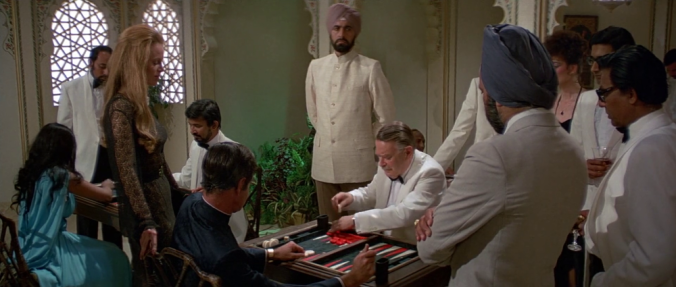
1+Completing+the+close-out

The players are two white people (okay, Kamal is SUPPOSED to be Afghani), while all the Indians are standing around.  Heck, Kamal’s opponent is a British Major!  This is 1983; why would a British Major be playing backgammon in a casino in India.  This isn’t 1883!  Think of who Bond interacts with India.  Yes, Vijay is Indian.  So is Gobinda, Kamal’s right hand man.  But Octopussy and Magda are not.  But they still dress as if they are.  That, more than the stereotypes, is what seems to have aged the worst about Octopussy.  Yes, it’s cringe-worthy when Bond hands cash to an Indian British agent and tells him, “That ought to keep you in the curry for a while.”  But it’s far more bothersome the idea of all the white people playing Indian.  Again, it’s different than a French actor playing an Afghani actor.  And I acknowledge that’s problematic (while I still LOVE Jourdan’s portrayal of Kamal).  But Octopussy and her troupe are assuming the lifestyle of Indian royalty and their court, but are clearly white characters.  They’re not white actors playing Indian character; instead, they’re white characters wanting to live like Indians.  Cultural appropriation at its finest…err, most unsettling.  Octopussy could have worked just as well, if the title character and her brood were actual Indians.

6.  The Action

What Works:

Director John Glen having previously been a secondary unit director was obviously good training for being the head man, for Octopussy has some of the best action sequences in any Bond film.  There’s not one that seems excessive, all are paced well,  Directors of modern action flicks could take a lesson here, instead of having the a ction goes on and on.  And on.  With Octopussy, the perfect balance is taken between plot and then action….and almost all the action comes out of that plot.  Take this pattern:  Bond arrives in India, beats Kamal Khan in backgammon.  Alright, time for action: cue the tuk-tuk chase/street fight.  Later on, Bond is on Octopussy’s island and they have their intimate moment.  This is immediately followed by the attack from the thugs Kamal hired.  And I have to say, the thug with the saw blade on a yo-yo was genuinely terrifying.  And in two cases, as soon as Bond begins to unravel the villain’s scheme, we go right to action.  No sooner has General Orlov’s helicopter flown away from Kamal’s palace but are we treated to human hunt scene, where Kamal and Gobinda on elephants are in pursuit of Bond.  As Kamal proclaims, “Let the sport commence!”  The second comes when Bond captures Orlov and he reveals what his nuclear ambition is.  Orlov soon escapes, and what follows is really, pretty much non-stop action (with a few breaks) to the end.  Bond trying to catch up to Octopussy’s circus train in Orlov’s car, even riding on the train rails; Bond battling Kamal and his henchmen on the train; and Bond doing whatever it takes to stop the bomb before it goes off (clown suit, anyone?).  From the moment we see the bomb placed on the train, the dramatic tension only keeps building.  And after a brief respite (like possibly 2 minutes), we’re back in India for the conclusion, with Octopussy’s forces raiding Kamal’s palace, Kamal taking her captive, and Bond coming to the rescue.

Because it’s Bond, and especially because the Bond is Roger Moore, a lot of the action is over the top.  The human hunt in the Indian jungle, for example.  Perhaps the most hard to believe is Bond holding onto to the exterior of Kamal’s plane.

10632689_1025944547420456_2277413119684599188_njpg

It’s outrageous…but I guess after the ridiculousness of Bond in Space just two movies earlier, this doesn’t really bother me.  However it was filmed, it looked very convincing.  And composer John Barry (more on him soon), like Bernard Herrmann with North by Northwest and its crop duster attack, knew that sometimes with aerial combat, its more impressive if the plane engine is the soundtrack.  Here’s the second half of the scene; this is preceded by a part where Kamal does all kinds of aerial acrobatics to dislodge Bond.  I know its ridiculous but it’s the final combat of the film…you have to pull out all the stops, don’t you?

I also have to mention that pre-credit scene.  It has absolutely nothing to do with the plot of the film; it’s just an 8 minute action stand-alone.  And it ABSOLUTELY works.  What’s striking about it is, Bond seemingly fails on his mission there.  He plants a bomb to blow up some experimental aircraft in this Latin America country (Cuba?), but his cover is blown.  His female accomplice bails him out, he then uses a secret miniature jet of his own, and still achieves his goal.  It’s a great scene; a bit over the top, but completely fun and sets the tone for the film.  It’s John Glen’s way of saying, buckle up friends, we’re going to have some fun tonight!

What doesn’t work:

There’s a bad tendency in Roger Moore films to put unnecessary slapstick/visual/aural gags into the action.  The Man with the Golden Gun has one of the best automobile stunts in all of James Bond…and its accompanied by a slide whistle.  Moonraker has a pigeon doing a double take when Bond drives a gondola out of the Venice canals and into St. Mark’s Square.  Octopussy is not free from these sins.  Bond swinging on a jungle vine during the hunt?  Sure, I can buy it.  But do we need a Tarzan yell while doing so?  And like that Venetian pigeon, Vijay beating a goon with a tennis racket and those watching turning their hands back and forth, as if watching a tennis match.  Yes, we get it…Vijay is a tennis pro….but could we do without the gag?  In both cases, it just takes away from what was a really good action sequence.

By now, you’ve probably got the impression that I really like Kamal Khan.  Louis Jourdan nailed the role.  The Bond films have so many crazy, threatening, snarling over the top villains.  Octopussy has that with Orlov.  But there’s a reason Kamal lasts till near the very end.  His suave, elegant nature improves every scene he’s in.  I can’t disagree more with people who consider him an unmemorable villain.  Sure, if you like your villain a megalomaniac with a world destruction plot, Kamal’s not for you.  Or if you want your villain to be physically threatening to Bond like Scaramanga or Largo, that’s not Kamal either.  But if you want a villain who doesn’t want world conquest but rather, just riches, is smooth as silk, as is just a suave operator, that’s Kamal Khan.

The reason I bring this up here is….I feel like Kamal’s death is sort of tacked on.  Bond and Octopussy get out of the plane and then it proceeds to crash.  Bond never personally killed Kamal, like he did Stromberg, Kananga, Scaramanga or Drax; he damaged his plane and Kamal never regained control.  In fact, Kamal and Bond never really have a one-on-one confrontation outside of backgammon.  So why do I bring this up?

Well, let me explain.  The Roger Moore films never had a reoccurring villain like Blofeld (I’m not counting Jaws, as he was a henchman not a head honcho, and he’s pretty much comic relief by Moonraker); due to legal questions regarding ownership, Blofeld and SPECTRE are out of sight in the Moore era.  For Your Eyes Only begins with Bond dumping a bald man with a Persian cat down a factory smokestack….but the name Blofeld is never given.  It’s the producers’ way of saying F YOU over the legalities of Blofeld.

So how does this relate to Kamal?  In a typical Bond film, the villain’s master plan is foiled and now it’s Bond just cleaning up.  That’s when Goldfinger goes down.  Stromberg too.  What was really going to happen to them?  Their master plan is over with; how do you come back from that?  But with Kamal, it’s different.  It was Orlov who wanted the nuclear explosion; Kamal just wanted the reward.   After that, he’s clearing out, with plans to go into counterfeiting.  How easy would it have been for Kamal to regain control of his plane, and as Bond and Octopussy pull themselves to safety, see it fly off into the distance.  Perhaps Kamal smiles and salutes, “To next time, Mr. Bond!”  And there’s your answer to Blofeld.  Kamal flies off to somewhere else obscure on Earth and begins a new criminal enterprise.  He’s kind of like Prof. Moriarty in Sherlock Holmes.  It’s Orlov who wants war, Kamal has the criminal operation to help him make that happen….for a handsome price.  I know Octopussy was possibly going to be the final Roger Moore film….and probably should’ve been, the way A View to a Kill turned out!  So there really wasn’t the need to introduce an archvillian who spanned multiple films at that point.  Too bad.  What if Octopussy had happened earlier in the Moore tenure?  Kamal wouldn’t have had to be a Blofeld-type out for constant world domination, but perhaps the head of an underground network who’s path Bond kept running into.  I think it could’ve had potential!

The_death_of_Kamal_Khan_Octopussy

Kamal, you deserved better!

Only two more categories to go.  Hey, Octopussy is over two hours long; this has to take a while!

9.  The Music

I’m going to go the opposite of what I’ve been doing and go first with..

What Didn’t Work

That song.  It has some nice moments to it, especially some very tasty guitar work during the “hold tight, let the fight begin” part.  But man…All Time High is SOOOO dated.  That light rock (or soft core porn, if you prefer) saxophone solo.  Here’s the opening credits.  The way that saxophone just rips in, it so perfectly DESTROYS all the fun from that pre-credit scene!  Look, I get it; composer John Barry was trying to match what Marvin Hamlisch did with Nobody Does It Better from The Spy Who Loved Me.  It’s just….not as good.  Rita Coolidge is not Carly Simon.  And Nobody Does It Better was a great song of the 1970s.  But Octopussy is 1983 and All Time High is not hip.  It’s soft rock.  It’s not a forgettable tune, it’s not a bad one….it just seems tired and out of place.

What Did Work

EVERYTHING ELSE MUSICALLY.  Literally….EVERYTHING ELSE.  John Barry did not score all of the James Bond films but he’s pretty much the guy who made the Bond sound.  A court case upheld Monty Norman as the composer of the Bond theme…but it’s pretty much agreed that it was John Barry who arranged it to the form we know and love.  But if there’s any doubt that John Barry didn’t create the Bond sound, I got one word for you: GOLDFINGER.  Admit it, you heard Shirley Bassey’s voice when you read that, didn’t you?  That was John Freaking Barry.  And it’s not just Goldfinger.  How about those wonderful cascading strings to start You Only Live Twice?  Or Bassey again, with Diamonds are Forever?  All John Barry.

I’ve long believed John Barry is right there near John Williams in terms of film composer greatness.  And there really isn’t anyone ever in Hollywood history who could write the HUGE, sweeping theme as JB.  Here’s one that won him an Oscar.  That theme.  Barry had done that his whole career.  From Born Free to Dances with Wolves.. And Octopussy is no different.  Remember when I said how soft rock an All-Time High sounded?  I stand by that.  But when John Barry uses it as the background for the love scenes, it’s positively GORGEOUS.  Man, I don’t know if another composer in movie history could write so well for strings.  Take a listen at 3:10 mark.  Isn’t that just beautiful?!

Two things stand out for me about John Barry’s work on Octopussy, which I really think is some of the best work of his entire career. In Out of Africa, Director Sydney Pollack wanted native African music.  Barry successfully fought against that because he said the movie was about the relationship between Karen Blixen and Denys Fitch-Hatton, neither of whom were African.  He does the same with Octopussy.  I’ve already talked about how, while the major characters are in India, none of them are actually natives.  Barry picks up on that.  He gives us music that is exotic, with a touch of danger to it….but it never claims to be Indian.  It’s full Western symphonic music.  Whether you want to add that to the complaints of Octopussy being white people playing at India…well that’s up to you.  Take a listen to the music for the scene of Kamal arriving at the Island of Octopussy.  There’s mystery to it, it’s exotic, there’s a touch of danger.  To meJohn Barry completely captures the mood.  It doesn’t try to be imitative of India, it’s just….exotic.  I love it.

The other thing about Barry’s score to Octopussy is how he calls up the James Bond theme to kick some of the action scenes into higher gear.  That’s not coincidental.  Octopussy had to contend with competition at the box office from Never Say Never Again, the non-Eon James Bond film.  It had the rights to Blofeld, SPECTRE and basically the plot of Thunderball.. But it didn’t have the right to the music or the trademark Gun Barrel opening.  So with that being the case, Barry used that familiar theme to remind everyone that this was the REAL Bond.  Watch this scene from where Bond is escaping from the Russians, to chase Octopussy’s circus train.  The first couple minutes are silent.  John Barry typically doesn’t use music to accompany action, it’s more to set the mood.  But once the train is on the tracks, we immediately get the Bond theme.  The timing is PERFECT.  Barry had been with the franchise since Dr. No; he knew what he was doing.  No he didn’t write that song, but when composing for James Bond, nobody did it better.
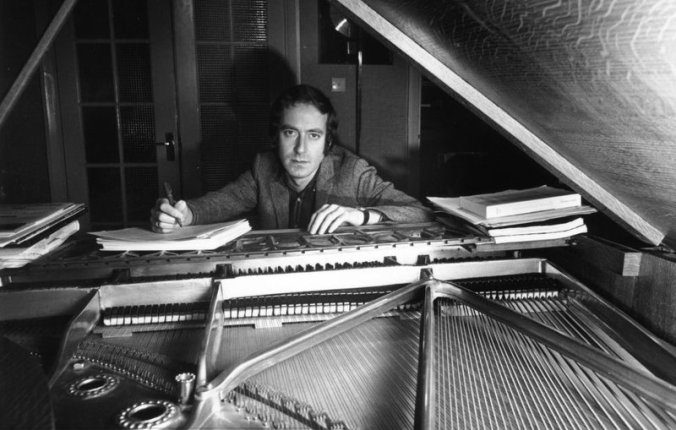
John Barry

John Barry at his piano in 1967, the year You Only Live Twice — the fifth of the 11 James Bond films he scored — was released in theaters.

10.  James Bond himself.  

I saved this one for last because this is probably the biggest bone of contention Bond fans have with Octopussy.  You mean, the one where Bond is a clown?  It’s unforgivable!

Octopussy-Clown-Suit-2

Or is it?  Let’s go first with

What Didn’t Work

This is really a commentary on the entire Roger Moore Bond era but there’s always an upping the ante in terms of the slapstick.  Starting with his first film, Live and Let Die, the preposterous gets hyped up.  The villain in Live and Let Die literally inflates and pops.  Don’t believe me?  The plots, as I’ve mentioned before, get crazier throughout the Moore tenure, till For Your Eyes Only grounds everything.  Octopussy looked like it was going to be the final Moore film, and we see someone who is very at ease playing 007.  Maybe just a little too at ease.

Here’s Bond at the end of the pre-credit scene, landing his mini-jet at a service station.  Look at the smug smile, as he says, “Fill ‘er up, please.” Unknown

It’s not a scene breaker; that is accomplished by the soft core porn saxophone that immediately follows.  But that smug smile….sort of, yeah I’m James Bond, I know that’s cheesy, but what are you going to do about it?  And for better or worse, I think that’s kind of what defines Roger Moore in Octopusssy, sort of a Devil may care attitude, this is my last go-around, so what the Hell?

People love to bag on Bond in a clown suit.  Let us not forget just 20 minutes of movie time earlier, he was in a gorilla costume.  I’ll explain in a bit why the clown moment doesn’t bother me.  And yes, I know, it’s a circus train, sure there’s a gorilla suit nearby.  But it just seems more like Roger Moore saying, “It’s my last go-around, why not wear a gorilla suit?”

But the number one problem with James Bond in Octopussy is, quite simply, Roger Moore was in his mid 50s.  Octopus is closer to Bond in age, Magda not so much.  I get that Magda was just trying to retrieve the Faberge egg for Kamal, but it’s still hard to fathom her being interested in someone who is so much older.  And if you think that age difference is bad, just stay away from A View to a Kill.  Look, Moore being older doesn’t impact the action sequences.  He’s in great shape, and he looks rightfully exhausted when he escapes from the jungle hunt.  Same with when he’s running through the German forest from the knife thrower.  I’m venturing into What Worked territory, but when Bond is trying to reach the U.S. Air Force Base, he looks completely drained.  He looks like…well, what a mid 50s guy would, after running.  That all works.

But what doesn’t work is the descent to immaturity.  The irreverent one-liners, that’s part of the Bond shtick.  But the scene that really sticks with me is Bond in Q’s lab.  You know the drill; outrageous killing machines being tested and Bond with a groaner of a line, to jab at Q.  While Q is showing off a video camera, Bond trains it on the cleavage of a nearby desk worker wearing a low cut top.  I don’t mind Bond flirting with Miss Moneypenny’s new assistant, Penelope Smallbone.  If anything, that was a great touch by John Glen to show how everyone is getting older.  Miss Moneypenny is training her younger replacement.  And of course Bond is going to flirt.  But zooming in on the cleavage of some woman who is probably 30 years younger?  That scene hasn’t aged well at all.  If Bond did it in Live and Let Die, when Roger Moore was much younger, it still would seem cringe-worthy today.  But when you add the age difference between Moore and whoever played the secretary….its just gross.  I’m not saying Roger Moore was too old to play Bond in Octopussy; in many ways (Miss Moneypenny’s replacement, looking tired, Octopussy herself being older), the script and direction accounted for an older Bond.  But there were still too many moments where you just wanted to say, James, really….haven’t you grown up yet?  Which is basically what Q tells him.  Here’s the scene.

What Did Work:

Alright, let’s get to the Clown Suit.  Look, I get it, I really do.  James Bond is too tough to wear a clown suit.  Bond just wouldn’t do that.  Well, a couple things here.  First off, the movie prepares us for it.  The first scene after the credits is a clown running from pursuers in East Berlin.  We find out that was 009.  So it’s not like Bond is the only 00 to go clown.  Next, let’s re-trace the steps that led to Bond as a clown.  He’s stowed away on Octopussy’s circus train, aware that there is an atomic bomb hidden in the cannon.  He’s first in the gorilla costume, and then in the red shirt and black vest of the knife throwing act.  He’s been thrown from the train, killed the other knife thrower (“That’s for 009,” he brags, as he dispatches the assailant) and is trying desperately to get to the Air Force Base.  Time is ticking down on the bomb.  We see Bond, James Bond, on the side of the highway, hitch-hiking.  That’s right, the man who drove an Aston-Martin is hitch-hiking.  And when a car full of teen-agers fool him into thinking they’ll give him a lift, he flips them the bird!  Bond ends up walking into town, is shut out from using a public phone booth, and resorts to stealing a car.  From that, he crashes into the Base and changes into the clown outfit.  If your next question is how he puts on all the clown make-up…..well, just roll with it.

Look, Octopussy is no Daniel Craig film.  There’s a limit to how vulnerable James Bond will be.  But again, as this was going to be Roger Moore’s last film, I do think he was open to taking chances.  And one of them was making Bond seem human.  This is a 007 with a limit.  He is affected by Vijay’s death, much more noticeable than when any previous accomplice died.  He is desperate to try and stop the bomb; there’s no gadgets, no fancy ride.  Bond tries to hitchhike, steals a car, and dresses up as a clown.  There’s no Bond in a tux with a deadly shot; this is as humbling as it gets.  It’s a preview of the Bond who will be played in later films.  Here’s the entire clown scene.  Yes, I understand if you can’t handle Bond as a clown.   But this goes to my point of how, at this point in the role, Moore was okay with Bond not being invincible.  Not only is Bond a clown, he can’t even convince anyone that there really is a bomb about to go off.  It’s about as hopeless as a Roger Moore James Bond has ever been.  You might have to go all the way to Casino Royale for the next time Bond seemed so desperate.  Sure, I get it; James Bond as a clown who no one will believe is a long way from Bond in a casino, in a tux, drinking a martini, shaken not stirred.  If that’s the only way you want envision James Bond, then yes, the clown outfit just doesn’t work.  But if you’re open to Bond being shown with his defenses down, at his wit’s end, up against impossible odds….then the clown suit works.  And that’s why I put James Bond in a clown suit as what worked about Octopussy.

Overall thoughts

So, after all that, does Octopussy work in 2020?  Yes….with reservations.  All that made it enjoyable are still pretty much there.  The action scenes are still gripping, the setting is still fabulous, the characters are still memorable….its still a fun ride.  And it could be made today….with some necessary changes.

And that’s what I’ve been thinking about.  The last Bond film, SPECTRE, brought back the character of Blofeld, and even gave him a backstory.  The next to be released film, No Time to Die, is rumored on the internet to give us the character of Dr. No, from the very original film.  If Eon Productions is revisiting some previous Bond characters/ideas, another look at Octopussy would actually work really well.  Here’s why and how:

  1. The character of Octopussy and her operation.  Perhaps even make her a villain, or explore more of the moral ambiguity of what she does.  Octopussy never really went there.  There’s so much potential in the character of Octopussy and her operation.  Bond encountering a criminal operation in India, run by all beautiful women, also fronting legitimate business enterprises, and operate as a cult on a floating palace…there’s so much to be done there.  BUT….

This time around, Octopussy has to actually be Indian.  Or if you want to keep the tie to her father being a rogue British agent apprehended by Bond, make Octopussy’s mother Indian.  Just don’t make her all white.  If you want much of her minions to be white, fine.  You can keep the idea of women coming to Asia searching for something.  Octopussy can still be their guru.  But make her authentic to her setting, rather that someone playing Indian..

2.  Keep all the action, just remove the slapstick.  Let Bond swing on a jungle vine, just do so without a Tarzan yell.  Keep a Tuk Tuk chase, just take out the Indian stereotypes.  The action itself is great.

3.  In terms of villains, a new version of Octopussy would have to replace the Cold War setting.  So, something would have to take the place of General Orlov and Red Army ambitions.  But there’s definitely a place for Kamal Khan in re-imagined James Bonds.  A fabulously wealthy and silky smooth gentleman operator of international criminal enterprises….to me, a a reimagining of Kamal Khan would stretch multiple films, but would never be the arch enemy.  I see Kamal as someone Bond crosses paths again and again.  Each film has a villain with a global scheme…..but Kamal is always operating in the background as a connecting force.  Perhaps this modern Kamal doesn’t exactly hate Bond; they run parallel to each other, a Ying and a Yang.  Some films, Kamal might have a small part, others a bit larger.  Think of him sort as the opposite of M.  Or of Q.  Perhaps Kamal is selling weapons.  Or information.  Bond repeatedly encountering a villain who doesn’t have a scheme, but just operates a network that enables other baddies….that’s something that could really work.  And Kamal Khan is the type to pull it off.  And of course….if Kamal is Aghani, have him played by an Afghan actor.  No offense, Louis Jourdan!
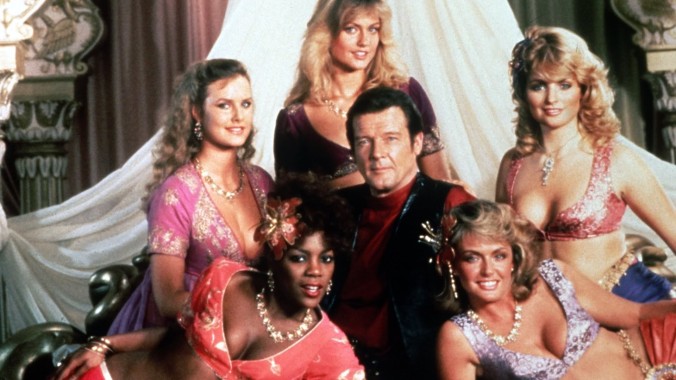
octopussy-06

Look, there’s probably not any movie 40 years old that hasn’t had problems with aging.  The most egregious thing about Octopussy today is the cultural appropriation: white people playing at India.  And with Bond being British, it’s the idea of revisiting the Raj.  The white-centric of all the Indian scenes is troublesome.  But it’s a long list of scenes from Bond films that aren’t great today.  Sean Connery telling a girlfriend to run along because it’s Man Talk now in Goldfinger comes immediately to mind.  But for me, the question is, is there more to Octopussy than these problems?  Take the tropes out of the Tuk Tuk chase and it’s a great sequence.  The attempts to stop the bomb are great.  Kamal, Gobinda and Orlov are all great villains.  The plot is both fantastic and realistic.  Octopussy herself (yes, cultural appropriation) has such a different backstory for a Bond girl.  And related to that, it’s a Bond film where the women can stand on their own.  Team Octopussy taking out Team Kamal is terrific.  That in and of itself, is something remarkable for its time.  And it’s all filmed so well.  Octopusssy is not without its problems, but its still a Bond film I rank very high.  Flawed, yes…..but it works.  I put it right there with The Spy Who Loved Me for Roger Moore’s finest.   It’s a mess….Faberge eggs, a crime network of beautiful women in India, Cold War nuclear schemes, a Circus…..but somehow, between Roger Moore, John Glen, John Barry and Louis Jourdan it all just works.

And for those reasons, Octopussy will always be a Bond film I’ll periodically return to.  I can’t say the same for Moonraker, The Man with Golden Guy, or Live and Let Die.  Now, if you’ll excuse me, the soufflé can’t wait.  And I must learn how to play backgammon!
khan-and-gobinda

Trying to recapture that Poppins magic; or, A Brazzle-Dazzle attempt!

As I’ve mentioned before, Disney+ for me has been less Mandalorian (though I have FINALLY started watching that) and more getting a chance to re-examine films I haven’t seen in years. YEARS. DECADES. So far, that’s included Snow White, Pinocchio, Fantasia, Bedknobs and Broomsticks, and most recently, The Great Mouse Detective. This past week, the revisiting tour continued with a film I think I may have only seen once in my life, this one;

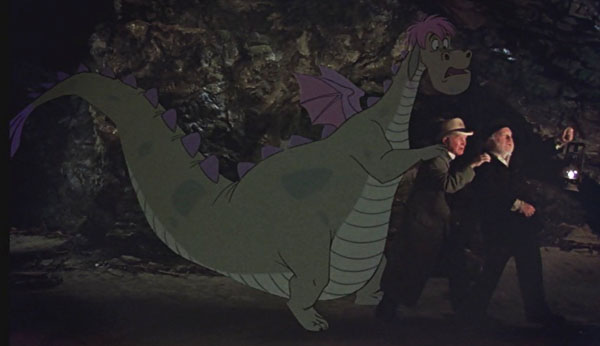
We’re talking the original, 1977 version of Pete’s Dragon. I’m 47 years old, and if you’re much younger than me, I suspect there’s a very good chance you’ve never seen this film. Hell, you may never have heard of it; only knowing its 2016, non-musical remake. I never saw that one. Come to think of it, I have no memory of seeing the original Pete’s Dragon all the way through either. I just remember the story: orphan run-away with animated dragon friend, taken in by lighthouse keeper in Maine; snake-oil salesman’s evil scheme; and a dramatic finish involving a near shipwreck and a long lost love. Perhaps I had seen pieces here and there. And I did remember some of the music; Mickey Rooney singing about seeing a dragon, the villain’s plan, and, of course, Helen Reddy’s big ballad. But perhaps I knew those from a record collection of Disney music I had as a kid. Truth is, the only solid memory I have of Pete’s Dragon as a kid was this:

That’s right, the float in the ol’ Main Street Electrical Parade at Disneyland. Growing up in California, I went to Disneyland usually twice a year, and that parade was a mainstay of most every childhood visit. I remember some kid would play Pete and ride his electrified pet dragon, Elliott. And you’d get Elliott’s weird babbling sounds. Clearly, I remembered more about the float than the movie itself. So, the question facing me, when I pulled up Pete’s Dragon on Disney +….does this film need to be remembered, or is it best left in the also-rans of the Disney oeuvre? The answer, as I found out, is not really clear-cut.

The noted movie critic and animation afficianado Leonard Maltin characterized Pete’s Dragon as Disney trying to recapture the magic of Mary Poppins, but finding it out of step with the times. I think that’s a pretty darn accurate description. In many ways, Pete’s Dragon follows the Mary Poppins playbook: live action, with interaction with animation; child in need of parental love; set-in the not-too distant past; original songs, and lots of choreography. All the elements of what made Poppins so perfect (and I absolutely need to write a blog about that masterpiece some day) are on hand in Pete’s Dragon….but it doesn’t QUITE work. I’ll say this up front, after watching Pete’s Dragon last week: it’s not a bad film. Parts of it are very enjoyable. But overall….I felt it came CLOSE to being great….but just didn’t make it. So, let’s look at what holds Pete’s Dragon back…and what it does well.

The first flaw that comes to mind with Pete’s Dragon is it’s length. It’s over 2 hours long. And I get it, Mary Poppins is a long film too. But everytime I think about how you could trim Mary Poppins down, I can’t come up with how you do it. Every song advances the storyline, every sequence means something. So you want to cut out the Tea Party on the Ceiling and Uncle Albert…..well, then how do you get the remarkable resolution of elder Mr. Dawes laughing and flying? And cut down the chimney sweeps dance, or the adventures in the animated chalk drawings? FORGET IT! Those are moments of incredible technical virtuosity, from the animators to the music of the Sherman Brothers and Irwin Kostal, to the talents of Dick Van Dyke and others. Or trim down Mr. Banks walking alone through the deserted streets of London, en route to being fired? NOT A CHANCE. That whole sequence, with the orchestra playing a haunting version of Feed the Birds, and the pause to where the bird lady would’ve been, that all works. We guess that Mr. Banks, alone with his thoughts, is having the seeds grow that will lead to his complete turn-around, when he is discharged at the Bank. Trust me, I’ve thought about it PLENTY. I don’t see how you cut down Mary Poppins‘ running time without negatively impacting what is such a PERFECT film.

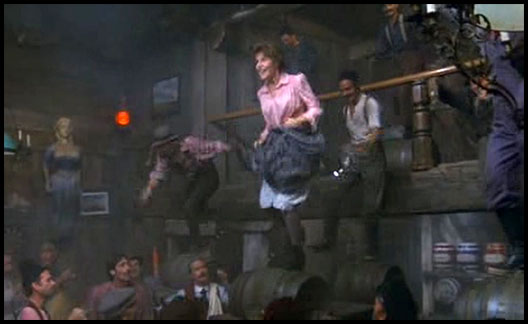
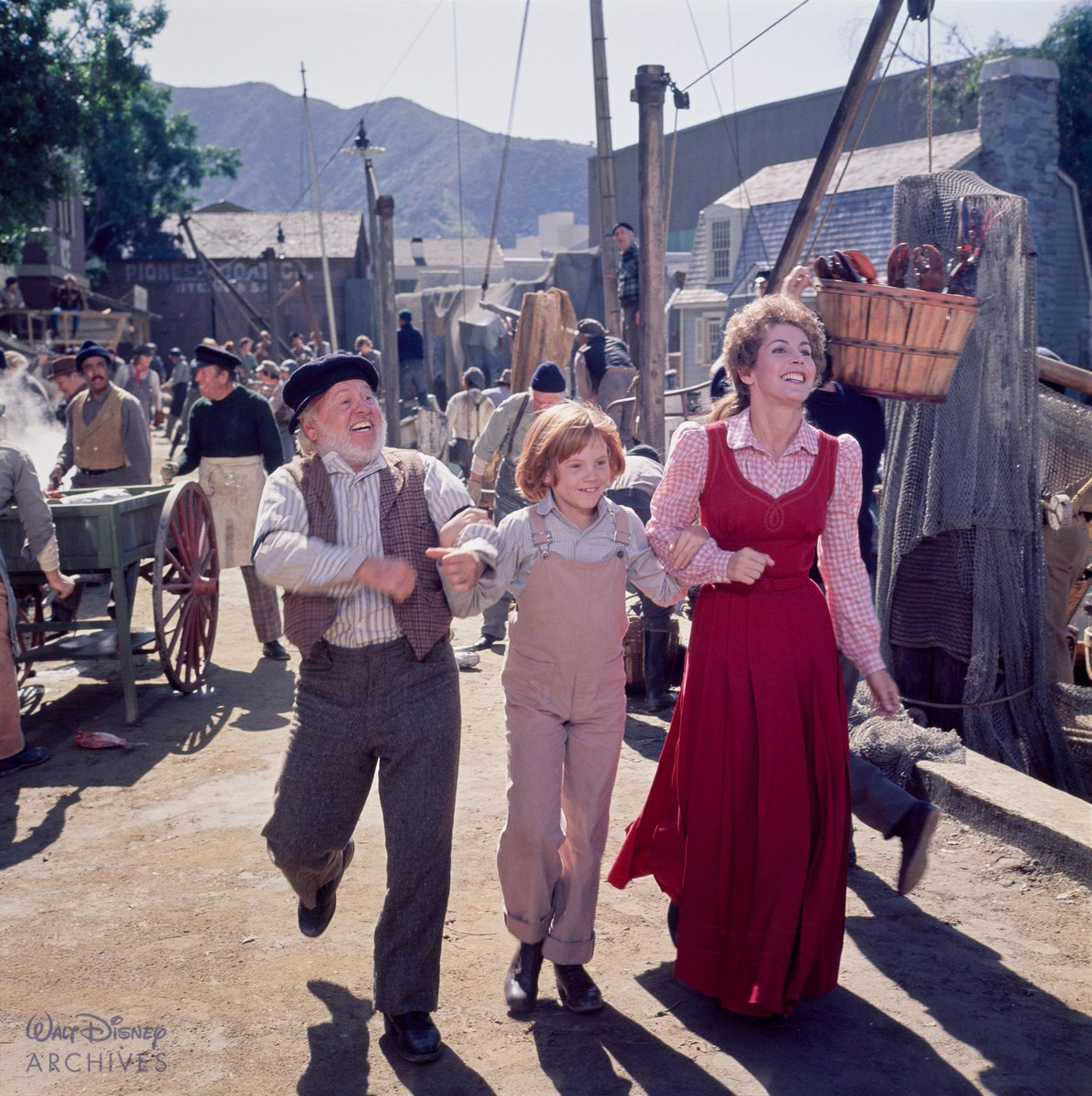
The same does not hold true for Pete’s Dragon. The songs and dances are there, but in too many cases, they don’t seem essential to the story. Rather, they’re there because it’s following the Poppins playbook. Take this scene, for example. What’s happened is Lampy, the town drunk played by Mickey Rooney, has seen Elliot, and runs into the town bar to warn everyone. A song breaks out, about seeing a dragon. The rest of the barflies treat Lampy’s spiel like you would expect; the ramblings of a drunkard. Lampy’s daughter Nora, played by Helen Reddy, shows up to retrieve drunk ol’ Dad. And then the scene just goes ON. First off, we have some of the barflies being rough with Nora, something that’s pretty cringeworthy viewed now. Secondly, a wholesale big production dance breaks out, with stomping on the bar and kegs being popped open. It’s as if the writers thought, Mary Poppins had chimney sweeps dancing a production number on the London rooftops. How do we top that? I know, let’s go with drunks dancing on the bar and beer flowing like geysers! The concept is weird for a family film, and I’ll get to that in a bit. But the bigger problem is….why is this production happening? We just met Lampy one scene earlier, when he encounters Pete and Elliot. We haven’t been introduced to Nora; she entered during this song. And yet here we have this huge song and dance production, involving a bunch of saloon denizens. It’s so different than the Step in Time sequence in Mary Poppins. That one happens late in the film, we already know all the characters, and because of Chim-Chim-Cheree just 10 minutes earlier, we know all about chimney sweeps. If you want to say that scene goes on, I’ll disagree but I can listen to the complaint. The point is, Step in Time flows naturally out of the story. I Saw a Dragon worked just fine as Lampy trying to explain what he saw. But as a full-fledged production number, it just seems ridiculous. Who are these people, that they’ve earned the right to go extravaganza on us this early on? We don’t even know them!

Impressive spectacle….but for spectacle’s sake?

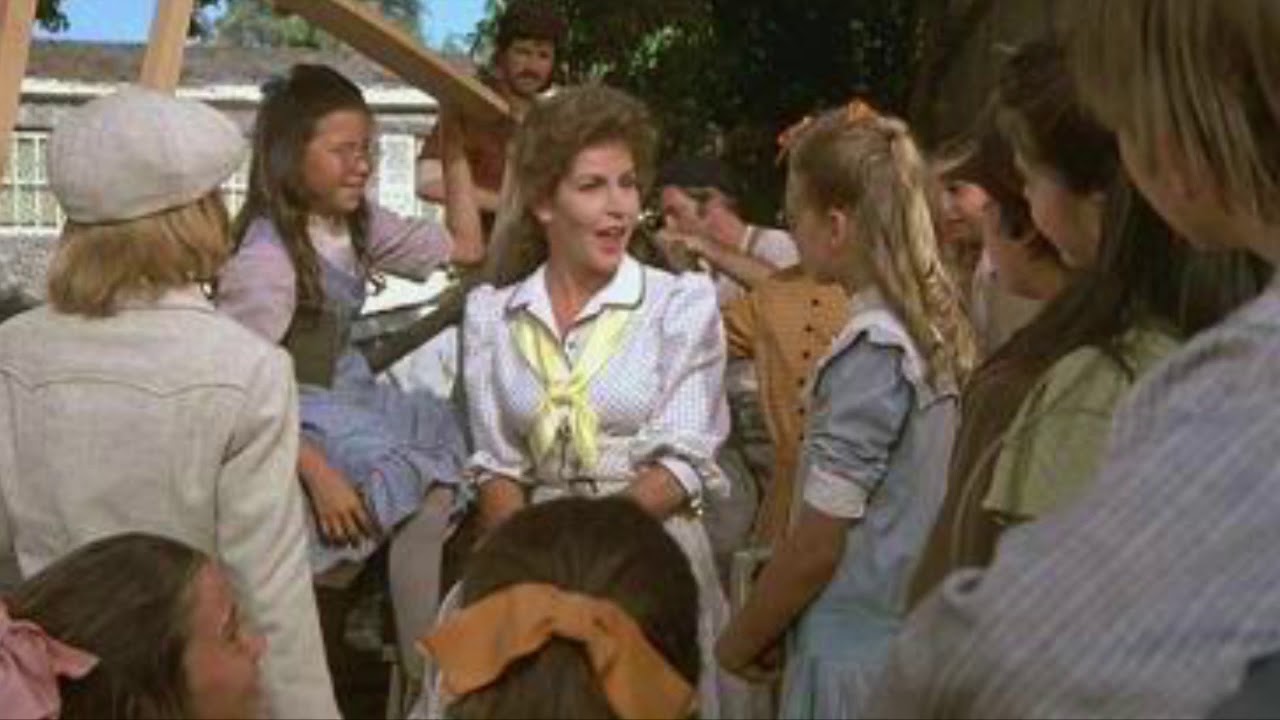
Something similar happens when Nora takes Pete to school. The fishermen aren’t happy to see him because, since he came to town, all the catches have gone bad. Nora responds with the lovely There’s Room for Everyone in the World. It’s a nice song with a great sentiment. But what happens is, again, it becomes a full song and dance production number with a huge cast. Here’s the scene. I guess you can justify in that, with all the school children joining in, it shows that Nora’s message of acceptance is working. I can buy that. But for me….the scene is just kind of….blah. The song is nice….but not great. Not to keep comparing to Mary Poppins, but here’s the thing: the production numbers in Poppins are SOMETHING. They blow you away in their quality, and they always advance the story. Spoonful of Sugar, with the magic of the nursery cleaning itself? AMAZING! Jolly Holiday, be it just Bert and Mary, barnyard animals, or penguins? Maybe the greatest work done in Walt Disney’s lifetime (and that’s not hyperbole; someday I am going to write about how that sequence is the culmination of his career). So if Jolly Holiday goes on, SO WHAT?! You’re watching magic happen. Dick Van Dyke dancing with penguins, for crying out loud! But when a bunch of Maine school kids dance around, it just doesn’t feel that special. Maybe because it’s just…..ordinary. Sure, it looks great, but its not unique. We’ve seen big dance production numbers from lots of movies; its not Disney exclusive. Though I will say, the creation of the fictional Maine town of Passamaquoddy is impressive to look at. So if There’s Room for Everyone ‘s spectacle is an excuse to show that off, I guess I can allow it. But if the complaint is that Pete’s Dragon is just too long, which I think it is, these are two examples where you could easily make up time. And I’ve got more example than that coming!

One of the things that sort of stands out in the Disney films of the 1970s and ’80s is how dark they could get. I wrote about how, in 1986’s The Great Mouse Detective, we have heavy drinking and a mouse being fed to a cat, yet its treated so ridiculously, it doesn’t really bother you. Pete’s Dragon comes 10 years earlier, but its sort of the same idea: present something dark but so ridiculous, it doesn’t disrupt the merriment. There is a LOT of drinking in Pete’s Dragon. I’ve already talked about the beer a-flowing in I Saw A Dragon. The character of Lampy is nearly always drunk; we never get any reason why. There’s a never backstory, of something dark in his past that has turned Lampy into a lush. He’s just (nearly) ALWAYS drunk. Its played as a joke….like, hey kids, let’s have a laugh at Grandpa Drunky! I get that was Dean Martin’s shtick for so many years….but I also don’t recall Dean Martin being in a Disney film.

The constant alcohol use is not just the propriety of Lampy. We have a scene where two of the villains, Dr. Terminus (more on him shortly!) and his sidekick Hoagy, are consoling themselves in the saloon, with a bottle of whiskey to share. The so-called doctor doesn’t seem too much of a drunkard, though he does throw a few glasses down. But Hoagy, he’s right there with Lampy. And no wonder they hit it off so well. Heck, Hoagy carries a flask with him that even he later shares with Elliot! Lampy is played by the famous Mickey Rooney, and he just goes over the top with the imbibing shtick. It’s cheesy and makes me wonder how it got into a Disney film. But then again, you bring in Mickey Rooney and subtlety is not on the menu. And no…I’m not going to share ANY clips of him from Breakfast at Tiffany’s; you’re on your own there. But when director Don Chaffey put a drunk Lampy and a drunk Hoagy together, to go find Elliot…..now you had inebriated comedy that actually worked. It helps when Hoagy is played by veteran showman Red Buttons. Everyone in Pete’s Dragon hams it up, and Buttons, as the sidekick to number 1 villain Doctor Terminus is no exception. Yet for some reason or other, I found his drunk act amusing. Maybe because it’s not all he does in the film. The same cannot be said Rooney, whose Pete’s Dragon is ALMOST a one drink, err one trick pony. Anyway, here’s a scene where the two drunks go dragon-hunting. These are two actors from a previous generation, where slapstick was a thing….and it shows. It really plays like a Vaudeville routine, and I think is one of the more underrated moments in Pete’s Dragon.

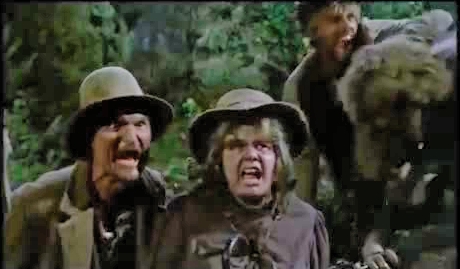
But Buttons and Rooney weren’t the only stars of a previous era to make an appearance in Pete’s Dragon. The opening scene introduces us to Pete (and Elliot) running away from the Gogans, a really unattractive hillbilly family that purchased him to work their farm. The Gogans are crude, ugly and evil. And they’re led by Ma Gogan, played by another Oscar winner from decades before, Shelley Winters. Just like everyone else in Pete’s Dragon, she goes to town in terms of over-acting. My guess is, with her years as a sex symbol gone, Winters said, What the Hell, and decided to go all-out cheesy. And the way the film begins, it’s another example of Disney presenting the dark so ridiculous, you don’t really notice how dreary it is. The song is The Happiest Home in the Hills, and I really don’t know how to describe it. Here you go, have at it. I have no memory of what I thought as a kid. Was I scared? Watching this scene last week, me now being 47 years old, I had no idea what to think. The two boys are singing of all the horrific things they’ll do to Pete; everyone is dancing and singing while brandishing weapons. I know its supposed to be ridiculous, but as I watched it, I was just struck by how morbid a tone was being struck. And it’s like I wrote about the Ratigan song in The Great Mouse Detective; when you turn the villain’s song into something cheery, just as this is, it lightens the scene. Still….this is the opening moment of Pete’s Dragon. Everything is dark, dreary and grimy. You’re definitely not in Mary Poppins!

Welcome to Pete’s Dragon!

There are two acting performances in Pete’s Dragon that really added something to the film. One was Helen Reddy as Nora. If you want compare to Mary Poppins, she’s the Julie Andrews….and if that’s the bar, Reddy comes out very well, despite how high that bar is. She had already had her major hit with I Am Woman (Hear Me Roar). In some ways, the comparison to Andrews is apt, as she was just coming off starring on Broadway in both My Fair Lady and Camelot, but had not made a movie yet. I THINK (not positive on this) Pete’s Dragon was Reddy’s first film and I have to say, I am quite surprised she didn’t have more of an acting career. Take a look at this scene, one of her first with Peter. She’s naturally comfortable, and this happens in scenes beyond ones that involve singing. In perhaps the only scene in the movie where Lampy is NOT drunk, they argue about Nora not letting go of her assumed dead fiancee. Likewise, there’s a very good exchange later on, where Nora advises Pete to forget about Elliot (whom she assumes is an imaginary friend) just as she needs to give up on Paul (her long lost fiancee).

Now, calm down; no, I’m not about to say that Helen Reddy was better than Julie Andrews. But hear me out here. Mary Poppins, as we all know, is, (say it with me) “Practically perfect in every way.” Or as Michael Banks put it, “Rosy cheeks and everything!” Mary Poppins came out in 1964, Pete’s Dragon in 1977. In the years in between, there was the war in Vietnam, the Civil Rights movement, rioting, the assassinations of Martin Luther King Jr and Robert F Kennedy, the violence at the 1968 Democratic National Convention, and Watergate. America had seen a LOT between the releases of Poppins and Pete. And I think Pete’s Dragon reflected that. I mentioned how it has darker elements than Poppins, from the Gogans to all the drinking. And the same goes for the female lead. Nora is big hearted, just like Mary. But she’s dealt with heart-break and loss. Her life hasn’t been easy. She’s also not magic, like Mary Poppins. She’s earthy, she’s gritty. And she’s played by the woman who sang I Am Woman (Hear Me Roar). She’s a Mary Poppins, updated for the time. And Helen Reddy was great in it. Again, how she didn’t become a bigger movie star after this, I don’t know. I’m not going to say she was better than Julie Andrews. What I will say is, its one of the finest performances by a female lead in a live-action Disney film. Its not even fair to compare to Andrews, because the roles call for something so different. Poppins: magic. Nora: grit. But both played with a whole lot of heart. Put me down as an audience member, impressed by both. Is that fair?

Pete’s songwriters, Al Kasha and Joel Hirschhorn, gave Reddy a big ballad, with which to bring down the house, Candle on the Water. It’s definitely a creation of its time; I could hear Carly Simon singing it. It’s set up for Reddy to knock it out of the park, and while she does just that vocal-wise……and lackluster is director Don Chaffey’s filming of it! It’s just Reddy on the top of her lighthouse. That’s it! So much more could’ve been done with this. Nifty camerawork and special effects, stretching from near and far, over different landscapes. Instead, it’s so….static. This really should’ve been a much more grand moment. Take a look for yourself.

Sean Marshall, as the title character, is sort of….ehh for me. He has the whole cute kid thing going for him. The problem is, personally, I find the characterization the exact opposite of Helen Reddy. He’s just too sweet. This is a kid who is an orphan and has been purchased by a family of brutes to basically be their slave. Yet, he is unfailingly optimistic and full of cheer. Yes I know, he has a pet dragon who’s looking out for him; that would cheer me up too. But I guess my thinking here is, this is a movie which shows plenty of darkness: abusive, exploitative foster home, and then heavy drinking amongst adults. It doesn’t mean Pete needs to be suicidal. But look back to the scene I posted, where Nora and Pete have their first song together (It’s Not Easy). Pete is so sweet-natured and takes to Nora instantly. Wouldn’t you think that a boy who has been through so much might just be a little guarded, especially around adults? Now of course, Nora isn’t the monster that Ma Goggins is, BUT STILL. I would think Pete would be just a bit shell-shocked and withdrawn around adults by this point. But nope, he takes to Nora like a cat to cream. It’s as if director Don Chaffey decided, there’s enough darkness, let’s make the kid as bright as can be. We’re going to make him as Disney as possible.

Who knows, maybe child actor Sean Marshall just didn’t have the range to play Pete with depth. Maybe that was the case. Look. he’s fine. He’s cute, he’s wholesome, he’s likable. But for being the title character, to me, Pete just isn’t memorable. He’s kind of the vehicle that the story centers on…..but those that are orbiting that center are just more interesting. That’s the case with Helen Reddy as Nora. It’s the case with Red Buttons as Hoagy. I wouldn’t say Ma Goggins is an interesting character but Shelley Winters clearly was having a ball playing her. And even though there’s no depth, no interesting backstory to his character, Mickey Rooney’s Lampy at least is entertaining. That is, if jolly alcoholics is your brand of humor. Somewhere Barney Gumble approves. And there is one more character I haven’t really talked about too much, who is most DEFINITELY interesting. And that character, for me, is, far and away, the best element of Pete’s Dragon.

I’m talking about Jim Dale as the primary villain, Doctor Terminus.

Maybe the greatest Disney villain ever….and that’s not hyperbole

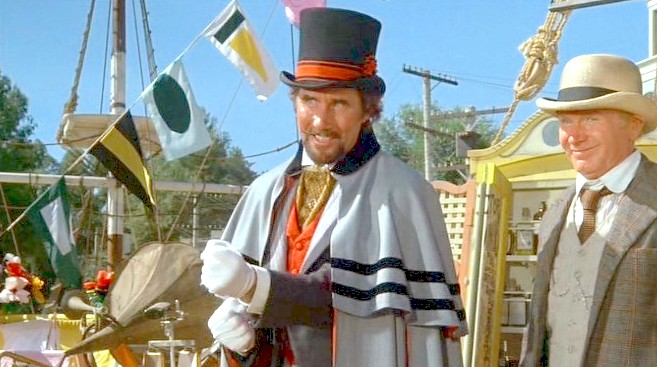
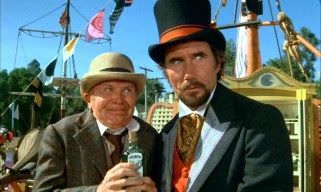
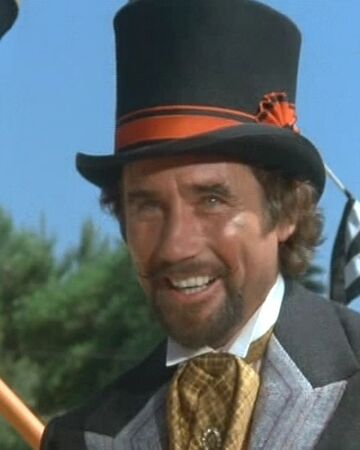
I mentioned how I don’t remember much about Pete’s Dragon from childhood. Well, I did remember Dr. Terminus. And how could you not?! Just look at Jim Dale in that picture: top hat, goatee, ascot tie, scarlet waist coat, cape and kid gloves. Mickey Rooney and Shelley Winters may have chewed on their scenes but that was NOTHING compared to what Jim Dale did. But you know what? It works BEAUTIFULLY. “Dr.” Terminus is a quack artist. He comes to town peddling all kinds of dubious medical treatments, and it turns out he’s been to Passamaquoddy before. He travels by a sail wagon because as he mentions, he lost his horses to settle a malpractice suit! I have no doubt in my mind at all that Jim Dale was channelling The Music Man’s Prof. Harold Hill for the role. And why not? Both were con men, preying on small town early 20th century America. Dale was a stage performer in England, and not long after Pete’s Dragon, won a Tony for his portrayal of P.T. Barnum in the Broadway musical Barnum. You have to think that show’s producers were inspired to choose Dale after seeing Pete’s Dragon. Here’s Dr. Terminus’ debut number; you tell me if this isn’t the successor to Ya Got Trouble?

I really hesitate to say Jim Dale overacts. He is a lightning bolt of energy that just dominates the screen. And there is such total commitment to the role; his facial expressions are deliciously wicked, his voice so silky smooth, his mannerisms all with a purpose. This character works so well. Shelley Winters: okay, I’m going to play a dirty mean, old lady and have fun with it. That she does….but how much screen time do you want of a dirty, mean old lady? Mickey Rooney: I’ll be the lovable town drunk and have fun with it. And it’s fun….till that joke gets old. Meanwhile, Jim Dale….whereas Robert Preston bellowed his way into River City, I’m going slime my way into Passama….whatever the town is called, and charm the local residents out of their cash. And you, gentle viewer, won’t be able to look away. It’s a total commitment to a role that is completely one -dimensional and shallow. There’s no backstory on Dr. Terminus, there’s no redeeming grace. He’s an unapologetic sham and Jim Dale milks everything out of it, and then some!

To put into perspective how much Jim Dale dominates the film, Dr. Terminus doesn’t arrive till about 45 minutes in….and all of sudden, everything shifts into high gear. Everything had been uneven till that part: Pete escapes from the Gogans and their song and dance, he and Elliot have a VERY forgettable number together, Pete comes to town and mischief ensues, we have Lampy and the saloon dance, and then Pete is taken in by Nora. Nice film, nothing special. But then the good Doctor blows into town, and from that point on, friends, I could’t look away. Every scene he was in became must-watch. This movie, which had been taking its time, like a pleasant, uneventful stroll, suddenly became a sprint through a minefield. Everything is exciting and its all from what Jim Dale brought to the role. If he wasn’t as enthusiastic in his delivery, the film falls flat. Dr. Terminus isn’t a menacing villain. He’s not going to hurt Pete, Nora or Lampy. And his scheme is so simple. He doesn’t want to capture Elliot to show him off, like King Kong. No, it’s about chopping a dragon to peddle more “cures.” The whole villain scheme is that simple. Yet it works because Dale is just so delicious in every scene. There’s a great moment when he comes to the lighthouse to recruit Pete . Nora doesn’t approve and he just shuts her down, “Paint your lighthouse, Nora.” It’s sexist, its misogynistic, and it should be noted, he’s saying this to the woman who sang I am Woman (Hear Me Roar). We should hate him for it, especially with the zeal Dale delivers the line. Again, it’s such a commitment to the role.

Dr. Terminus only gets two songs and both are tour de forces. You already saw his introduction. For my money, Terminus’ second number is the best song in the entire film. It’s where he’s just discovered how many cures he can make from a dragon. Again, the concept is so silly; no, I’m not afraid of a fire breathing dragon. All I want is to use him to increase my business. I don’t want to overthink this, but isn’t it interesting how the villains in Pete’s Dragon are all scheming for business gain? When the Gogans come to claim Pete, they sing about how they have a Bill of Sale. And Dr. Terminus and Hoagy’s shining moment is a song extolling all the money they’ll make. Nora and Lampy take Pete in for love, while the villains are out for financial gain. A commentary by Don Chaffey in 1977? Hmmm?

Anyway, I’ve said how some of the musical moments in Pete’s Dragon go on too long by becoming spectacle. That’s not the case with Every Little Piece. You’ve got two professional song and dance men in Jim Dale and Red Buttons; let them go! And boy, did they deliver. Take a look. And when you do, look at the facial expressions from both of them, especially Dale. His gestures, too! And that diabolical laugh. Not to mention the dance routine. This is the exact opposite of I Saw a Dragon. We know who these two characters are, and their giddy dance is all part of the story; it’s their glee at the nefarious plot being hatched. Not to mention, Dale and Buttons are just sooooo good. Did you see near the end, where Dale tosses his cane to Buttons, who tosses it right back? It’s consummate showmanship. Every little thing Jim Dale does in Pete’s Dragon is worth watching. He is, without a doubt in my mind, the best part of the film, and quite possibly the greatest Disney performance you probably don’t remember. What a pity!

There are two more things I’d like to discuss about Pete’s Dragon. One is the music. Unlike Mary Poppins, the typical Disney songwriting team of the Sherman Brothers was not on hand, Instead, the honors went to Al Kasha and Joel Hirschhorn, who were hot at the time. They had apparently had the market cornered for songs from disasters pics, with Oscar-nominated tunes from The Poseidon Adventure and The Towering Inferno. Their work on Pete’s Dragon is, to me, hit and miss. Candle in the Wind is the big anthem; Nora and Pete’s duet of It’s Not Easy really quite lovely, and I’ve waxed on about the two numbers for Dr. Terminus. They also have a big, happy anthem in Brazzle-Dazzle Day. On the other end are Pete and Elliot’s duet, which I might go so far as to call the cheesiest, most forgettable song in any Disney film EVER. I know that’s a strong statement but judge for yourself. When I watched it last week, I almost hit the fast-forward button. See what I mean about Sean Marshall just being too cute? This one, like Marshall himself, is too sweet, enough to make one sick.

My biggest problem with the songs to Pete’s Dragon is that they tend to sound like when they were composed: the mid 1970s. Here’s the thing about the Sherman Brothers and Mary Poppins. The movie came out in 1964 and is set in 1910. The songs aren’t really imitations of Gilbert and Sullivan or contemporary English styles; there’s just a timeless, undated sound to them. They’re neither 1964 or 1910….they just exist on their own. And that’s why they work so well still today. Seth MacFarlane (yes, THAT Seth MacFarlane) opined a few years back how the current trend in Broadway shows doesn’t really give a long life to the tunes, since they’re written in current styles. Here’s the article, if you’d like to read it. MacFarlane talks about how a show like Brigadoon has a timeless quality, because the music isn’t wedded to a particular popular style.

Just before I watched Pete’s Dragon, I also watched The Greatest Showman, the movie musical about P.T. Barnum. Wonderfully filmed, beautiful to look at, colorfully staged….a whole lot of fun. But what didn’t work for me was the music. Something about people from the 1840s singing in current styles just seemed off. This doesn’t bother me with Hamilton because from the get-go, you know this is a unique take on history. Thomas Jefferson played by a black man, for starters! So, when Alexander Hamilton raps, it doesn’t seem out of place. But when figures such as P.T. Barnum and Jenny Lind are in their contemporary setting, in their contemporary clothing, singing in modern styles, it just seems off-putting. That’s what I feel about much of Pete’s Dragon. Songs like Brazzle-Dazzle Day, It’s Not Easy and Candle on the Water are really nice…..but the sounds of soft rock 1970s in early 20th century Maine just didn’t mesh. And that’s another reason the Dr. Terminus numbers absolutely DO work. I don’t know if Kasha and Hirschhorn set out to make Every Little Piece sound like a show tune from the first decade of the 20th century. But what they did create was what the Shermans did with Mary Poppins; that tune has an undated feel to it. It seems completely in place in early 1900s Maine. With the exception of the Elliot/Pete duet, the songs of Pete’s Dragon are not bad. Occasionally they’re terrific. But they don’t work together as a unified whole like the Shermans’ do in Mary Poppins. There’s too much variety in styles…..especially when the styles don’t fit with the setting.

It probably sounds like I didn’t like Pete”s Dragon. That’s not the case. There is much of it I liked, and more than just Jim Dale and Red Buttons. Helen Reddy, as I mentioned, was terrific. What also was terrific, and may have been an improvement over Mary Poppins is the filming. Sure, I criticized the staging of Candle on the Water. But let’s look back at Poppins. Everything was on a sound stage. Nothing was shot outside, nothing natural. Pete’s Dragon is a BEAUTIFUL film to look at…..well, when we’re not looking at the ugly Gogans, that is! The recreation of the Maine waterfront is so picturesque. I’ve been to Maine beach towns plenty; Disney really got the New England feel right. It was all shot in Southern California, but I thought the recreation was perfect.

Also, look at the costumes! Disney did a FINE job with the recreation.

Another part of the production that I think anyone who saw Pete’s Dragon remembers is the Lighthouse. To my great surprise, that was not a pre-existing structure! Disney had it built and installed near Los Osos, California. It’s no longer there. I can’t imagine the cost and this wasn’t at at time when the studio was rolling in cash, either. And while the lighthouse didn’t add too much to Candle in the Wind, Don Chaffey made up for that with Brazzle-Dazzle Day. Here is another example of justifying the full-blown production. Its a happy buoyant song, coming in the film right after Nora and Lampy tell Pete they’d like him to live with them. Spirits are high; the moment calls for extended celebration. And while the song, yes, is out of place in early 20th century Maine, the sentiment is fitting. Chaffey makes the most of this sequence with all kinds of long range shots that just emphasize the majesty of the setting. It’s a lighthouse on a cliff, better make the most of it, and Chaffey did! It’s everything Candle on the Water was lacking. Yeah, the butt rub of the glass is weird…..but just go with it. It’s a delightful scene, and in this regard, if it doesn’t top Poppins, it at least matches it. What Mary Poppins brings in animated and sound stage magic, Pete’s Dragon matches with outdoor, aerial shots that showcase the natural beauty. Sure, that’s the Central Coast of California, not really Maine….but I don’t care. Is Mary Poppins‘ sound stage 17 Cherry Tree Lane really Edwardian London? It doesn’t matter; what it was was magic. Just as the California recreation of Maine works for Pete. At times, it’s a beautiful movie to behold.

Oh, one more thing about the Pete’s Dragon Lighthouse. I don’t remember much, if anything, about the film from viewing as a kid. But what I do remember is that in the climatic scene, Nora’s long lost fiancee is returning on a ship to Passamaquoddy, but a storm has extinguished the Lighthouse. It’s predictable what’s going to happen…..and damn, if I didn’t find the whole sequence really gripping. Watched just a week ago, at age 47, it’s still suspenseful. Really great bit of tension that just makes for an even better resolution to the film: the Gogans have been dispatched, Dr. Terminus has been foiled, but there’s one more obstacle to Nora being reunited with her love, and only Elliot can save the day. It’s also a nice touch that Nora, while completely sympathetic to Pete, never believed Elliot was real. And in saving her fiancee, she gets to meet the dragon. The whole sequence really draws you in and makes for a wholly satisfying wrap-up.

Well, I guess that about does it. I’ve discussed the music, the characters, the setting, the pacing, the acting. Anything I missed? Oh, how silly of me…..just this guy!

There’s an awful lot Disney did really well with Elliot. It probably starts with just how he’s drawn. He’s funny. There’s nothing terrifying about him at all. Him flying with those little wings, and his human like face are such a fun touch. My understanding is, in the remake, the dragon is CGI and more realistic. I get that, in the era of Game of Thrones. But in a film where Pete is escaping really grim circumstances (the Gogans) having the equivalent of a cartoon dog for the dragon ABSOLUTELY works. I also think Chaffey and his writers make a great choice in keeping Elliot invisible to most everyone else. We saw the wreckage he causes in Passmaquoddy (never out of ill will) and there’s the great visual of his outline framed in the ruined wall of the school house. But the only people who have seen Elliot besides Pete are Lampy and Hoagy….and both were drunk at the time! Even when Dr. Terminus captures Elliot with a net, we still don’t see him. We only see a dragon shape filling out the net…but no Elliot. Only when the plots have been foiled do the ordinary see Elliot, such as when Dr. Terminus is hanging from the pole, or when Elliot saves the Mayor and his committee. Great choice from the team of limiting how many people Elliot is visible to.

Another great choice was making Elliot a truly friendly dragon. Think about all the times we see him breathe fire: to roast an apple for Peter, and to incinerate the Bill of Sale the Gogans have to Pete. That’s it. Outside of knocking someone over, we never see Elliot attack a person. Heck, he knocks Dr. Terminus’ “medicine” wagon into the harbor, he doesn’t burn it up. In fact, Pete‘s Dragon is one of the very few Disney films where no one dies. Think of all the movies from 90s on? The Little Mermaid, Beauty in the Beast, The Lion King, Mulan, Tarzan, The Hunchback of Notre Dame….all the villains met their doom. But not so in Pete’s Dragon. Once the Gogans lose any evidence of owning Pete, they simply fall into tar, just like they fell into mud in the movie’s opening. We assume they just went home and continued to be awful people. Perhaps the townspeople run Dr. Terminus and Hoagy out of town on a rail….but they definitely aren’t killed. It’s actually quite refreshing that, for a movie that could be dark at times, the ending is so light.

I don’t mind that Elliott speaks in noises and Pete can understand him. If you have a problem with that, then I would like to know how you get around Han Solo communicating with Chewbacca. The one thing I wish we had a little more info on is how Elliot and Pete came together. Pete says something to Nora about how Elliot comes to help orphans in need. And then, right near the end, when it’s clear everyone has a happy ending, Elliot tells Pete he has to go now, as Pete no longer needs him. I know….I already said the movie is too long. But perhaps if you cut out some of the production numbers or I know….replace the silly duet with a song that explains how Elliot first came to Pete, that would solve it. Admittedly, it’s a minor gripe, but the notion of a dragon that came to the rescue of orphans, what an interesting concept. Anyone else interested in learning more?

So, the original Pete‘s Dragon, what to make of you? At your best moments, you’re a fun story that (after a while) drawn you in. You’re beautifully shot, whether on an artificial set or in nature. Your songs are hit and miss; the best ones are memorable (if somewhat out of place), but they have a tendency to go on too long. Not every song deserves a production. And you have actors who REALLY loved the camera. In the case of Jim Dale and Red Buttons, that’s an incredible plus going for the film. In the case of Mickey Rooney and Shelley Winters, a mixed bag. And in Helen Reddy, you have the most worthy successor to Julie Andrews possible. If Mary Poppins is innocence and optimism, Nora is world-weary yet still full of love. It’s a natural evolution, and Helen Reddy played it PERFECTLY. And I think that sums up Pete‘s Dragon pretty well too, if I say so myself. When it’s following the Mary Poppins playbook, it’s a poor successor: Candle on the Water is no Feed the Birds. Mickey Rooney is not Dick Van Dyke. Drunks on a bar are not chimney sweeps on London rooftops. But when Pete’s Dragon went its own way, it fared more than decently. Mary Poppins had no true villain; Dr. Terminus is the best villain in any Disney live action film I am aware of. And like Van Dyke, any moment Jim Dale is on the screen, you have to watch. Mary Poppins is on a soundstage; Pete’s Dragon gives us a recreation of early 1900s Maine, complete with a lighthouse. And maybe most interesting, in Mary Poppins, our characters jumped into the animation. Pete’s Dragon brought the cartoons into the real world.

Mary Poppins‘ supremacy as the greatest film of Walt Disney’s career is not threatened by Pete’s Dragon. In fact, it’s not even eligible, since Pete’s Dragon came a decade after Disney’s death. And when compared as a Poppins clone, Pete’s Dragon suffers. But when viewed on its own, without the comparison, it works. Sure, its too long. Sure, not all the songs are great. Sure, it could use some judicious cutting. And really, Mary Poppins is such a high bar to compare to. I know I’m biased, but I don’t find anything I’d change with that film. I can’t say the same about Pete’s Dragon…..but that doesn’t mean I didn’t like it. It’s a good film. I enjoyed it. Just because you may not be practically perfect in every way, doesn’t mean you can’t be brazzle-dazzle!

Check it out on Disney + and let me know what you think. While it’s not a masterpiece, it’s still worth your time. Or at least an hour and 45. And why that particular amount, you might ask? Because I figure after trimming enough of Pete’s Dragon to get to that running time, now you’ve got something!

These two performances alone, more than enough reason to check out Pete’s Dragon

A Meek Appearance; or a Prophet Meets God

As I have mentioned before, I read a chapter out of the Bible every morning. I think I started this sometime around 2000….I’m not exactly sure. But seeing as that’s the year I entered the Roman Catholic Church, it would make sense if that’s also when my daily Scripture began. I’ve lost track of how many times I’ve been through the Bible; I start at the beginning, go to the end, and then repeat. I would be lying to you, though, if I said I read EVERYTHING. There’s that part after the Israelites escape from Egypt, where it bogs down into the building schematics for the Tabernacle. I’m not a huge fan of the Psalms. And call me a bad Catholic, but St. Paul’s Letters/Epistles (whatever you want to call them) somewhat loses my attention. Give me the parts of the Bible where there’s a narrative, characters, people doing things and action happening. Even the part that don’t read well today, like all the slaughter in the conquest of Canaan. At least there’s a story to follow.

I’ve always been an avid reader, and for me, one of the signs of great literature is that, when you return to it, you take away something different. Two books, widely divergent, that I frequently re-read: The Great Gatsby by F. Scott Fitzgerald, and Wind in the Willows by Kenneth Grahame. I couldn’t tell you how many times I’ve read either of them; I just know that whenever I return to them, I come away with something new. It may not be anything profound; I’ve never come to the conclusion of Jay Gatsby as a Christ figure, or Mr. Toad a symbol of the moral decay of the English aristocracy. More often than not, it’s finding something I missed, a detail I overlooked, a character I had forgotten about. The point is, these two works (and I’m sure there are many like them) qualify as great to me, because I they always have something new to say. They’re eternally relevant.

The Bible functions the same way. The text hasn’t changed, there’s no new edition. The stories are still the ones from my childhood. But each time I read it, I glean something different. Much of this has to do with me. If we accept that around 2000 was when I first started reading the Bible cover to cover, then, we have to consider who I was in 2000: under 30 years old; music teacher in a small town in Iowa; single. Today, I’m 47; married; and a college professor in New England. I don’t say this to sound boastful but I mention it to make a point: 2020 me is kind of at where 2000 me dreamed of being. Not that everything is now perfect; far from it. But in terms of where I am professionally….it’s kind of what I had dreamt of. So naturally, 47 year old me brings an entirely new perspective and a wider range of experiences when reading the Bible. I’m still the same person as I was in 2000, but my experience have so changed.

But even something as simple as the time of year can change my perspective. Which brings me to the point of today’s blog. I’m currently writing this on December 23rd. In other words, two days before Christmas. But when you read the Bible cover to cover, moving sequentially, it’s pretty rare that my journey lines up to the Church calendar. In other words…I’m nowhere near the beginnings of Luke or Matthew. Heck, I’m not even to those passages in Isaiah, which predict the Messiah. No, I’m in the First Book of King. You know, the parts where we are told King So-and-So did evil and turned away from the Lord. You lose track of the names, they all seemed such a bad lot. However, late in 1 Kings, that monotony is broken by the stories of the Prophet Elijah. And that’s where I am currently.

In the past, I wasn’t the biggest fan of Elijah. I wouldn’t say I disliked him; there was just never anything that I identified with. I knew him as a miracle worker and a bringer of justice and condemnation for Israel’s ruling couple: Ahab and Jezebel. I think (mind you, I’m no Biblical scholar) he’s one of, if not the most important, prophets of the Old Testament. The listing of bad monarchs stops, in order for us to hear of his deeds. Must be pretty important then, eh?

Elijah has two pretty unique characteristics: the first is, he never dies. He’s taken up to Heaven in a chariot of fire. The second is that he appears in the New Testament. It’s he and Moses that visit Jesus during the Transfiguration. Also, let’s not forget when Jesus asks His Disciples, “Who do people say that I am?”, a common response is….you guessed it….Elijah. So obviously, Elijah is a figure of no small significance. If you had to list the major figures in the Old Testament: Adam and Eve, Noah, Jospeh, Moses, David, Solomon (maybe), Elijah, Elisha….and that may be it. I’m sure you can make the case for others, like Joshua, Aaron, Ezra, Daniel and more. The point is, though, not many Old Testament figures carry over into the New Testament. And Elijah is one of them. As Ron Burgundy might have put it, he’s kind of a big deal.

Perhaps Elijah’s most famous scene comes in 1 Kings Chapter 18, where he takes on the prophets of Baal. They both erect altars and make a sacrifice. The challenge is, which god will light a fire upon the altar? This sequence is a bit amusing, in that it gives us Biblical smack talk. When Baal does not respond to the prophets, Elijah taunts them, by suggesting that perhaps their god is sleeping and they need to yell louder. Or that their god is on vacation and can’t be reached. Then, when it’s Elijah’s turn, he calls upon the Lord, and lo and behold, fire comes down from Heaven and consumes his sacrifice. The people are amazed, and in typical Old Testament retribution, the prophets of Baal are executed.

As I mentioned, Elijah was not a favorite of mine. He’s outspoken, full of swagger, braggadocio; a “pay attention to me” type. I get that an Israel that had forsaken its God needed someone to call them to accountability. But I also get the impression that Elijah wouldn’t be too much fun to be around; it would be an awful lot of everything being about him…or at least him at the center of every story. “Woe to you, Israel, you have forsaken the Lord. And let me tell you what’s going to happen next because I’m Elijah and I’m righteous, unlike you!” That kind of thing. But that’s where a Bible re-reading can change your mind. I knew the story of the showdown with the Baal prophets from Sunday school. I remembered the next sequence, where he outran King Ahab’s chariots. But the Elijah in the following chapter (1 King 19, for those of you scoring at home) is different than what I previously thought. And so we arrive at my most recent re-reading.

The story begins with Queen Jezebel sending a message to Elijah that she will have him killed. So how does the arrogant, confident Elijah respond? You know, the same guy who was talking smack to the Baal prophets? Well, according to Verse 3, “Elijah was afraid and fled for his life.” Not only was he scared, he becomes depressed and even suicidal! We have him in verse 4 pleading to God: “This is enough, O Lord! Take my life, for I am no better than my fathers.” What is going on?! How did this proud vessel of God’s might become so down? A few verses later, we find out the reason. Verse 10: “I have been most zealous for the Lord, the God of hosts, but the Israelites have forsaken your covenant, torn down your altars, and put your prophets to the sword. I alone am left, and they seek to take my life.”

This is just me speculating, but I wonder if there are some details missing to the story. Chapter 18 ends with the triumph over the Baal prophets and Elijah correctly predicting the end of the 3 year drought in Israel. He seems triumphant….and most likely pretty smug about it, in his zeal. Yet the next chapter, Elijah is completely despondent. What happened? My guess is, Elijah was expecting Israel to come back to God en masse after his tour de force at the ol’ prophet showdown. The crowd followed his instructions to seize the Baal prophets and it was Elijah himself who slit their throats (lovely, right? Ahh, the Old Testament). My guess is, Elijah was expecting all Israel to have his back. So imagine his surprise when Jezebel pronounced his doom, to find himself all alone. Elijah’s prediction of Israel returning to the Lord might have been a wee bit premature, especially in the wake of royal fury. And so, confident, proud, boastful Elijah found his aspirations broken. He went from his greatest triumph to now wanting it all to end. The Super Bowl winning quarterback getting cut at training camp. The platinum selling artist being dropped by their label. Hopefully you get the picture, because I’m plum out of analogies!

As much as I had been through the Bible, I don’t think the depressed, distraught Elijah had ever caught my attention before. It’s absolutely critical. What it does is, it humanizes him. We had the confident, swaggering, maybe even arrogant, Elijah putting on a show. This was the man who could, by his own command, demonstrate the mighty power of God. Not only did he defeat the opposition, he executed them! But instead of wearing the victor’s laurels, he’s a man on the run. Perhaps Elijah was being punished for his hubris. Was God not pleased with his smack-talk? I wouldn’t go so far as to postulate that God was punishing Elijah for his swagger; after all, He did come through and send fire down, making Elijah the winner. But here’s the thing….a prophet who can summon fire from Heaven isn’t very relatable. But you know what is? Someone who is depressed, someone who finds everything going against him and just can’t do it anymore. Someone who just wants to give up. Elijah in Chapter 19 is no fire and brimstone prophet; instead, he’s one of us.

There are many times in reading the Bible that I find myself asking, “Why is that in there?” This is VERY common in the Old Testament; be it the violence, such as in the wiping out of the Benjamites at the end of the Book of Judges, or the bizarre tales, like the story of Lot’s daughter (ewww). I don’t have answers for that. But I do think Chapter 19 of 1 Kings is there to give us an example of God comforting His people. Elijah wants to end it all, but God won’t let him alone. God reveals himself to Elijah, described in colorful detail in verses 11 – 13. It’s a theophany, a physical manifestation of God. This happened before in the Old Testament a couple times, but the theophany to Elijah is different in a most important way. This theophany is one that prepares the way for the New Testament and Jesus. But before I get to that, let’s look back the theophany in Exodus 19…..hmm, is it a rule that a theophany has to happen in the 19th chapter?

The Israelites have camped at the base of Mount Sinai, where Moses will receive the Ten Commandments…along with all the other instructions for building the Ark of the Covenant, the Tabernacle, the Priestly Garments, etc. Anyway, God’s arrival on Mount Sinai is described as peals of thunder and lightning, with trumpet blasts. The top of the mountain is surrounded with smoke and it appears as if its on fire. Later on, God tells Moses that he will only be able to see Him pass by from the back, for to look upon God’s Face means death. By the time Moses’ conversation was done, his face had become radiant, to such a degree that he was asked to wear a veil, to keep from blinding the Israelites!

Now, back to our guy, Elijah. When we left him in 1 Kings 19, he’s hiding in a cave on Mount Horeb, which is described as the mountain of God. Queen Jezebel has promised death. He feels utterly crushed and abandoned. Elijah is in the zone where nothing seems worth it. When God asks him why he is in hiding (verses 9 and 10), Elijah is at wits end. No matter what he has done, the Israelites have not turned away from wickedness, and now his life is at risk. Compare this to Moses, who was filled with righteous indignation at the Israelites worshipping a Golden Calf. No fury here from Elijah, just complete despondency.

At this point, I should point out that the Mount Horeb Elijah is seeking refuge on is the same location that, according to Deuteronomy 4, God gave Moses the Covenant. Yeah, in Exodus, it’s called Mount Sinai. I didn’t do the writing, so I’m not sure how to answer that. But if you go with Deuteronomy, Elijah is meeting God in the same place Moses did. That cannot be a coincidence. And just like with Moses, God’s arrival in an awesome, earth-shaking theophany…..except for one major difference. Let me start with Verse 11 of 1 Kings 19:

Then the Lord said, “Go outside and stand on the mountain before the

Lord; the Lord will be passing any.” A strong and heavy wind was rending the

mountain and crushing rocks before the Lord – but the Lord was not in the wind.

After the wind there was an earthquake – but the Lord was not in the earthquake.

After the earthquake there was a fire – but the Lord was not in the fire.

After the fire there was tiny whispering sound. When he heard this, Elijah hid his face in his cloak

and went and stood at the entrance of the cave.

We get the same awesome display of divine power as Moses encountered; there’s all kinds of natural phenomena….except for the passing of God Himself. Whereas Moses could only witness God from the back, and in doing so, his face became ablaze, God to Elijah is the meekest of whispers. No voice resounding from the Heavens, as we see at the Baptism of Jesus. No, the Voice of God to Elijah might not have even be perceptible. What are we to make of this? Just a chapter earlier, God responds to Elijah’s exhortations by sending down fire from the skies. You can’t get much more dramatic than that! So why, just one chapter later, is His response so minute?

Well, I think there are a couple things at play here. One goes to my main point of the humanizing of Elijah. Let’s face it; after this episode, Elijah is back to being the voice of authority, the righteous prophet. We see him condemning Ahab and Jezebel for the murder of Naboth. And, obviously, Elijah’s exit in 2 Kings 2 definitely does the OPPOSITE of humanize him…that is, unless you are familiar with any other individuals who have left this Earth riding in a flaming chariot. I know I don’t know any. Yet, for one chapter, we get an Elijah we can relate to; one dealing with the very real feelings of abandonment and hopelessness. And I think God’s response, coming only in the tiny whisper, is a continuation of that humanization. Maybe I’m wrong about this, but I have to think, God typically answers us not unlike He did Elijah; in meek, quiet and quite possibly, imperceptible ways. I’m not going to go so far as to say God (or other aspects of the Divine) never reveal themselves to us in dramatic fashion. You won’t get me on the record denying the appearances of the Virgin Mary, such as Our Lady of Guadalupe or Our Lady of Fatima. But I think it’s safe to say, those kind of supernatural encounters are VERY few and far between. The Divine appearing to us, responding to us, conversing with us….if you believe that happens (and I definitely DO), then it happens in the manner of the theophany to Elijah. It’s not the thunder, lightning and shining radiance of Moses. It’s something so minute, we probably don’t even know it’s there. And in all likelihood, we’re not listening to it. For the overwhelming majority of us, God’s interface with us can’t be perceived. It’s in our everyday existence….something so ordinary you probably would never know it’s God.

I am reminded of perhaps my favorite bit of Catholic literature, Evelyn Waugh’s brilliant novel, Brideshead Revisited. And reflecting on how I started this blog, there’s a book I am WELL overdue to re-read. So much there, from wickedly funny satire of British society, to coming of age, to the passing of the British nobility, to a love that just can’t be. And of course, at the center of the finale, a return to God. Waugh uses the term “A Twitch Upon the Thread”, which he takes from G.K. Chesterton. SPOILER ALERT for those who have never read Brideshead: the patriarch of the family, on his deathbed, accepts the Sacrament and Last Rites. There’s probably not much too that. I’m sure countless of dying individuals have returned to the faith of their youth, even if just in ritual, when facing death. But that’s the twitch. That simple gesture has a profound affect on all the other characters. Julia can’t marry Charles Ryder; she’s divorced and realizes they’ve been living in sin. She instead returns to the Church . And by the very end of the work, Charles Ryder himself, who has seemingly been agnostic his entire life, appears to be a practicing Catholic. There was no extraordinary miracle worked. Nothing happened that was even remotely supernatural. A dying man, perhaps as a way of hedging his bets in the event there is an afterlife, accepts Holy Communion. Nothing abnormal there at all. But, it’s the tiny whisper that Elijah heard. Lord Marchmain’s acceptance of the Sacrament is the catalyst that changes others. It’s a Twitch Upon the Thread. It’s the Tiny Whisper. It’s an incredibly powerful scene, particularly if Catholicism means something to you, like it does to me. Whether Waugh had Elijah in mind when he penned it, I have no idea. He was definitely a practicing Catholic at that point this life. And yes, I know Brideshead Revisited is a work of fiction. But it’s a perfect example of God in the “tiny whisper.”

That’s why we have the the theophany of 1 Kings 19. It’s to prepare us for our own interaction with God. Unless we’re somehow chosen for seem dramatic Divine Encounter, our personal interactions with God is likely inperceptible. We may never know of His Presence in our lives. I’m guessing none of will have to look upon God’s Back, for fear of death from seeing His Face. But the theophany Elijah encountered….that’s the one that IS a part of our daily existence. And think….Elijah only hear that tiny whisper because he was told that the Lord will be passing by. You and I probably don’t get an advance notice. Is our “tiny whisper” speaking to us, and we’re just not listening?

I mentioned earlier that any re-read is influenced by changes in your life. I would also contend that WHEN you re-read can be a factor. With regard to our topic at hand, I must point out that I most recently read 1 Kings 19 on December 21. In other words, right near the end of Advent and the celebration of the Brith of Christ. So with Christmas already on my mind, the tiny whisper takes on another meaning. I’ve spoken about how the example of God in the tiny whisper to Elijah is applicable to our own time. Well, what of the birth of Christ? The Magi come from the East, following a star announcing the birth of a King. Now, we tend to combine the Nativity stories of Matthew and Luke, with the Magi following the shepherds to the stable, with baby Jesus in a manger. The Magi only appear in Matthew, and there’s no mention of Mary and Joseph being turned away from the inn. We are only told that the Holy Family is in Bethlehem. For all we know, the infant Jesus they paid homage to was in a crib….or whatever babies slept in back then. Still, Mary and Joseph were not royalty. Even if not a manger in a stable, one would have to think the Magi were a bit surprised that the star did not lead them to a palace. They were foretold the birth of a king, and instead found what was probably a modest family and an ordinary infant. Yet, Matthew 2 does not tell us the Magi rejected the baby Jesus. Rather, they paid Him homage and gave Him expensive gifts. The ol’ gold, frankincense and myrrh party pack, if you will. Did these Magi hear the tiny whisper? Did they recognize an infant as the tiny whisper of the Divine? And if you really want to continue down this road, Matthew tells us the Magi were warned in a dream to not to return to King Herod but to go home by a different route. Was the dream the tiny whisper, again?

Look throughout the whole story of Jesus. He is rejected speaking in the synagogue in his hometown, because He is the carpenter’s son and a familiar figure in the community. Surely He can’t be someone of importance. His followers are fishermen. He is scorned for associating with tax collectors and other personages of ill repute. He is crucified alongside two criminals. At His trial and crucifixion, Jesus is taunted with jeers about saving Himself, and how He said He would tear down and rebuild the temple. He is questioned by the Roman governor about His Kingdom. Yes, Jesus worked miracles, such as the feeding of the multitudes and the healing of the sick. But there was no awesome display of power like Elijah calling down fire. If we believe that Jesus is God, then there’s no question He could have vaporized His tormentors. Old Testament-type wrath was just a thought away. But that’s not what Jesus was going to do. He was the embodiment of the “tiny whisper” that Elijah heard. A carpenter’s son, executed as a common criminal. There was no overthrowing of Roman rule. No great return of the Kingdom of Israel was established. In Matthew 13:31, Jesus compares the Kingdom of God to a mustard seed. Here’s a picture of one:

Pretty small, isn’t it?

Jesus tells His followers that the mustard seed is the smallest of seeds, and yet from it comes the largest of plants. Something immense grows out of something seemingly insignificant. Sort of like a tiny whisper, don’t you think? You probably don’t ever hear it, yet like that slight twitch on the thread of Evelyn Waugh, something great happens. I today, in December 2020 read 1 Kings 19 and see the tiny whisper as an Old Testament predictor of just what the Christ would be. I have no idea if anyone at the time saw it as such. But I do think it’s worth pointing out, Jesus disappointed many because He and His Kingdom were not what they were expecting. Just like Elijah: the wind, the earthquake and the fire were probably what he was expecting for God’s arrival. After all, it’s what Moses encountered in the same location. But God wasn’t in any of that. As meek as a tiny whisper was to Elijah is how Jesus probably appeared to his contemporaries.

In 1 Kings 19, the tiny whisper gave specific instructions to Elijah: they involved anointing a new king of Israel and commissioning the prophet Elisha. I’m going to guess our encounters with tiny whispers won’t be so detailed. Let’s go back to just when God came to Elijah. It wasn’t Elijah seeking out God, it wasn’t him calling out for vengeance on his enemies; it was an Elijah who was down and seemingly out for the count. One chapter, proudly triumphant over the prophets of the Baal, working wonders for all Israel to see. The next chapter, on the run for his life and utterly depressed. He’s a man without hope. And though he sees natural phenomena, that’s not how he encounters God. Elijah is answered through a tiny whisper. At his weakest moments, when all he wants is to die, God reaches out in a barely perceptible way. Folks, this is Elijah. We’re talking the prophet who stood up to King Ahab and Queen Jezebel, who called down fire from Heaven, who was taken up in a chariot of fire, and who even came back to visit with Jesus. Not too many Old Testament figures got a return engagement, but Elijah did. If someone that major, in his hour of most dire need, encounters God in this most inperceptible of ways, then shouldn’t we be assured of the same? Think how that can apply to your life. Have you ever felt you were done for, that there was no hope, no light at the end of the tunnel? Wondering why you should go on? Well if you have, then you have something in common with one of the Bible’s greatest prophets. It’s the only reason I can come up with for 1 Kings 19 being in the Bible. In every other appearance, Elijah is a giant of man. But not here. Here, at his lowest moment, he is us. And the way Elijah encounters God, so to it us for us.

Elijah knew to listen, and thus heard God in the tiny whisper. The implication then is clear for us; are we listening?

I never thought of the story of Elijah as part of the Christmas tradition, but if God can take on as slight a form as tiny whisper, then why not an infant in a manger? I don’t think 1 Kings 19 will be read at this year’s Christmas Masses, but perhaps it should become part of the Advent readings. God in a form you don’t expect is still God. And hey, Elijah in a flaming chariot does somewhat resemble Santa in a flying sleigh…okay, I’ll stop. As Christmas is upon us and as we prepare to welcome Christ back to the world, let us remember that God is always around us. Be it a tiny whisper or a twitch upon the thread, Elijah’s example tell us that our God, whether we know it or not, is there at our lowest moment. He came to the proud, now humbled Elijah. So too will He do for us. My prayer for all of us at this Christmas season is to listen for the tiny whisper. I believe it speaks to us still.

Now, if you’ll excuse me, I have some Evelyn Waugh to pull off the bookshelf!

A second look at a childhood favorite; or Disney’s most-criminally underrated animated film!

DisneyPlus is apparently an amazing resource for all kinds of entertainment options. I am told yesterday, a slew of new Star Wars and Marvel movies and shows were announced, as well as a bevy of other programming. That’s all well and good; I know many RAVE about The Mandalorian. Me, I’ve never watched one episode. I’m afraid my Star Wars fanhood has stayed strictly with the movies; no animated series, and no Mandalorian. Maybe that will change at some point; for now, though, DisneyPlus serves one purpose, and one purpose only: allowing me to revisit films I haven’t watched in decades….like 3 decades, maybe even 4!

Since getting DisneyPlus, I’ve watched Fantasia (probably last watched in high school; and for frame of reference, I graduated in 1991); Pinocchio…..no idea when I last watched that, maybe junior high; Bedknobs and Broomsticks, used to really like when I was a younger,…it sadly hasn’t endured as well as I’d like; and most recently, Snow White, which I may have not seen since my age was in single digits. If not that long ago, it had to be close!

Of the films listed above, all, except for Bedknobs and Broomsticks, are unquestioned Disney masterpieces. You do a list of the greatest films that Walt Disney himself was part of, all those, save Bedknobs, are going to be on that list every time. But today’s blog is not about any of those. No, today’s blog is about a Disney film I saw once in the theaters, I must’ve been in junior high at the time, loved it….and then it was gone. I never saw it again, its characters never made an appearance at Disneyland, I don’t think I ever saw it on TV. It just sort of stayed as a memory in my childhood, something pleasant, a past enjoyment. Sort of like a root beer float, which I also don’t think I’ve had since junior high! But thanks to DisneyPlus I was able to watch for only the second time in my life, and for the first time since 1986, this seemingly forgotten Disney film:

And when I say The Great Mouse Detective is vanished from common Disney fandom, I’m not just talking about no ride in the theme park. I’m talking about…..no one talking about! I can’t remember the last time I ever discussed this film with anyone. Maybe because it came out in 1986, 3 years before The Little Mermaid. My current college students love Disney, but Ariel and Sebastian seem (For the most part) to be where their Disney knowledge begins. If asked to bring up an underrated or forgotten Disney flick, I’m likely to hear The Hunchback of Notre Dame or Atlantis: The Lost Empire. I don’t think I’ve ever heard anyone mention The Great Mouse Detective in….well, ever! Imagine my surprise, when out of curiosity, I read on Wikipedia that not only did the film make money, it basically convinced Disney executives to keep making animated films. And what came 3 years later? You’d think a film whose success made The Little Mermaid possible would be better known. Why this neglect?

Well, fortunately, DisneyPlus doesn’t just keep Star Wars or Disney classics….it apparently has every Disney film ever made, which, of course, includes The Great Mouse Detective. Last seen (and really liked) by a junior high me, what would a 47 year old version think? Well, let’s dive into this, shall we?

For those who have never seen The Great Mouse Detective, which I am guessing is most of you, it’s an animal version of Sherlock Holmes, with Basil of Baker Street the title character. It’s apparently based on a series of children’s books, which I’ve never read. Something I found fascinating, and it’s a shame Disney has never done this since (that I am aware of), all the animals live in the same universe as humans, and live a parallel existence. For example, not only does Basil lives within the walls of 221B Baker Street, but the actual Sherlock Holmes and Dr. Watson live above him. Similarly, in the walls of of Buckingham Palace is a Queen Mouse who is modeled right after Queen Victoria. Here she is:

So it’s this neat world, where there’s a real Sherlock Holmes and Dr. Watson, a real Queen Victoria, and their mice counterparts, co-existing at the same time. Kind of a parallel universe. They never cross; we never get the real Sherlock Holmes encountering Basil. It’s not like the Looney Tunes or Who Framed Roger Rabbit, where humans interact with anthropomorphic animals. No, despite the fact that most the animals (more on that shortly) in The Great Mouse Detective walk upright and wear contemporary clothing (for 1897), they are size appropriate for their species.

I just found this fascinating; in the dark, dingy London of 1897, there’s a parallel animal experience. It’s in the same London, happening at the same time, and in plain view….just smaller: In addition to Basil’s residence and the Queen Mouse, there’s a dive bar down on the wharves, in pretty much the same place such an establishment would be for the human citizens of London. And this bar on the wharf is filled with the same kind of characters you’d expect…..except they’re all mice.

A house of ill-repute for 1897 Londoner mice

I can’t remember if I had discovered Conan Doyle before I saw The Great Mouse Detective. I know I first started reading the Holmes stories in junior high. So was The Great Mouse Detective the entry drug, or did I enjoy the movie so much because I already knew Holmes? Impossible to say. But I do know that in the years since, I’ve probably read all the Holmes stories a couple times (My favorite: The Adventure of the Red-Headed League), And what struck me was how clever, at times, The Great Mouse Detective works as a parody of Holmes. Sure, there’s the obvious things: if Basil is Sherlock, then he must have a Dr. Watson. In this case its Dr. Dawson. And in a parody of Holmes’ abilities, Basil is able to deduce Dawson is a doctor who served in Afghanistan, just by the stitch in his coast. And again, this interesting world where just as the real British Raj is going on, with the Brits in Afghanistan, so too are apparently Britain’s mice!

As anyone who has read Conan Doyle can tell you, Sherlock Holmes can come across as arrogant. And Basil is just that. But this being a Disney film, between Dawson and the cute girl mouse Olivia wearing on him, he learns how boorish his behavior can be. For the viewer, Basil learning to curb his worst habits (thankfully, no cocaine usage, unlike Sherlock Holmes!) provides some of the funnier moments. When Basil agrees to take the case to find Olivia’s kidnapped Father, he insists that there is no way she will be part of the mission. The film then cuts to Olivia clearly in tow with Basil and Dawson as they go to recruit Toby, the bloodhound with the keen scent.

So much we know of Sherlock Holmes, we find in Basil. Arrogant: check. Confirmed bachelor: check. Plays the violin at a high level: check. Seen in the famous cap: what do you think? Master of disguise: well…..sort of. He and Dawson go undercover to check the dockside bar. But after their capture, archenemy Prof. Ratigan (more on him shortly!) mocks Basil’s disguise for what it was…a taped on mustache. I don’t recall any criminal exposing Holmes so easily!

Dawson and Basil in disguise

The silliness of Basil’s discuses is what The Great Mouse Detective does best; it’s a parody of Conan Doyle. Sherlock Holmes’ deductive ability always stretches credulity and The Great Mouse Detective takes that idea and RUNS WITH IT. Because The Great Mouse Detective is already unbelievable to begin with (hello, talking, clothes-wearing mice!), Basil’s analytical skills knows NO bounds. We first get him being able to decipher, just from the texture of a sheet paper, where Professor Ratigan’s lair is. But that doesn’t even compare to when Basil and Dawson find themselves trapped in a mousetrap on steroid, Ratigan’s Bond villain-esque device for bringing their demise. Here’s the scene. It’s preposterous, it’s Conan Doyle to the extreme….and it’s a delight! Sherlock’s abilities were already stretching belief….why not use animated mice to point out how absurd they can be….and have some fun with it?

Most popular continuations/versions of Sherlock Holmes have as a villain, the “Napoleon of Crime”, Professor Moriarty. He may have only appeared in, I think, two Sherlock Holmes stories (The Final Problem and The Valley of Fear) but the notion of a super villain as intellectually gifted as Holmes has long fascinated those who adapt Conan Doyle. The Great Mouse Detective is no different, and in this case, it’s Moriarty is the most memorable character in the entire film. One of the true shames about The Great Mouse Detective lack of renown is that it’s heavy is absent from the pantheon of Disney’s greatest villains. I am speaking of this odious fellow, one so diabolical he gets his own musical number to extoll his evilness, Professor Ratigan.

The Great Mouse Detective does not feature any famous names for voices….except for one. That would be the legendary Vincent Price, whose silky voice is the perfect match for Ratigan. Price clearly put his all into the work; he goes from arrogance to fury on the flip of a coin. And Prof. Ratigan is such a great character to work with! His name is part of the joke. Despite being MUCH larger than all of the mice, despite having a ratlike tail and other rat features, he insists he’s a mouse (“A very big mouse” one of his cronies adds). So insistent is Ratigan upon being known as a mouse, in one of the film’s most dark moments, he has a henchman eaten alive for drunkenly calling him a rat. But that’s what makes The Great Mouse Detective work for me….what could be a really grim moment just comes across as absurd. Ratigan’s method of execution: a gigantic cat with a bow upon her head, entitled Felicia. I also recently watched another animated film from my childhood, The Secret on NIMH. The household cat in that one is absolutely terrifying, Dragon. We hear that Dragon kills mice, including the protagonist’s husband. But we never see it happen. In The Great Mouse Detective, we actually see Felicia eat a mouse! But because Felicia is so ridiculous, the execution of the drunken henchman isn’t scary….it’s just part of the merriment. Here’s the scene. Composer Henry Mancini (more on that GENIUS shortly!) played a HUGE part in making this sequence work by having Ratigan’s song not be dreary or scary; it’s a bright, cheery anthem. A villain celebrating being a villain. The only thing I can think of to compare it to is the Gaston song in Beauty in the Beast. But that number was just extolling how great Gaston is. Ratigan’s song does the same….but the extolling is a cataloguing of dastardly deeds.

Felicia, Prof. Ratigan’s executioner. Intimidating, isn’t she?

This anchoring the darkness in ridiculousness is what I think makes The Great Mouse Detective work. Ratigan is a wonderful character but never really scary, even though we see him execute one of his own. It has nothing like the impact of Judge Doom dipping the toon shoe in Who Framed Roger Rabbit. Another similarity to Who Framed Roger Rabbit is the stage show at the dockside bar in The Great Mouse Detective. And before I get to that, I have to point out, there’s all kinds of drinking going on in this establishment. Disney in 1986 did not shy away from showing cartoon mice engaging in alcohol and tobacco. This is a tough bar, and the poor stage acts are frequently getting objects thrown at them. That all changes with a sultry performance from, at first, a meekishly dressed female mouse. But by the time our performer has gotten to the second verse of her Henry Mancini original, she’s gone from bookish to voluptuous, long legged, and not afraid to show it….and still a mouse! Jessica Rabbit, in Who Framed Roger Rabbit, was an animated woman…..obviously not realistic, but still supposedly a human. But this chanteuse, who the Disney animators gave a full figure is still a mouse!

First verse on the right, second verse on the left

We never find out anything about this character, and I’ll mention later how I think the screenwriters missed out there. But again, it’s part of this unique universe The Great Mouse Detective exists in; all the trappings of the underworld of 1897 London, but populated by mice, and happening in the same place and time of the real, human world. And in case you’ve never seen it, here’s the entire number.

So what else works about The Great Mouse Detective? I’ve mentioned it being a really effective parody of Conan Doyle; I’ve mentioned the fascinating concept of an animal world parallel and in the same time as the human one; and I’ve mentioned the great characters of Basil and Prof. Ratigan. I mentioned how Vincent Price was the only big name talent to provide a voice to characters. That’s not entirely true. The other MAJOR voice involved was composer Henry Mancini. For those not familiar with Henry Mancini, here’s his bio. 4 Academy Awards, 20 Grammys. We’re talking the guy who wrote The Pink Panther, Baby Elephant Walk, Peter Gunn, Moon River. In others words….an absolute LEGEND. I have to think Mancini was the biggest name composer to write for a Disney film to that point. I put that in bold, so don’t come at me with Phil Collins, Elton John, Hans Zimmer, etc. John Williams never wrote for Disney. Nor did Bernard Herrmann, Alfred Newman, Miklos Rozsa or any from the Hollywood Golden Era. The closest would probably be John Barry (see my blog about Octopussy to appreciate how brilliant that guy was!) composing the score for Disney’s The Black Hole. The point is, Henry Mancini was a giant of Hollywood composing who had never written for animation before, let alone worked for Disney, before.

But if you thought Henry Mancini would have viewed a Disney cartoon as a lesser assignment, you would be WRONG. I’ve already spoken about his two great songs, The World’s Greatest Criminal Mind and Let Me Be Good to You. There’s even a third, Goodbye So Soon which is even more ridiculous. Most villains monologue before executing their enemy. See any James Bond film. But Prof. Ratigan goes beyond that. He doesn’t just perform a song for the entrapped Basil and Dawson; no, he plays a record he made of himself singing…and the completion of that record triggers the execution. Talk about villainy overdrive! Again….it’s The Great Mouse Detective upping Conan Doyle into the realm of preposterousness, and I love it! But back to Mancini; his main theme is absolutely perfect for the film. It sounds completely at home in 1897; if you told it me was Sir Edward Elgar, I wouldn’t doubt it. It’s perfectly late Romantic and somewhat British sounding. Swashbuckling, full of adventure, triumphant and noble…..the perfect tone for the adventure. Heck, I think it would have worked for the real Holmes! Have a listen. Throughout the film, Mancini’s score adds to the action and suspense. He was one of the greats of Hollywood composers, and kudos to whoever at Disney thought to bring him in. I don’t think he ever did another Disney films, which is a shame….that could’ve been a great partnership!

Henry Mancini with what we assume is a pink panther

While I consider The Great Mouse Detective quite possibly the most criminally underrated Disney film (especially since it features The World’s Greatest Criminal Mind), it’s not the greatest Disney film. That, in my opinion, is Mary Poppins, and at some point, I’ll write a blog about what a perfect film that one is. Dare I sat practically perfect in every way? The Great Mouse Detective is not a long film, it’s running length being under 90 minutes. That being said, it’s finale confrontation between Basil and Ratigan goes ON! It begins with Ratigan kidnapping Olivia and escaping in his dirigible, pursued by Basil, Dawson and Olivia’s father, Mr. Flavisham, in pursuit in a jury-rigged balloon featuring a re-purposed Union Jack. This is a striking scene, as they chase in the skies over a nighttime London.

That leads into a very visually exciting duel between Ratigan and Basil inside and on the face of Big Ben. The combat in the clock gears is especially memorable. Also, during this savage combat, Ratigan’s suave ascot tie, cape and waist coat go by the wayside. Instead, we see him snarling on all fours…..in other words, Basil has forced him to become who he really was all along, a rat. It’s very effective……but the fight just keeps going. There are multiple falls off Big Ben before finally, SPOILER ALERT, Ratigan falls, and Basil survives. Now….I am watching this at age 47. Perhaps 13 year old me loved the combat. I just felt, trim just a little bit off that fight scene; the point had already been made. You don’t even need to shorten the film; I have an idea, which I’ll put in the next section about where you could have used that saved time.

So if that’s why I don’t find The Great Mouse Detective to be a perfect film, though I enjoyed it plenty, I also wanted to consider, why is it so universally underrated, Just why isn’t The Great Mouse Detective considered a Disney classic? So, with your indulgence, here are the reasons I think the film is excluded from the all-time great lists. Drum roll, please!

First off, the most obvious: the animation. It’s not bad. The characters are memorably drawn, especially fitting their personality. Take a look:

Basil: arrogant, smart, decisive
Dr, Dawson: kind, a bit stuffy, somewhat bumbling
Olivia: innocent, in need of help.
Professor Ratigan: suave, oily, deliciously evil
Fidget, Prof. Ratigan’s henchman. Doesn’t look like a nice guy, does he?

There’s nothing wrong with the animation in The Great Mouse Detective; it all works fine to advance the story. But it never, outside of the fight in the gears of Big Ben, really strikes you. You never stop, and are wowed by the image. That would not be the case in the Disney films that followed. Look at this shot from Beauty in the Beast:

Just look at the level of detail. Check out the depth, how you can see the chandeliers looming in front of the wall. Look at how you can tell the room is curved. Or how you can see the starry night through the windows. You can even see the shadows of Belle and Beast, on the floor underneath them. Or think back to the opening scene of The Lion King. And yes, I’m sure you just sang the Circle of Life in your head. The whole sequence of the animals arriving for the presentation….it’s a masterpiece. It took my breath away when I first saw it, and it still continues to amaze me, over 20 years later. There’s nothing like that in The Great Mouse Detective. Check out the backgrounds in the still of the characters. They’re not shoddy; they absolutely work for the course of the story. They’re just not on that level of artistry that you’ll find in the ’90s Disney films…..except for maybe The Emperor’s New Groove. That might be comparable; like The Great Mouse Detective, The Emperor’s New Groove is entirely character-focused, and so the animation is less detailed in the background.

Here is an example from the one visually striking sequence in The Great Mouse Detective. I’ve read this is the first use of CGI by Disney.

Raigan, caught in the gears of Big Ben

Also, it needs to be mentioned that The Great Mouse Detective actually seems to recycle some Disney animation. Amongst Ratigan’s gang is a green creature, who looks just like Bill, the lizard who is recruited to go down the White Rabbit’s chimney in Alice in Wonderland. Take a look:

Bill, in Alice in Wonderland
Is that Bill, now in Ratigan’s gang?

Also, I’m fairly certain the henchmen swinging from the chandeliers in Ratigan’s song is pretty much the same animation as the chandelier swinging in Mr. Toad. Check it out on your own.

Another reason that The Great Mouse Detective is excluded from the roster of Disney classics comes down to the nature of the story: it’s Holmes vs. Moriarty….err, Basil vs. Ratigan. And with Dr. Watson….err, Dawson along for the ride. Take Olivia Flavisham, the daughter of Mr. Flavisham, the mouse toymaker who has been abducted by Ratigan. Here she is:

Cute, isn’t she? The Great Mouse Detective came out in 1986, the same year as the non-Disney animated film, An American Tail. As you may recall, the latter starred Fievel, a cute kid of a mouse. He was the center of attention. But in The Great Mouse Detective, Olivia, as cute as she is, is only a plot device. She’s trying to find her father. Dawson feels sorry for her, and Basil, somewhat, tolerates her. A running joke is that he is so preoccupied, he can never recall her last name. Olivia is sweet, innocent and cute….and only exists to move the plot along. Our focus is on the arrogant and somewhat unlikable Basil, the clumsy Dawson, the vile Ratigan, and his gross looking bat crony, Fidget. Perhaps if Olivia, who seems to have no flaws, was fleshed out more, or had a bigger role, that would raise The Great Mouse Detective‘s stock. As it is, the story focuses on characters who are fun, who you like to watch….but aren’t exactly likable.

Another usual feature of Disney films, but one completely missing from The Great Mouse Detective, is any kind of romance. Granted, there are no love stories in Conan Doyle, unless you count Watson and the daughter from The Sign of the Four, and, of course, the never-ending speculation of Holmes and Irene Adler from A Scandal in Bohemia. You know, the one where Watson famously narrates, “To Sherlock Holmes, she is always the woman.” But other than that, romance doesn’t show up in Conan Doyle. Nor does it in The Great Mouse Detective. But it could have…and it wouldn’t have taken up any more of the film’s running time. Remember when I said how the ending fight goes on too long? Trim a few minutes off that, and put into the bar scene. Remember that sultry singer?

We never find anything about her, she sings her song and then is gone. But what if it turns out she and Basil have a history? It doesn’t have to be more than a few minutes. Perhaps, after the song, Basil and Dawson go backstage, to find out what she knows about Ratigan. In return, she slaps Basil for neglecting her, or standing her up? Perhaps she used to also run with Ratigan’s gang? Just some shared history between the two; it would’ve given the singer some depth, and also provided a little more about Basil. It needn’t have been a relationship throughout the rest of the film, just a few lines, one added scene, that would tell us more about just who the Great Mouse Detective is. You look at the Disney films that followed: The Little Mermaid, Aladdin, The Lion King, Pocahontas, The Hunchback of Notre Dame, Hercules; they all had a romance as part of the plot. But not The Great Mouse Detective. And I would propose that the lack of it is part of why the film isn’t included as a Disney classic.

So what then is The Great Mouse Detective, if not a classic? Well, with it’s lack of romance, but its emphasis on zany characters and a dramatic caper of a plot, it actually plays more like a long episode of DuckTales, which took to the air just a year later. Many of the Disney classics like The Lion King or Aladdin are about the characters, with the plot being secondary. But in The Great Mouse Detective, there is a major plot at hand, in which our characters are engaged. It’s not the characters of Basil and Ratigan that drive the movie, it’s Basil trying to stop Ratigan’s plot. Compare that to Aladdin, where Jafar’s plot is basically ancillary to the bigger story of Aladdin and Jasmine. Stopping Jafar is a plot device in Aladdin, the same with Simba dethroning Scar in The Lion King. The real story there was about Simba himself. But The Great Mouse Detective isn’t about Basil; it’s about Basil trying to stop Ratigan. The plot is everything, just like it is in Conan-Doyle.

What is The Great Mouse Detective? It’s a very entertaining, fast-moving romp with two memorable leads, dueling against each other, in an absolutely fascinating situation. Mice (and other animals) that dress, walk, talk and act like humans, in a parallel yet simultaneous universe with their human counterparts of 1897. Oh that Disney should revisit that concept! I’ve thought about what other works of fiction could be adapted in the same fashion as The Great Mouse Detective. The one that comes to immediate mind is Jules Verne’s Around the World in 80 Days. That would be a natural; just as the real Phileas Fogg and his servant Passepartout embark on their globe-trot, so too would be animals, acting out the same story at the same time. I that might have potential; anyone got an “in” at Disney, that can pass the word along for me?

But before I wrap this up, there is one thing about The Great Mouse Detective I don’t get. All the animals are anthropomorphic….except for Felicia the cat and Toby the dog. Those two don’t wear clothes, don’t speak English….and basically never stop being a cat and dog. Why is that? Both are much larger than all the characters. Is that only small animals: mice, lizards, rats, bats get to be human-like in The Great Mouse Detective universe? Anything bigger than that is just an animal? That’s never really explained.

Basil and Toby on the left, Ratigan and Felicia on the right. Why are the dogs and cats….well, dogs and cats?

So what doesThe Great Mouse Detective have going for it? Ratigan’s master plan is to replace the Queen with a mechanical version, which will proclaim him the Supreme Ruler. Why, a robot in 1897, along with a bicycle-powered dirigible? It’s downright steam-punk, years before that was a thing! Great music by a true master, in Henry Mancini. Two great adversaries: the somewhat unlikable but mostly unstoppable Basil, and the absolutely slimy and cunning Prof. Ratigan. And with Ratigan you get the incredible vocal performance of Vincent Price. I know everyone loves Robin Williams as the Genie in Aladdin, but give The Great Mouse Detective a try. Ratigan may not be as manic as the Genie….but he’s still pretty darn memorable. Again, he deserves a spot in the pantheon of great Disney villains.

But more than all of this, what The Great Mouse Detective has at its core, what it does best (and what I probably missed as a 13 year old) is a very ridiculous, over the top, yet still completely effective spoof of Sherlock Holmes. Especially since we see clearly that Basil is based out of the same 221B Baker Street that Sherlock himself occupies, the joke hits home. Take all the eccentricities and implausibilities of Holmes and blow them up a hundred times, and have it happen directly under his nose. But who would notice when its mice and one rat? Blow up what was sometimes hard to believe in Conan Doyle and make it completely preposterous; you can do that when you have animated animals, It’s satire….and The Great Mouse Detective does it very, very well.

So let’s review:

Romance: Nope.

Catchy pop tunes that kids love to sing: Nope….though Henry Mancini’s tunes are REALLY good. The Ratigan song wouldn’t be out of place in a Gilbert and Sullivan show, which would be that time period. Still, there’s no Can You Feel the Love Tonight or Under the Sea in the score.

Jaw-dropping animated visuals: Not really.

Warm, likable characters, such as Jasmine or Belle: Nope. Olivia is the only one that comes close, and she’s almost a minor character.

Great leading characters, who, while not likable, are PERFECT opposite each other: ABSOLUTELY.

Clever satire of a literary classic: BINGO

So that’s why The Great Mouse Detective isn’t a classic; it’s clever, it’s witty….but it’s not cuddly nor is it ground-breaking. Basil, Dawson, Rattigan and Fidget will never be the equals of Simba, Timon, Pumba and Scar. I’m never going to try and argue that The Great Mouse Detective is the Disney film you need to see. But what I will tell you is this: don’t know Sherlock Holmes, or have read all of them, The Great Mouse Detective is a VERY enjoyable 100 minutes. It goes by fast, and outside of an overly finale fight, there’s never a dull moment. I won’t call it a classic, but I will stand by this: The Great Mouse Detective may be the most underrated Disney film out there. So go ahead, take a break from your Mandalorian and use DisneyPlus for what it’s for: exploring all the Disney films you’ve missed. Which is probably The Great Mouse Detective. After all……Basil of Baker Street is waiting to take your case!

Biblical Epics, Hollywood Style: The Tale of the Tape

As I write this, we’re five weeks after Easter.  I think we’re technically still in the Easter season; I’ll know more in a few hours, when it’s time to watch Mass on television.  Oh, the going to Mass in person seems to get more and more distant….but that’s not today’s blog.  This is a blog I’ve had in mind for weeks, and it’s about time I get to it.

Cecil B. DeMille’s iconic 1956 film The Ten Commandments is a Easter season tradition on American television….yet it’s also a film I had never seen.  There’s a couple like that, movies that are noticeably absent in my catalogue of films I’ve seen; Roman Holiday; The Good, the Bad, and the Ugly and The Graduate are just three of well-known classics that I’ve missed.  I will say, I wasn’t in complete ignorance of The Ten Commandments.  How could anyone my age (46) in America be?  You’ve seen this clip before:

37515UNILAD-imageoptim-the-ten-commandments-parting-the-red-sea

You also know that it’s REALLY long, and that it’s about….well, the Book of Exodus.  And yes, Charlton Heston.  You know it’s directed by DeMille, and I think I also knew the cast included Yul Bryner and Edward G. Robison.  But that’s about it.

Palm Sunday passed and I still had not seen The Ten Commandments.  I had thought it was always televised Easter night…nope, the weekend before.  But lo and behold, a miracle almost as dramatic as a burning bush….I could speak into the remote of my cable box, and BOOM….the movie was available On Demand.  What a world we live in!  And since my wife was out, working overnight at our local hospital (hero that she is!), I had the near 4 hours to spare.  Time to address this void in my cinematic experience!

Apparently the television broadcast of The Ten Commandments differs somewhat from the full film.  The latter, which I watched, has a musical overture and interlude, and most notably, an introduction from Cecil B. DeMille himself.

hqdefault

If you’ve never seen it before, you can do so here.  I don’t know that it’s necessary or not, but I can understand why DeMille did it.  He frames the story of Moses and the Exodus in terms of freedom, the idea of the Israelites in slavery to the Egyptians and being liberated.  Makes sense; The Ten Commandments comes out a decade after World War II and during the height of the Cold War.  The concept of freedom from an oppressor sure seemed appropriate; substitute brick making for the Egyptians for serving a Communistic State!

The other thing DeMille uses his introduction for is to explain the source material.  As I was soon to find out, the Book of Exodus is only a small part of what is filmed.  Perhaps because everyone knows that story so well, DeMille felt the need to include stuff we don’t know.  I’m not a scholar of antiquities so I couldn’t tell you if DeMille citing Philo and Josephus is accurate, or rather some fluff to cover the plot twists that are definitely not in the Bible.  But I get why he does it; Exodus gives us Moses adopted by Pharaoh’s daughter and then fleeing after killing an Egyptian striking a Hebrew slave.  That’s about it.  DeMille gives us the full story of Moses as an Egyptian Prince.  Whether he has sources or made the story up….well that’s what the introduction covers.

So anyway, as I was watching The Ten Commandments, I kept texting my Dad with my thoughts.  Particularly, I was texting my thoughts on how The Ten Commandments compared to another Biblical Hollywood epic, one very near and dear to my heart (and also a favorite of my Dad’s).  I am, of course, talking about Charlton Heston again, just a few years later….

511aR1ePpZL._AC_

And if you’re like me, as soon as you drop a Ben-Hur reference, you immediately hear the first glorious notes of Miklos Rozsa’s incomparable score (more on that later) pounding in your head.  And in case you didn’t have that reaction.…  Now, before I go any further, I have to come clean, in comparing The Ten Commandments to Ben-Hur, I am far from unbiased.  I first saw Ben-Hur in 1992; we did a halftime show of its incredible music when I was in college.  I bought the soundtrack first and was instantly in love.  I’m getting ahead of myself, but to this day, Rozsa’s score is right at the top of my GOAT list.  Not longer after, I saw the film, and it’s been a favorite of mine ever since….not without its flaws, but still always in my conversation of best films.  A few years back, it played for 1 night at the local Cinemark.  Do you think I was going to miss seeing that spectacle on a big screen?  The chariot race, for crying out loud?!  I’m lucky my dear wife didn’t walk out, for as soon as the Rozsa score thundered….and yes it did thunder, through modern movie theatre speakers…I was bouncing in my seat.

The point of this is, I didn’t go into The Ten Commandments with an unbiased opinion.  I was comparing it, from the get-go, to a film I already had a very exalted bias for.  And I’m not the only one, apparently; Ben-Hur is still tied for the record for most Academy Awards, with 11.  Among those: Best Actor to Heston, Best Original Score to Rozsa (maybe the most deserving Oscar ever given), Best Director to William Wyler, Best Costumes, Best Editing, Best Cinematography, and most significantly, the biggest of them all, Best Picture.  The Ten Commandments, on the other hand, won one Oscar, for Best Special Effects.  For those of you scoring at home, that’s 10 less Oscars than Ben-Hur.  The Ten Commandments was nominated for Best Picture, but lost out to Around the World in 80 Days, a film I personally like but that’s for another blog.  The real loser in 1956 was John Ford’s The Searchers, which was not even nominated for Best Picture nor John Wayne for Best Actor.  But again….that’s for another blog.  Or should I say..,”that’ll be the day.”

So anyway, rather than share my text conversation with dear old Dad, I thought I’d try my best to give The Ten Commandments a fair shake.  My opinion is probably already made up, but what the heck, let’s do a category-by-category comparison of the two films.  I’ve done this previously, with two Holiday classics.  So why not try the same idea with these two Biblical epics.  First, let’s establish the categories.  In the interests of not-making this never-ending (both films are well north of 3 hours in running time), let’s go with only five.  They are:

  1. Presentation of the times depicted
  2. Character development
  3. Relationship to the Divine
  4. Music
  5. Spectacle/Cinematography/Movie Making

That last category kind of covers everything.  It might also be called “Better Director,” but  the Academy already settled that one.  Both moves are spectacles of a colossal degree, but which one was better at it?  And so, without further delay, let’s get to this!

1.Presentation of the times depicted:

In other words, this:

7-mysteries-about-ancient-egypt-we-haven-t-unraveled-yet

versus

hith-8-things-augustus

Again, I should come clear with my biases.  I’ve never really been interested in Ancient Egypt, whereas Rome of the Republic and Empire has always been a fascination of mine. So I’m already leaning towards Ben-Hur.  How did the Roman people, not the Italians, but just Rome, dominate the Western world for such a long period?  Just fascinating. Egypt has never had that allure to me.  But enough of my biases.  Let’s try and do this comparison.

This might be my biggest gripe about The Ten Commandments; it feels like a bunch of contemporaries playing at Ancient Egypt, particularly in the first half of the movie.  I get that Cecil B. DeMille wanted recognizable stars, and he also probably wanted it relatable his 1956 audience.  I get all that.  But so much of it seems…so out of place.  The scene early on, when the baby Moses is found in the basket in the Nile, the Egyptian court ladies in waiting seem to be American teen-agers on Spring Break.  Here’s the scene.  Similarly, the way Jethro’s daughters moon all over Moses….I can get Cecil B. DeMille wanted his audience to not find Ancient Egypt so….well, Ancient, but it just doesn’t work for me.

The other thing that really bothered me with The Ten Commandments in this regard was that the accents are all over the place.  Most bizarre is Edward G. Robinson, whose thick New York accent, certainly is jarring as an Ancient Hebrew.  Take a look, err…listen.  Some of the Egyptians have distinctive, near-British accents, which seems acceptable.  After all, George Lucas proved with Star Wars, if you’re going to have bad guys, make sure they’re British!  Cedric Hardwicke as Seti is the most obvious example, and though not British, both Vincent Price and Yul Bryner speak with distinctive tones.  In fact, both Price and Bryner are perfectly believable as powerful villains, with how silky smooth their voices are.  And sure I’ll buy Moses not having an accent; he’s not really Egyptian, after all.

But then there’s Anne Baxter.

Anne_Baxter_and_Yul_Brynner_in_The_Ten_Commandments_film_trailer

Look, I get it.  She’s beautiful.  Those ruby red lips, the way her chest fills out the blouse she wears.  Anne Baxter plays Nefretiri as a classic seductress.  It would be terrific as a femme fatale in a film noir.  But her voice seems so out of place in Ancient Egypt.   Here, you judge for yourself.  She’s an Egyptian princess…..so why is her accent completely different from Cedric Hardwicke’s, Yul Bryner’s or Nina Foch….she has some relation to at least one of them!

Let’s contrast that with Ben-Hur.  There, the Romans are all British actors, which provides consistency.  From Messala to Pontius Pilate, Quintus Arrius to the Emperor Tiberius, all the Romans sound somewhat similar.  They also speak with polish, which is what you would expect from those in positions of authority in a world empire.   But more than the accent, the Romans in Ben-Hur act how you’d expect the Masters of the World to do.  There is a haughty arrogance to all of them.  It’s most pronounced in Messala, who boasts to Judah Ben-Hur, “It was no accident that one small village on the Tiber was chosen to rule the world. ”  Or the disdain Pontius Pilate has for the gathered assembly at the Chariot Race.  Even when not going about the business of oppression, the Romans in Ben-Hur feel right.  George Relph as Emperor Tiberius has maybe five minutes of screen time, but is completely believable in them.  I unfortunately couldn’t find the full scene of his receiving Quintus Arrius in triumph, but Relph completely nails it.  Seated upon his throne, a dour expression on his face.  And whenever he speaks, it’s what you’d expect the Roman Emperor to say: “So it is the will of the Senate, and the will of the people of Rome” spoken deliberately in a British accent, with gravity to it.  There is, of course, no film footage of Emperor Tiberius.  And of course, if there was, he’d be speaking Latin.  But I am willing to believe Tiberius as seen in Ben-Hur is probably closer to the mark than Anne Baxter as Nefretiri.

1635322408-original

Tiberius Caesar, from Ben-Hur

Both films used sound-stages, locations, huge budgets and hundreds of extra.  The Ten Commandments filmed in Egypt, while Ben-Hur was filmed in multiple locations.  The sets are impressive.  The Ten Commandments gives us Pharaoh’s palace and the massive Egyptian construction site.  Ben-Hur tops all that by giving us the center of antiquity, Imperial Rome, and, most famously, a Circus Maximus.  What makes it different to me goes back to the characters themselves.  With The Ten Commandments, it feels like actors pretending to be in the Book of Exodus, while Ben-Hur submerses the viewer into the times.  That’s a HUGE difference, and it’s the difference between the two men at helm.

Cecil B. DeMille’s name is synonymous with spectacle.  The enormous scope of The Ten Commandments seems perfect for his talents.  Ben-Hur was directed by William Wyler who, as of this writing, is the only director who has had three different films win the Oscar for Best Picture.  Prior to Ben-Hur, he had directed films such as The Best Years of our Lives, the Oscar winner about American World War II veterans re-adjusting to life at home, and 1953’s Roman Holiday, with the unforgettable image of Audrey Hepburn and Gregory Peck, zooming past the Colosseum on a Vespa.  Unlike DeMille, Wyler didn’t have a background in spectacle….and it shows in Ben-Hur.  Because what makes Ben-Hur work, for me, is how intimate it is. But let me hold off on that.

Here’s a scene from The Commandments where the Hebrew slaves are building a city.  An older slave woman is greasing the massive blocks and is about to be crushed.  It turns out that woman is really Moses’ mother, which we already knew, but we still don’t have much of a connection to her.  Maybe it’s because this all done on a sound stage, but I had a hard time connecting with the hardships of the Hebrew slaves.  Even when we’re early on introduced to Joshua, we know he’s an ancillary character.  The major focus is clearly Moses, Ramses, and Nefretiri.  I know these slaves are being mistreated….but there’s not an emotional connection for me.  This changes later in the film, when Moses realizes who he is and enters into the mudpit.  There we see the Hebrew slaves being whipped, and when the old man dies “dancing” on the mud, it has impact.  It’s not because he died, but because Moses is there.  A character we know and care about is being mistreated,  Now the brutality of the Egyptians hits home.  DeMille has made it personal.  I didn’t care about it earlier, but now that Moses is suffering, I feel it.

With Ben-Hur, William Wyler always makes the suffering personal.  He doesn’t give expository scenes of the Roman legions putting down Jewish resistance.  We see the Jews scowl when the legions march by, but we don’t see any brutality.  And though Messala may boast of military conquest, we never see the power of Rome until the characters we’ve already gotten to know become its victim.  If you’ve seen Ben-Hur and I say the words “ramming speed,” you immediately know what I am referring to.  My God, what an iconic scene!  And at the risk of jumping the gun, how PERFECT is Miklos Rozsa’s music?! We see how horrible this is for the galley slaves, and how sadistic Rome must be, as embodied by Jack Hawkins’ First Consul Quintus Arrius (what subtle acting, as he licks his lips!).  But the scene wouldn’t work if we didn’t already know who Judah Ben-Hur is.  At this point the film, we’ve seen this proud, rich Jewish nobleman be betrayed by his former best friend Messala, and lose everything.  All Wyler has to do is show that Judah is a galley slave.  The camera can then show us much more: all the slaves suffering, the varied expressions on Jack Hawkins’ face, the doubt in the first officer.  But because we already know Judah, it’s personal.

ben-hur-heston

The sense of intimacy is what William Wyler brought to Ben-Hur, and why, in my opinion, it won Best Picture.  Very rarely do we get spectacle.  Sure, we have Quintus Arrius being received with a victory parade in Rome.  But then we also, a few scenes later, have the wonderfully poignant scene where Judah tells Arrius he has to leave.  We never get a bird’s eye view of the magnificent city.  We just have the two conversing with the hills of Rome behind them.  Rome may be the center of the world at that time, but it’s just a still, sparkling backdrop for a bittersweet moment between a man on a mission, and the one who would be his father.

The juxtaposition of one or two people against imposing space is throughout Ben-Hur.  When Judah and Messala first reunite, they are separated by an immense, torch-lit hall, lined with spears.   It’s foreshadowing of the divide between a Jew and a Roman.  Similarly, much later in the film, when Judah rejects the offer of Roman citizenship extended to him by Pontius Pilate, the two are again spaced apart from each other, the only two humans in a broad, marble hall.  Pilate reminds Judah that when he ascends the steps, he is now the embodiment of Roman power.  Intimacy is broken up by space.  And most hauntingly of all is the scene after the famed chariot race.  Judah has just witnessed Messala die.  He walks out of the dark hospital, into the light of the now empty Circus.  Trash whirls in the wind.  A lone trumpet echoes the glorious fanfares of hours earlier.  I can’t remember, but I think Judah throws aside his laurel wreath.  The revenge Judah has long wanted has been attained, and he’s left empty.  What a striking image; the victor, on the now deserted field in which he had just triumphed.  Again, intimacy.

And that intimacy is why I give Ben-Hur the edge over The Ten Commandments in terms of “Presentation of the Times Depicted.”  It wasn’t actors playing Ancient Rome and Judea, it’s intimacy made it the real thing.

Ben-Hur: 1

The Ten Commandments:  0

And now, moving on….
round-2

2, Character Development

Let’s go with Ben-Hur first this time, shall we?  And of course, where to go than with the title character.  Over the course of it’s 3 and 1/2 hours (or is it more than that?), we see Judah Ben-Hur go through A LOT:  Jerusalem’s most eligible bachelor: handsome head of a wealthy family, even a prince.  And he’s got connections; he’s BFF (or at least, was) with the Roman Tribune, and also is a well-respected member of the Jewish council.  An hour later, he’s a prisoner, first in the Fortress of Antonia, then on a horrific prisoner march (more on that later), and finally, the aforementioned galley slave.  The proud Jewish citizen is now one whom Quintus Arrius describes as “full of hate.”

3cuy8d

By 90 minutes in the film, the former Jewish Prince turned convict is now the adopted son of the First Consul of Rome.  And not just an ordinary son, but one who has, as Arrius proclaims, driven chariots to victory fives times in the Circus Maximus.  Sounds like a great life…..but that’s still not enough for Judah.  He’s soon on his way back to Judea; the reason he gives is to find out what has become of his mother and sister.  And I suspect that’s true.  While a galley slave, he tells Arrius that’s what keeps him motivated.  But there’s something more.  There’s a motivation to revenge himself on Messala.  He didn’t admit it at first, but when the Sheik (unfortunately played in brown face by Hugh Griffith.  That wasn’t so problematic in 1959, as attested by the fact he won the Oscar for Best Supporting Actor!), mentions the possibility of facing Messala in a chariot race, the wheels in Judah’s mind are set spinning.  That sets up this wonderfully dramatic scene, where Judah confronts his old friend.  Charlton Heston did not win an Oscar for The Ten Commandments but he did win Best Actor for Ben-Hur.  His intensity in that scene was probably a big part of the reason why.  Ben-Hur is a LONG film so there really wasn’t time to go other directions.  Still, I’ve always felt, after that scene, that an opportunity was lost in not following Judah living a double-life as a Roman noble and as a Jewish prince.  His hair combed in proper Roman fashion and looking correct in his robes, that would’ve been an interesting side story, how Judah could have used this double-identity to support his quest.  Now that I think about it, that was what Arrius had wanted for him, but much like Moses (soon to follow), Judah had to stay true to his birth.

What’s interested about Judah, though, so consumed for vengeance, is how hollow he feels after he wins the chariot race.  I’ve mentioned how there’s no glory after Messala’s death.  I’ve often felt the movie seems a bit aimless for the next 30 minutes.  Once the antagonism with Messala is gone, it lacks a purpose.  But after most recently watching Ben-Hur, I think that’s the point.  Of course the film lacks purpose; Judah has no purpose. The love interest Esther points out how he has become like Messala.  The hatred he has for Messala is now extended to all of Rome, so that he renounces being Arrius’ son.  It is only through his witnessing of Christ’s crucifixion that Judah finds resolution.  And it’s worth noting, this is before he discovers his family is cured of leprosy.  When Judah returns home from the Crucifixion, he tells Esther that he’s found peace.  Go ahead, call it a deus ex machina.  We are talking about an encounter with the Divine, after all.  The point is, we see the character of Judah Ben-Hur complete a full development in the course of the film:

  1. Jewish nobleman, successful, well-connected.  Loyal to his people, will not collaborate with his former friend if it means betraying his countrymen.
  2. Convict burning with a mission: unclear if motivation is revenge or saving his family.
  3. Vengeance is mine!….but it’s hollow
  4. Redeemed.  At peace.  And for an afterthought, your family is restored.  Its like the end of the Book of Job.  Job isn’t prosperous again because he has accepted God’s Will; rather, it’s his reward for doing so.  Judah accepts peace….and as a bonus, he gets his family back.  It’s all quite the development!

Moses has a similar character development….to a point.  Much like Judah, when The Ten Commandments gets into its story proper, Moses is also a prince.  He is an accomplished general, bringing Ethiopia under Egypt’s dominion.  But he is also a gracious ruler, bringing the Ethiopian delegation as a friends to Pharaoh, not prisoners.  We see him do what his rival, Ramses, cannot, build the new city with the Hebrew slaves.  And again, it is through being fair.  He gives grain to the slaves and a day of rest.  But much like Judah, it’s bound not to last.  When Moses finds out his true identity, he becomes a slave.  He kills Baka, the master builder, when he would seduce one of the Hebrew slave girls.  He does not repent of his actions before Pharaoh and is banished.  Somehow surviving the desert, he finds his way to Midian, where he is taken in by Jethro, and eventually marries his eldest daughter, Sephora.  Unlike Judah, though, Moses does not seem to burn with vengeance.  Joshua finds him and asks him to return to Egypt, to be the Deliverer to the Hebrew slaves.  Moses is not interested; he’s turned his back on those days.  Until, of course, he spies a burning bush upon Mount Sinai.    And what once looked like this….

image

Now looks like this:

71wSgDBpXcL._AC_SX425_

That’s not out of keeping with the Book of Exodus. There, we’re told that Moses had to wear a veil after speaking with God, as his face glowed.  So, Moses being physically different after meeting the Divine…that works.

But here’s my problem with the film The Ten Commandments: Moses as a character, from that point on, has no more development.  In The Book of Exodus, we know that Moses is reluctant to return to Egypt, he makes the excuse that he won’t be able to speak.  God tells him his brother Aaron can handle that.  Only problem here is….Cecil B. DeMille has made the character of Aaron almost invisible.  By choosing to emphasize Joshua, as played by the muscular John Derek (later to be Bo’s husband), there wasn’t really room for Aaron.  So instead of Moses unsure about his command, we see him descend from Mount Sinai seemingly shell-shocked and on a mission.  And that’s the end of it.  For the remainder of the film, Moses is a demagogue.  He goes to Pharaoh (now his former rival Ramses) and demands his people be let go.  He warns of serious consequences, and we even see him bringing some about, such as turning the Nile into blood.  But Moses the man….he is now unwavering.  And it’s such a shame, as there were opportunities.  When Pharaoh refuses Moses’ demand but instead, increases the work order on the slaves, we see the people upset.  But what we never see is Moses worried or facing self-doubt.  When the Hebrews are ready to leave Egypt, this massive caravan of all ages, is Moses sure of himself?  Is he up for the challenge?  We just don’t know.  Or when Pharaoh’s chariots are in pursuit, an ocean lies ahead, and Dathan is stirring unrest….is not Moses weary?  Has he not been frustrated?  Does he doubt God?  Does he doubt his mission?  We know in the Bible he does.  But in The Ten Commandments, we just don’t see it. DeMille’s Moses, after the Burning Bush, is superhuman.  Heck, the only emotion we see from him is when he realizes that Pharaoh’s threat of the first-born has doomed Nefretiri’s son.  He is a rock after the Burning Bush.

And there was such a perfect opportunity that was missed, too!  When Nefretiri visits Sephora, the latter laments of how, since the return to Egypt, Moses has basically been absent as a husband and a father.  What a potential story there!  The Preacher’s Kid syndrome, where the Pastor is so focused on caring for other families, he’s not caring for his own.  The spectacle of the Hebrews preparing to leave goes on FOREVER!  That could easily have been shortened to give us a scene of domestic strife with Moses and Sephora. A scene where she yells at him for being absent, of not providing emotionally for the family, and he defending himself because of the needs of the people.  A debate over the priority of the family or the society.  It would’ve humanized Moses…..but DeMille just didn’t want to go there.  I’ll later debate about how each film depicted the Divine, but I’ve already commented a bit on that.  Seeing the Crucifixion brought about the resolution of Judah Ben-Hur’s ordeal.  Seeing the Burning Bush ended Moses’ character development….with still something like 2 hours more of movie to go!

maxresdefault

Thou Shalt Not Grow as a Character From this Moment On

As you can tell, in terms of protagonists for character development, it’s EASILY Ben-Hur.  Perhaps if DeMille had shown continued growth/change in Moses post-Burning Bush, we’d have an argument.  But with Moses becoming a monolith, it’s Ben-Hur all the way.

But before moving on, let’s look at a couple other characters.  Villains always sell copy, so why not go there.  Now, granted, both Yul Bryner’s Ramses and Stephen Boyd’s characters are pretty one-dimensional.  Both are deliciously evil and both actors have a tendency to overact.  Ramses’ motivation is pretty simple: he wants to be Pharaoh, and Moses is a threat to that.  He is nowhere as good as Moses.  Ramses couldn’t get the city built, Moses did.  Nefretiri always prefers Moses.  When he discovers that it was Moses who did away with Baka, he has his opportunity.  But strangely, like Moses, Ramses ceases to be interesting in the film’s second half.  He’s Pharaoh and pretty much plays the role like it’s depicted in the Book of Exodus.  He won’t change his mind about letting the Hebrews go, and once he finally does, he immediately changes course, sending out the chariots.  There’s nothing wrong with that, but again….it seems like DeMille just decided to not pursue emotional options.  Somewhere there could’ve been a scene, where, when Moses demands “Let My People Go”, the histrionics are then lowered….where Ramses recalls the previous years and the choices both made.  It’s natural that Ramses and Moses will be opposed….that goes back to the source material.  But seeing as how Cecil B. DeMille sure opened up storylines that were not part of Exodus, why not do so here?

But to do so would have been to make Ramses human.  Why do that when you can have this?

Stephen Boyd’s portrayal of Messala definitely chews up the lines but his motivation is interesting.  It’s all about Rome.  In their early reunion, Judah remarks how much he’s changed, to which Messala answers, “I’ve been to Rome.”  He brags about the military campaign from which he brings a brooch to Tirzah, Judah’s sister.  Messala scoffs at Judah’s God, by saying how the Emperor is real power.  Now granted….we have to accept this all as character development, as we never saw Judah and Messala before he left for Rome.  We’re only told they were once friends, but now Messala is a force of power.  But at the very least, these scenes give motivation for why Messala is who he is.  As Judah rants to Pontius Pilate late in the film, Messala wasn’t evil.  Rather, it was Rome that made him so.  Messala is consumed by Roman pride, or perhaps arrogance.  It’s why his chariot is the last one to enter into the stocks at the Chariot race.  It’s why he scoffs at Judah; he refuses to accept the Jewish people as anything but Roman subjects.  When the Sheik offers him a wager on the Chariot race, he gloats at “4-1 odds, the difference between a Roman and a Jew.”  No doubt, filmed in 1959, William Wyler was making an analogy to the Nazis of the previous decade.  It’s that racial pride/aspiration that makes Messala more interesting to me than Ramses.  And like a Nazi, Messala is unrepentant to the end. We see Ramses return to Nefretiri a broken man.  He’s lost his elite chariots, he’s lost his son, he’s lost, assuringly, his wife.  Everything is lost.  He’s been beat.  But Messala…his legs are crushed in the Chariot race.  Judah has bested him.  The surgeon says the legs must be amputated immediately.  Yet in his agony, he refuses.  Like some sort of rabid animal, he demands that he cannot be seen by Judah without his now useless limbs.  And when Judah does arrive, he uses his remaining strength to taunt one last time.  No, it’s not enough to inform Judah his mother and sister are still alive and in the Valley of Lepers….he has to get one more goad in.  “Look for them in the Valley of the Lepers…..if you can still recognize them.”  And after that…..he expires.  Messala the proud Roman to the very end, still can’t humble himself in front of a Jew who bested him.

I did mention how much Stephen Boyd chews up his dialogue.  He does have one great moment of subtlety, though.  When Judah is sentenced to the galleys and thrown upon Messala’s desk, he swears his vengeance to God.  Messala has one response: “Return?”  The questioning way he says it, it lets all of us know, you don’t come back from the galleys.  We haven’t even seen what the galleys look like, just Messala’s tone of voice leads to dread what’s coming next.  With the one word question, we now know the galleys is effectively a death sentence.  There’s not much subtle about Stephen Boyd’s Messala, but that one word makes the most of it.

Yul Brynner The Ten Commandments  vs. 37ff1417ae91653e74be588d5f36efb8

Point for character development in villains:  Ben-Hur

Now, note….I didn’t really say anything about the female characters because in both films, they tend to be undeveloped.  Anne Baxter is definitely memorable as Nefretiri, and for my thinking, for how out of place she seems.  But her character pretty much stays the same throughout the whole film.   She’s hot and heavy for Moses and doesn’t really like Ramses.  Nothing changes too much.  As I’ve mentioned before, Sephora had the potential to be interesting,,..but Cecil B. DeMille didn’t really seem too interested in going there.  There is the Hebrew slave girl who ends up with Dathan but was Joshua’s interest…..again, not developed enough.  Ben-Hur gives us Esther, the slave girl who Judah has feelings for.  Her character isn’t too interesting but does serve the purpose of being the one who brings the Hur family to Jesus.  So at least there’s a point for her being through the film.

The most interesting female character in either film is Bithiah, as played by Nina Foch.  She’s a member of the Egyptian royalty and the one who adopts baby Moses.  We see her threaten her maid with death if she ever reveals Moses’ true heritage.  And when Moses returns and the Plagues are in full effect, she chooses to leave the Egyptian Palace and join the Hebrews.  We see her sharing a meal with Moses’ family, and she leaves Egypt with everyone.  She embraces Moses’ birth mother and finds more in common with them than with the Egyptian royalty of which she is a part.  There’s no other female character in either film who is more fully realized.  She doesn’t get as many scenes as Anne Baxter, but Nina Foch is very effective in the role.  The audience can sympathize with her, and understand why she chose a mother’s love over the comforts of Pharaoh’s palace.

And so….for female character development, because of Bithiah, I’m giving an advantage to The Ten Commandments.

3720dd964a5c1624be39d8717e60c4ee

Nina Foch as Bithiah, cradling the point for female character development

As far as supporting characters, you have a LOT to choose from: Finlay Currie as Balthasar, one of the Three Wise Men in Ben-Hur, Hugh Griffith as the Sheik, for which he won an Oscar, or Jack Hawkins as Quintus Arrius.  I’m going to put forth Arrius, as Balthasar doesn’t really change; he’s a kind old man who believes in Jesus.  Griffith is ruled out for the brown face.  So let’s go with Arrius.  First Consul of Rome.  A hard man, who may be sadistic; remember the “ramming speed” scene?  That look on his face as he watches the slaves pushed to the limit.  He’s a cynic; he tells Judah that his God has no meaning, just as his own does.  And he finds Judah’s (or #41, as he refers to him, his seat in the gallery) purpose laughable. When Arrius is thrown from his ship, he tries to kill himself, since as a Roman leader, he is responsible for the loss of his men.  Yet when he and Judah are rescued and Arrius becomes a hero, he raises Judah up with him.  Quintus Arrius is probably in the film only 20 minutes, but he’s completely memorable.  Jack Hawkins is convincing as the cynical, weary, embittered Consul, and then later, as the old man who has been rejuvenated by adopting Judah.  It’s a great role.

But I’m going to give the Supporting Character Development award to The Ten Commandments because of this man:

edward g.

Yes, I know….I already wrote about how out-of-place Edward G. Robinson’s accent is.  But once you get over that, and it does take a while, his character of Dathan plays an interesting role in the story.  At first glance, everything seems black and white: Hebrew slaves – good; Egyptian masters – bad.  But then you get Dathan.  He is a Hebrew, but is one who is willing to collaborate with the Egyptians.  Being shot in 1956, just over a decade after the end of the Holocaust, I wonder if Dathan was seen as an analogy of the Kapo, the Jews in concentration camp who worked as supervisors.  Early on, we see Dathan try to ingratiate himself to the powerful Egyptians by promising to find out who the Deliverer is.  He fulfills this when he reveals Moses to Ramses as the one who killed Baka.  But he doesn’t do this for loyalty to the Pharaoh; no, it’s an exchange for the title of Governor.  He now supervises the slaves.  And when Baka is no more, Dathan has no qualms in taking for himself his Hebrew slave, the one who was Joshua’s partner.

But then, Dathan’s character takes an even more interesting development.  Joshua paints blood on Dathan’s door the night of the Passover, even though there are no children there.  The reason ends up being, the Egyptians see the mark, associate Dathan with the Hebrews, and thus he has to leave with the rest of them.  All of Dathan’s power is gone; he’s jeered by the other Hebrews when he tries to move all his possessions in the caravan.  But if you were thinking Dathan would be redeemed, no way.  He’s always a rabble-rouser.  He’s the one who is raising charges against Moses’ leadership, as the Egyptian chariots draw near.  And again…here’s where DeMille missed a chance.  We never see Moses react.  Is he irritated by Dathan?  Angry at him?  We never find out.  Moses just keeps being…..Moses.  And even when Moses, through God, delivers the Hebrews across the parted Red Sea, that’s still not enough for Dathan.  For he’s the one who organizes the creation of the Golden Calf.   His reasoning: Moses has been gone for a long time, up on Mount Sinai and the people have no food.  Dathan, being known to Ramses, claims he can bring them to Egypt, but to do so, they need a god to go before them….hence the Golden Calf.  What happens next is an out-and-out bacchanalia, probably as close to a drunken orgy as could be shown in 1956.  Here it is.  And just look at Edward G. Robinson, dancing around!  He’s got no reservations in putting his old flame, Joshua’ wife as a sacrifice to the new god.

Of course, Dathan gets his just desserts in true Old Testament style.  The earth swallows him up, which is what I think happens to him in the Bible.  He doesn’t get a last word of spite to Moses, like Messala does Ben-Hur.  And again, he’s the not primary villain, Ramses is.  But Dathan is throughout the film, whereas Quintus Arrius or the Sheik only have some 20 minutes of screen time.  Arrius actually transforms, unlike Dathan…..but there’s just something sleazy about the latter, the fact that a scumbag opportunist stays true to his nature…it just works.  Sure, the voice is terrible, but the character is memorable.  And because of that, I’m going to award the Supporting Character Development to The Ten Commandments.  Yes, I know, I know….Dathan doesn’t really develop, does he?  Whereas Quintus Arrius does.  Maybe it’s a technicality based on who had more screen time.  Still….I’m sticking it with Dathan.  And to quote the big villain from The Ten Commandments

54fee4f81b549924b488e18d97e82705--the-ten-commandments-movie-classic-movie-quotes

So, to break up this round:

  • Protagonist character development: Ben-Hur, due to Moses ceasing to be interesting halfway through The Ten Commandments.
  • Villain character development:  Ben-Hur, due to Messala’s motivation being more interesting than Ramses
  • Female character development:  The Ten Commandments, thanks entirely to Bithiah’s story arc.
  • Supporting character development: The Ten Commandments….sure, on the technicality that Dathan has more screen time than Quintus Arrius.  So be it.

And so, that makes Character Development….a DRAW.  Both films get a point.  Which makes our score, after two rounds:

Ben-Hur: 2, The Ten Commandments: 1

keep-calm-and-are-you-ready-for-round-3

3. Relationship to the Divine

Okay, this one is hard to judge due to the nature of the subject matter.  The God of The Ten Commandments is the All Powerful Being, who doesn’t have a human form.  This is a vengeful God.  Meanwhile, Ben-Hur is set at the time of Christ, with multiple interactions with Jesus.  So, it’s two total different conceptions of God.

The Ten Commandments has Moses encounter God two times directly, both on Mount Sinai.  First is the afore-mentioned Burning Bush scene and the second is when God gives Moses the Ten Commandments.  In both scenes, there is no shape to God; He’s more like a source of energy.  There is a large, booming voice, and in the scene where the Commandments are given, a burst of flame is shot forth, to inscribe the stone tablets.  It works for the idea of the all-powerful God.  My complaint goes back to what I’ve said before about the Burning Bush scene; in The Book of Exodus, Moses hems and haws about the charge given to him.  He comes up with questions and excuses, with God always answering him.  We don’t get that in  The Ten Commandments.  Moses is given his charge, and goes to it.  I think this again plays into my complaint about the lack of character development of Moses.  In the Bible, he is full of doubt.  But we never get that once, post-Burning Bush.  He has become the agent of God and thus, he’s God-like.  But in all my readings of Bible, I’ve never gotten that impression.  Moses, time and again, is shown to be human.  There’s the great sequence in Exodus Chapter 18 where Jethro comes to visit, and tells his son-in-law that he’s taken too much on, and how he needs to delegate authority.  It’s a wonderful moment because it’s ever relevant.  Moses has real person problems; any leader has been there.  The Biblical Moses comes across human….much more so than DeMille’s version.

And of course, because of it’s subject matter, The Ten Commandments’ God is awesomely powerful.  Moses’ staff can turn into a snake.  The Nile can turn to blood.  And of course, this can happen:

Screenshot-2019-03-31-at-6.21.08-PM

You might say, DeMille’s speciality was for the Old Testament.  But for a movie that will encounter Jesus periodically, a Jesus without grand miracles, then you want intimacy.  And that’s what William Wyler did so well with Ben-Hur.  The ability to create intimacy in an epic….that’s quite the task, and it’s what makes Ben-Hur work.

Take the opening of the film: with Balthasar’s narration, we are immediately placed into the epic.  Judea as part of the Roman Empire.  The decree of Caesar Augustus.  The Fortress of Antonia and the Second Temple.  But soon we are shown the Nativity.  And from the beginning, Wyler never really shows us Jesus.  We the Shepherds gathered outside the stable.  We see the Wise Men approach.  We see animals.  But we only somewhat see Mary, Joseph and baby Jesus.  This framing approach is used throughout Ben-Hur.  When the movie proper begins, Messala and his legion are seen approaching through the windows of Joseph’s workshop.  Tiberius’ palace in Rome is not seen fully, but rather, from the vantage of Quintus Arrius as he approaches the throne.  Even the Chariot race….well, I’ll save that for later.  The point is, Wyler likes to frame the moment. But just when we see the intimacy of the Nativity, a shepherd moves to blow his horn.  The Star of Bethlehem vanishes.  And the shofar is answered in the most magnificent manner of all: the awesome brass of Miklos Rozsa’s music.  Here it is.  I have to wonder, if you were sitting in a theatre in 1959, did you about crap your pants at the moment, with that incredible music surrounding you?  And the intimacy of the Bethlehem stable has been replaced with the ceiling of the Sistine Chapel.  More specifically, this:

unnamed

You’re going to struggle to get more epic than Michaelangelo’s Creation of Man.  That’s William Wyler: the intimate and now the epic.  Just brilliant.

There’s several sequences where Ben-Hur shows us Jesus, but it’s Judah’s first encounter that is the most memorable.  It’s one of the most famous scenes in the film.  It’s right after Messala has sentenced Judah to the galleys, and he’s on the prisoner march.  It’s absolutely brutal, the prisoners tied together, barefoot, being dragged along unforgiving terrain.  Not all make it.  And then the procession stops for water.  Well…..why don’t you just watch the scene and we’ll talk afterward.  Here you go. 

Alright, watched it?  First off, how about again, Wyler using the window to frame the scene. It’s a carpentry shop and a young man with long hair working.  Hmm..  Also, look at how he makes Charlton Heston just one of many there.  The camera does not focus on him exclusively.  He’s just one of a group of convicts.  The shot where the camera goes down the line, treating him like any other.  It emphasizes just what Messala has done to him.  He’s taken away his whole identity.  The only time Judah receives focus is when the Centurion orders no water for him, and pushes him away.  The pure degradation of the Centurion spitting out water in front of the parched Judah.

And then, the encounter with the Divine.  Judah on the ground, praying for help.  A shadow comes over him and Rozsa’s score turns heavenly.  We never saw this person approach, nothing is said, He is just there giving water.  And Wyler’s decision to never show Jesus’ face in the film was BRILLIANT.  Rather, we get the facial expressions of those who gaze into who is presumably Jesus’ face.  First, Judah, who doesn’t say thank you, but somehow understands.  But that is NOTHING compared to the Centurion.  Charlton Heston won an Academy Award.  The actor who played the Centurion never even gets his name in the credits.  Jesus never says anything when the Centurion demands no water for Judah.  He just stands and turns to him.  But the gamut of emotions on that Centurion’s face!  Confusion, anger, doubts, fear, questioning….take your pick.  If there was any doubt of what a great director William Wyler was, that scene should answer it, getting such a performance out of a nobody.  As an aside, I’ve wondered if this scene explains Luke 4:30, where the Jews were going to throw Jesus from the top of a hill, “But he passed through the midst of them and went away.”  Did that angry crowd get the “Centurion” treatment from Ben-Hur?  And what’s also interesting about the exchange in Ben-Hur is that no one else notices it.  The other prisoners are drinking, the rest of the soldiers stand guard; no one takes notice of the Centurion backing down from Jesus.    It’s a individual, unspoken exchange, which I guess gets to the Gospel message of a personal relationship with God.

And then the way the scene ends.  Judah knows something is special.  The look on his face as he stares up at Jesus.  He realizes this wasn’t just an act of kindness, that there was something different happening here.  He never says a word, just reaching out to touch Jesus’ hand.   Judah goes back into the line, is whipped for not moving…BUT DOESN’T NOTICE.  He keeps staring back at Jesus.  An Miklos Rozsa jumps into the moment; the orchestra begins playing Judah’s heroic theme in a stirring, moving fashion.  We the audience know that Judah’s going to be all right.  And what makes it even better is what happens next.  There’s no conversion following this moment.  The very next scene is the galley slaves, where Judah is lean, muscular, and full of hate.  The water scene is only referred to on a couple of occasions: when Quintus Arrius orders #41 to be unchained, Judah recalls a man giving him water once and he never understood why; and then, when Judah re-encounters Jesus, when He stumbles on the Way of the Cross.  There’s no immediate ramification of Jesus providing water to Judah…just that it keeps him going.

There are other scenes with Jesus in Ben-Hur, and always you never see His face or hear His voice.  And even scenes that are familiar to us, Wyler uses the framing technique to bring intimacy.  Take a look at this:

ben-hur

It’s Pontius Pilate washing his hands before sending Jesus to be crucified.  Pontius Pilate, who we have encountered several times throughout the film already, is front and center. The focus is on the character we know.  Jesus, I assume either Barrabas or one of the others to be crucified with him are in the background and then the crowd.  We never hear any dialogue; there’s no explanation of what is going on in this shot; Wyler assumed his audience knew the backstory.  But what’s striking to me is, again, the intimacy.  The focus is on the character we know, Pilate.  The camera is less interested in the epic-ness of the moment, it’s focusing on the personal.  Why give us a close-up of a character we don’t know?  Wyler, even in this well-known moment, makes it personal.

Still, despite the fact that Ben-Hur shows the Nativity, the Sermon on the Mount, the Via Dolorosa, and the Crucifixion, in my opinion, it’s best interaction with the Divine is the one not based on the Gospel…..unless there is an apocryphal Gospel story of Jesus providing water for the convicts.  Yet…it seems so likely, Jesus taking pity on the lowest of society, and how He was not to be stopped until the Passion.  It’s an intimate moment, and one who’s true impact wouldn’t be felt till much later in the film, when Judah’s remembrance of it at the Via Dolorosa leads to his finding peace.   For it’s totality, of Judah being just one in the prison gang, Miklos Rozsa’s stirring music, and the incredible facial expressions of the uncredited Centurion, I not am going to give Ben-Hur the point here for Relationship with the Divine but will go one further:  The Water Scene in Ben-Hur is the single best depiction of Jesus in any film ever.  It gets right to the crux of what Jesus was about…and it’s not even depicting a scene from the Bible.

And yes I know….this category wasn’t fair, as the God of The Ten Commandments is not he personal deity of Jesus of the Gospels.  But let’s be honest, if Cecil B. DeMille was directing Ben-Hur, do you think he would’ve pulled off the intimacy of the scene as William Wyler did?  That’s what I thought.

So…after 3 rounds:

Ben-Hur:  3, The Ten Commandments: 1

Round_4

The Ten Commandments was scored by Elmer Bernstein who really was an accomplished movie composer.  Among his memorable work are The Magnificent Seven (iconic theme, one of the definite Westerns), To Kill a Mockingbird, and that great jaunty march to The Great Escape.  Take a listen.  Isn’t that great?  The Ten Commandments had much opportunities for music, and Bernstein wrote fine, fine stuff.

I’m sure you’re saying, “So what’s the problem?”  Well, two things…

1.).  Like with my first category, it sounds exciting, dramatic, imposing….but it doesn’t always sound Ancient.  It sounds impressive and full of spectacle, which the movie was.  But to me, it sounds like 1950s epics, not Biblical times.  And yes, I know….we don’t know what the music of Ancient Israel or Egypt sounds like.  I get all that.  I find the themes dramatic, but I don’t find menace in them, sorrow in them, doubt, fear.  I just find….epic.  Maybe I’m wrong; here, you judge for yourself. 

But the biggest problem for the purpose of this discussion is….

2.).  Ben-Hur is, quite simply, in the short list for greatest film scores of all time, and that is a hill I am prepared to die on.  Remember how I said, I didn’t feel Elmer Bernstein’s score feels Ancient?  Compare that to this.  I listen to that and I feel I’m in Judea, as part of the Roman Empire.  It’s dramatic, its regal, it’s varied….and it just feels accurate.  Which is all the more amazing as….we have no idea what the music of Imperial Rome and its Provinces sounded like.  Sure, we have images of the instruments, but the music has not survived to today.  And that’s what makes Miklos Rozsa’s work on Ben-Hur so incredible: he basically has created for us an aural image of what Rome sounded like!  Just as John Williams has set the standard for the sounds of space, Rozsa did that for Rome.  Check out Gladiator.  Or any documentary on Rome.  Chances are, if you see the legions marching or the Colisseum in its day, you’re hearing music inspired by Rozsa.  The influence of the Ben-Hur score is incalculable.  Take a look at the Triumph for Quintus Arrius’ return to Rome.  We see a Roman marching band.  Since we see the instruments, it’s easy to assume that Rozsa’s music is authentic.  It might be…we just don’t have the historical records to know.  But it sure fits!

But just as William Wyler’s film balanced epic with intimate, so did Miklos Rozsa.  I can write on about the music accompanying the galley slaves or the Parade of the Charioteers (just wait!), but Rozsa also excelled with beautiful, moving accompaniment to the smaller moments in the film.  One of the most outstanding examples of this is the scene in which Quintus Arrius and Judah are conversing at his estate, overlooking the hills of Rome.  Arrius tries to convince Judah to stay.  It’s an intimate moment, between a man who would be Father to someone who feels pulled elsewhere.  And Rozsa’s music is perfectly sublime.  Take a listen.  Around the :40 second mark is where the music really hits its a high point.  The lush low strings, so warm and rich, and the solo violin.  It’s soft, it’s soothing….and it’s full of melancholy.  Judah is truly grateful to Arrius but knows he cannot stay.  Arrius lost a son before and realizes he is losing another.  It’s not pathos, it’s not maudlin.  It strikes the right balance.  And it ends with the three-note motif that appears throughout the film, to signify this part of Judah’s story is now done.

I could go on about Miklos Rozsa’s score, of the Alleluia motif for any scene with Jesus, or how he brilliantly places Messala’s brooding, menacing theme into a bright major key for the Parade of the Charioteers, but I think you get the point.

Elmer Bernstein, you did fine work on The Ten Commandments, and for that, I’m going to give you a point.  But you went up against a score in contention for the GOAT of film scores.  So I give Ben-Hur 2 points in this category….and really could’ve made it 10 if I wanted!

hqdefault

1960 Academy Awards: presenter Gene Kelly with Oscar winner Miklos Rozsa

And so, before we being our final round:

The Ten Commandments: 2

Ben-Hur:. 5

And now…..

fround


5. Spectacle, Cinematography Movie-Making

This category, you would think would be a slam-dunk for The Ten Commandments.  After all, when you say Cecil B. DeMille, what word comes to mind besides “spectacle”?  And there’s no doubt The Ten Commandments has plenty of it.  The Hebrew slaves building a city.  The gifts of Ethiopia being brought to Pharaoh.  The parting of the Red Sea.  The bacchanalia in front of the Golden Calf.  I think, though, at times, The Ten Commandments goes for spectacle for the sake of spectacle.  Take the Hebrews leaving Egypt.  This should be an epic moment and it is…..but it goes ON!  This is only a sample of it.  The whole sequence takes over 10 minutes…probably more.  And the problem is, it’s just too much.  It’s one thing for the characters we know about, such as Dathan being thrown off his litter.  But there’s hundreds, maybe thousands of characters in this sequence who we’ve never encountered.  The ducks on the march.  The children.  I imagine DeMille thought it would humanize the moment, and it does.  But it doesn’t make it personal.  We have no connection to so many of these people.  DeMille could have shown the immensity of the undertaking and still have cut 4 – 5 minutes out of the scene; if anything, it might have had more impact.  And again, I know I’ve written about this before….but what a wasted opportunity.  We should see Moses with self-doubt.  Is he up for this challenge, of leading this mass of humanity out into the desert?  But instead we get a demagogue.

The most famous scene in The Ten Commandments is, of course, the parting of the Red Sea.  To us today, the special effects seem laughable, but I have no doubt they were the best possible for 1956.  It’s a spectacle and again……it takes SOOO long!  Take a look.  Two things strike me: how Edward G. Robinson and Charlton Heston are acting apart from each other.  Again, here was a chance to humanize Moses.  He has to be able to hear Dathan’s complaints.  Yet he completely ignores him.  The next: how long it takes for the Hebrews to walk through the dry land.  The Ten Commandments is a ridiculously long movie, over 3 hours and 40 minutes.  Just trimming both of the spectacles could’ve made the film shorter and still had the same impact.  And while we’re at it, take out most all the scenes of Jethro’s daughters in Midian.  You could get the movie closer to 3 hours and still have plenty of spectacle left.  And that’s my big criticism of DeMille: not that it’s spectacle, but that the spectacle just runs on.  And on…and on.

Alright, let’s go over to Ben-Hur.  If you think the parting of the Red Sea when you think The Ten Commandments, then there’s also one particular scene in Ben-Hur that immediately comes to mind.  Yes friends, it’s finally time to talk about:

ben-hur-slice-600x200

Where to even begin?  How about the fact that William Wyler knew he wasn’t the director to pull such a spectacle off, so he enlisted legendary Hollywood stuntman Yakima Cannut.   You know, the guy who 20 years earlier did this?   With that kind of cred, why not give him the reins (some pun intended) for what would be an epic film’s make or break moment.    Yet even if Cannut directed the race itself, Wyler’s touch is on everything.  Let’s take a look at how it all begins.  We don’t start in the Circus.   No, we’re backstage.  We’ve never seen anything overhead, there’s no idea what’s coming next.  The viewer has no idea what the Circus will look like/. And what a perfect decision to have Messala come in late.  The Roman arrogance on full display.  And then….look at the 2:12 mark.  Rozsa’s brilliant brassy music begins, the chariots enter the circus,…and then the camera pulls back.  But not suddenly.  It’s a gradual, slow curtain raising.  Again…what this must’ve been like to see in the theater in 1959.  The music blaring and the screen slowly becoming more full, till finally, we see the immensity of the Circus.  And just as the screen is full, so does the crowd noise amplify.

It’s simply stunning…..but it works because Wyler didn’t throw us into the spectacle.  He starts with the intimate….Judah, Messala and the others, backstage….and then slow burns what were about to experience.  Absolutely brilliant film-making….intimacy amongst spectacle.  And a quick aside back to the music, at the 3:00 mark, we see Roman trumpeters.  Why, of course Rozsa’s crowning achievement, the justly lauded Parade of the Charioteers seems acceptable as the sound of Empire.  We see it being performed!  And again, the framing angles: the chariots parading in front of the reviewing stand, as seen in the background of Pontius Pilate and his delegation, taking their seats.  Compared to The Ten Commandments, nothing seems excessive.  Why?  Because Wyler doesn’t focus on strangers.  The camera shows Judah, Messala, Pilate, the Sheik.  The spectacle is intimate because it’s filled with those we know.

There’s not much I can say about the chariot race itself.  The biggest thing that can be said today is…..NO CGI.  It all happened with real stunt people.  Here it is.  To my way of thinking, it has aged incredibly well, maybe because it could never be filmed like this again.  The cost alone must’ve been staggering; how much was building the Circus?  An interesting decision by Wyler was to not have Rozsa compose music for the race itself.  All you get is the roar of the crowd and the sounds of the competition.  You didn’t need dramatic effect.  Rozsa only returns when the race is won, to announce a victor.  Messala’s demise doesn’t even get a dramatic musical accompaniment.  You see enough in the faces of the shocked Romans.  And there’s so many touches that heighten the sequence: the stretcher-bearers running onto the track when the chariots pass, so familiar to our auto races of today.  The storming of the infield as Judah reaches the finish line.  What can I say but this:

  • Kudos to William Wyler for knowing when to reach out to someone else to handle directing something like this.
  • The Chariot Race has to still be considered some of the finest movie-making in Hollywood history.

So in terms of spectacle, I’ll give The Ten Commandments a point.  Come on, I’d be doing Cecil B. DeMille a disservice to not award him something for spectacle.  But I’m going to give Ben-Hur 2 points for spectacle, as not even the parting of the Red Sea compares to the fabled Chariot Race.  The former: a special effects stunner for the time.  The latter: no effects, outside of matte painting of the full Circus.  Stunt professionals, the authentic sounds of the event, two brilliant directors, and yet in all of this, still intimacy.  You’re going to have a long search ahead of you, finding a better example of movie-making.

Both films are really long.  The Ten Commandments clocks in at 3 hours and 40 minutes, and Ben-Hur actually tops that, at 3 hours, 44 minutes.  Perhaps The Ten Commandments feels longer because, through the Chariot Race, so much happens in Ben-Hur: falling out with Messala, blamed for an assassination attempt on the Roman governor, an encounter with Jesus en route to the galleys. becoming Quintus Arrius’ son, return to Judea, the Chariot Race…..and then…and then…

You see, both films struggle with what happens after the main antagonist is gone.  The Hebrews have escaped from Egypt, and Messala is dead.  But both films aren’t over.  I’ve already spoken about how, after my last viewing of Ben-Hur, I understand how the narrative needs the remaining scenes to complete Judah’s journey.  Perhaps, though, Wyler could’ve have reduced it to only one visit to the Valley of the Lepers….though the first one leads to Judah being too angry to attend the Sermon on the Mount, and to then returning Arrius’ ring to Pontius Pilate.  Perhaps Wyler could’ve have left out Esther going to the Sermon.  I originally thought that the scene of Judah’s mother and sister being cured of leprosy after the Crucifixion went on too long, but looking at it on youtube, it’s under 2 minutes.  And it’s also effective.  You be the judge.  And so, while I agree Ben-Hur is lengthy….I guess I might cut back on some of the scenes with Esther and Judah.  Its a romance that really is never developed; if anything, it’s established in the first part of the film, so that there is a connection when Judah returns.  But other than that, I struggle with what scenes in Ben-Hur can be excised and the story still work.

The Ten Commandments, however, has a problem.  And its probably because of its name.  The movie is not a literal description of the Flight out of Egypt.  You reasonably could have ended the film after the Red Sea sequence.  The Hebrews are safely away from Pharaoh, who returns defeated to his place, and to the derision of Nefretiri.  A few more shots and a voice-over could have explained that the Hebrews reached the Promised Land, and a great nation was born.  End the film right there.  Only problem….the move is not called Exodus or Up from Egypt.  It’s called The Ten Commandments, and  if you end the film after the Parting of the Red Sea….well, there’s no commandments.

And so, Cecil B. DeMille gives us the sequence of both Moses receiving the Commandments and of Dathan bringing about the Golden Calf.  I get it, it’s part of the Bible story….but Moses leading Egypt into battle over Ethiopia wasn’t.  Nor a romance with Nefretiri or Joshua coming to bring Moses back.  There already had been liberties taken with the source material; the story didn’t need the Commandments and the Golden Calf….except for the fact that the movie was named The Ten Commandments.  I can complain about how long Ben-Hur continues post-Messala, but there is a need to resolve Judah’s story.  The Ten Commandments  didn’t need that.  The only thing that is resolved by adding this sequence is to finally be rid of Dathan.  But we’ve already seen Moses ignore him and his complaints.  It would’ve been reasonable to assume Dathan became quiet after the crossing of the Red Sea.  The real Dathan in the Bible does indeed rebel against Moses and is indeed swallowed up by the Earth….but it’s well after the Golden Calf.

But if the Commandments and the Golden Calf were essential to The Ten Commandments to justify the title, the final scene is way too much.  It’s Moses on Mount Nebo, his beard and hair now long and white, saying goodbye.  He passes the mantle of leadership onto Joshua and explains he cannot go into the Promised Land because of something he did that angered the Lord.  That part is  in the Bible…..but the problem is, we never saw it happen in the film.  Here’s the scene I’m talking about.  The part I am referring to starts at 6:38.  I know I’m beating a dead horse here, but I just hate DeMille’s decision to make Moses into such a wooden character.  He wasn’t in the first half of the movie; he showed doubt, concern, pride, vanity and tenderness.  But after the Burning Bush, he is completely one-dimensional: total faith in the Lord and distributor of Divine Judgment.  The Bible depicts Moses a human, with frailties.   Even in this scenes, Moses speaks of how he angered the Lord….but we don’t see it.  Yes I know….the last thing The Ten Commandments needed was more scenes!  But look at this final scene:  there’s no regret and not getting to enter the Promised Land.  There’s no sorrow for how so few remain of those who left Egypt.  There’s no sentiment even for his wife!  She says she loves him…..thats nice.  No, it’s Moses giving instructions and proclaiming freedom.  It’s so……Cecil B. DeMille.  To the very end, he stays true to his big theme of freedom, and won’t let any human interaction take away from that.

Here’s one of the final shots of The Ten Commandments:

the-ten-commandments-the-final-scene-before-the-fadeout

Spectacle to the very end.  Moses isn’t even human, apart and above everyone else.

Compare that with the end of Ben-Hur:

imGwNv

Nothing grandiose.  It’s the re-uniting of the House of Hur, Mother and Sister healed, Judah at peace, and we assume to begin a relationship with Esther.  It’s human, it’s relatable, its full of sentiment that we can share.  It’s….and I know you’ve heard it before but even in the final shot, it’s intimacy vs. spectacle.  It’s Wyler vs. DeMille.  And it’s why one film won the Academy Award for Best Picture and the other didn’t.

Truth being told, the above is not the final shot of Ben-Hur.  This is:

lb02mxjoz9aoan9fr8v5

And here’s the scene in context.  Yes I know, Rozsa’s music is epic.  Anything but intimate. I’ll grant you that.  Perhaps in keeping with the film, it should of ended quietly, rather than what sounds like his version of the Hallelujah Chorus.  But….two things;

  1. It’s Miklos Rozsa.  I’ve read that Ben-Hur to this day is the longest film score of all time.  I’ll allow him a glorious ending, after everything he’s already written.
  2. At the risk of getting Biblical….it fits with Jesus.  Miriam and Tirzah never actually meet Jesus.  Yet they are healed.  Judah never speaks with Jesus, but he’s decided to stop being full of hate.  His turmoil is healed.  It’s miracles on a personal level, which is the point of Christianity.  And so, a family embracing and  flock of sheep passing the empty crosses is a fine ending.
  3. And yes….Rozsa probably should have turned it down a notch, but hey, an intimate miracle is a miracle too.  And well, after 3 hours and 44 minutes, why hold anything back?

So how will I score this?

  • As I mentioned, in terms of spectacle, 1 point to The Ten Commandments but 2 for Ben-Hur because this:

5cae4c3343fbb.image

just completely surpasses this

364d47cede96d0c26bce0b2147ef563d

The Chariot Race…..unless there’s a dramatic change in the movie industry, hard to see it ever being topped.

And then we looked at how the films end.  Both struggle with keeping the narrative moving, after the removal of the main antagonist.  But because Ben-Hur still needs more to happen to resolve its titular character’s story arc, I’ll allow it.  The Ten Commandments continues because Cecil B. DeMille felt like adding on more segments from the Bible.  They might complete the story, but I still maintain they weren’t necessary.  And we learn nothing new about Moses, just that Dathan is done for.  So, I’ll give Ben-Hur one more point here, and none for The Ten Commandments.  The total points for this round: 3 for Ben-Hur, 1 for The Commandments.

And so….after Five Rounds, our final score is:

Ben-Hur: 8

The Ten Commandments: 3

Behold, Your Champion!

ben-hur-1959-1200-1200-675-675-crop-000000

It really should come as no surprise.  The Ten Commandments was nominated for 7 Academy Awards, including Best Picture, and won one: Best Visual Effects.  Undoubtedly deserved.  Ben-Hur was nominated for 12 Academy Awards and won 11, a record it holds to this day, with Titanic and Lord of the Rings: The Return of the King.   Among the Oscars, one for Miklos Rozsa (as if there was ever any doubt), Best Supporting Actor for Hugh Griffith in the brown-face portrayal of the Sheik (ugh), Best Actor for Charlton Heston, Best Sound Recording (just watch the Chariot Race if in doubt), Best Cinematography (without question), Best Costume Design, Best Director for William Wyler, and Best Picture.  And if you’re interested in a stroll through history, here’s John Wayne presenting Wyler the Oscar, and Gary Cooper presenting the Oscar to Producer Sam Zimbalist’s widow.  Zimbalist suffered a heart attack during the making of Ben-Hur; the film was the most massive, expensive undertaking in Hollywood history.  Pretty easy to imagine the stress on Zimbalist.

Impressive isn’t it, that William Wyler beat Billy Wilder for Best Director, over Some Like It Hot?  That’s not a mistake.  Wyler is the only director to have 3 films win Best Picture.  He is the most nominated director in Hollywood history.  He also has the record with 36 actors receiving Oscar nominations from movies he directed, and 14 winning the award.  So how can a spectacle movie be better than the magnum opus of the master of spectacle?  By not being a spectacle.  Cecil B. DeMille made spectacles.  William Wyler had made Wuthering Heights, Mrs. Miniver, The Best Years of Our Lives, and Roman Holiday.  Nothing among those would have indicated that he was the man to head the epic of all epics.  In fact, I recall reading that Charlton Heston had apprehensions about Wyler as director, since the big picture wasn’t his calling card.  As it turned out, that wasn’t entirely true.  Some 30 years earlier, Wyler had been an assistant on the 1925 silent version of Ben-Hur.  But sometimes….it just takes the outsider’s touch.  Miklos Rozsa had already scored epics, including Roman ones, with Quo Vadis? from 1953.  Charlton Heston had played Moses.  Jack Hawkins was in Bridge Over the River Kwai just a few years earlier.  Wyler was the one who was new to spectacle, and I think that’s what made the difference.  The Best Years of Our Lives is an intimate film….and that’s the difference between Ben-Hur and The Ten Commandments.  Sure, there’s spectacle…..but even in the rowing of galley slaves, of Roman triumphs, of Chariot Races, and encounters with the Divine, there’s moments of smallness.  For me, The Ten Commandments is something I watch.  Ben-Hur is something I am drawn into.  Which is all the more ironic, as some of my gripes about the former is how out-of-place some scenes seem, where DeMille tries to make Ancient Egypt relatable.  Wyler doesn’t make Roman Judea relatable to us; but he puts a human story in an epic setting and now I can relate.

Again, I didn’t go into this unbiased.   I knew before I started writing this blog that I prefer Ben-Hur.  The Ten Commandments is spectacle; Ben-Hur is a great movie.  And some of the categories were slam dunks.  Poor Elmer Bernstein never stood a chance against Miklos Rozsa.  Heck, I doubt Leonard Bernstein could’ve toppled Ben-Hur.  But I did try and give The Ten Commandments a chance.  Hey, I gave it points for a better developed female character with Bithia and a better, more fuller supporting character with Dathan.  And Yul Bryner as Ramses is memorable….but I just found Messala’s character line more compelling, even though Stephen Boyd does chew on all his lines.  Roman bias over Egypt, sure, I’ll agree to that.  But the final score is what it is.  The Academy wasn’t wrong with which one won Best Picture.

Your champion of the Biblical epic, by a score of 8-3:  Ben-Hur.  But as a consolation to the loser, let me borrow a line:


SO LET IT BE WRITTEN…..SO ENDETH THIS BLOG!!


Easter Parade, COVID-19 style; or, An Update of Irving Berlin

You have to hand it to Irving Berlin.  America has had many great songwriters, but was there anyone in the first half of the 20th century who could so perfectly capture a mood? Cole Porter was witty and urbane; the Gershwins always high quality; and Richard Rodgers and Lorenz Hart had a sarcastic bite that just stood out from their peers.  But in terms of just summing the general feel of something…who did it better than Irving Berlin?  How can you have Christmas without Bing Crosby (or many other artists) singing White Christmas?  Has anyone ever so perfectly captured the excitement, the thrill, the energy of performing than Berlin did, with that showstopper from Annie, Get Your Gun, There’s No Business Like Show Business? And, of course, did any popular songwriter ever write a more stirring, memorable beloved patriotic anthem than Berlin, when he gave us God Bless America?  And no Lee Greenwood, you do not have an argument here.

That’s just a beginning.  I could go on how no other tune speaks to the glitz and glamor of 1930s musicals as Puttin’ on the Ritz.  Or of how there really aren’t any songs from 1911 that are remembered any more….except for Alexander’s Ragtime Band.  Or of how there probably isn’t a more simple, yet completely effective, expression of heartbreak as What’ll I Do? The simplicity of Berlin is probably the reason the great Jerome Kern said, “Irving Berlin has no place in American music.  He IS American music.”

irving-berlin-9209473-1-402

The genius of Irving Berlin is simplicity.  He was not musically educated; it is rumored he could not read sheet music, and could only play on the black keys of the piano.  He and Cole Porter were two of the very few songwriters of the day who wrote both the music and the lyrics.  But whereas the Yale-educated Porter was know for his very clever (and often risqué) choice of words and his occasional advanced harmonic language, Berlin was direct.  Berlin had no education, and earned income by singing songs he made up, first on the streets of New York and then as a singing waiter.  There’s no question that experience shaped him into the success he would become: to make a living, he had to grab the listener’s attention quickly and hold onto it.  You can’t be subtle or obscure; rather, you have to be direct.

Let’s go back to White Christmas.  I don’t need to list all the lyrics here; you know them as well as I do. Sing it for yourself for a minute.  Nothing in it is profound….but nothing is lacking, nothing is wrong.  The rhymes fit just perfect: “Where the tree tops glisten and children listen,” or “May your days be merry and bright, and may all your Christmases be white.”  Of course, it helps when you have as master an interpreter as Bing Crosby (that bass!) singing. But still….there’s no way you can improve those lyrics!  Mel Tormé’s The Christmas Song may seem more urbane, and I’m never going to argue against Nat “King” Cole.  But there’s just something about White Christmas that works so perfectly.  The melody is simple, the words direct, the harmony adds a touch of melancholy..,and you have magic.  It’s sentimental, but not overly so (I’m looking at you, Have Yourself a Merry Little Christmas).  We’d all agree that White Christmas is timeless, and it’s Irving Berlin’s that is a big part of the reason why.

I’ll go with one more example before moving on to the subject of this blog: let’s go back to There’s No Business Like Show Business.  Think of those opening lines, “There’s no business like show business like no business I know.”  The word “business” appears three times in one sentence; Berlin didn’t even try to come up with a rhyme!  Now, sing it with the melody.  All of sudden, it comes to life.  There’s that rhythmic energy that makes you forget how little words Berlin uses.  In fact, more words might lose the direct appeal.  Not only does the rhythmic energy fit the words perfectly, it basically sums up the excitement of opening night.  There’s an electricity to the song that just matches that exuberance of opening night.  In other words, the words and music perfectly capture what Berlin is writing about.  Heck, look at the end of the song; he repeats the final phrase, “Let’s go on with the show.”  And it works perfectly.   When There’s No Business is over, you feel like the singer does; enough jitters, let’s get this show going!

So we all grant Irving Berlin king of Christmas; after all,  White Christmas is still the best-selling song in history.  And with God Bless America, he’s a king of patriotism.  But Berlin wrote for more holidays than just Christmas and the 4th of July.  And that brings us to the subject for today’s blog.  It is more than interesting that Berlin, who was Jewish, could write two brilliant songs for Christian holidays: White Christmas and Easter Parade.  Now…yes, I agree; both songs are COMPLETELY secular, with the only mention of anything religious is the first syllable in the word :Christmas.”  I don’t read too much into a Jewish artists writing such great songs for these Christian Holiday.  Irving Berlin long proved a master of capturing the mood or a spirit of an occasion, so why not give the people what they want?

Now, Easter Parade as a song has never achieved the popularity of White Christmas.  There’s a couple reasons for that; some have to do with Berlin, and some with just the nature of Easter.  I’ll go with the latter first.  Let’s face it: Easter just is never as popular as Christmas.  Full disclosure: I am a practicing Catholic; I’ve felt for many years that we religious make too big a deal of Christmas.  It’s great that Jesus was born.  But Easter is where His mission was completed,  He has risen from the dead; it’s the biggest moment of Jesus’ time on Earth.  But all that being said…Easter just doesn’t have the same commercial appeal as Christmas.  As a kid, I remember Easter egg hunts and painting eggs.  I remember my Mother had plastic eggs that you could open up,  She would place in each egg instructions to look around the house.  You follow the instructions and BAM…there’s a gift waiting for you.  It wasn’t wrapped like a Christmas present, but it was still a gift.  Do people still do things like that?  Not having any children of my own, I’m not sure.  And obviously….this Easter is a poor example, as we’re all sheltered in place.  I won’t be going to any Church this Sunday.

I hate saying this, but commercialism has made Christmas gigantic and Easter not so much.  We see our first Christmas shopping commercials in October.  I’ll grant you, there are some retail commercials associated with Easter….but when talking the latter, the term “Black Friday” has a bit more a sacred (and somber) connotation.  In other words…Santa Claus has definitely triumphed over the Easter bunny.  Just look at the songs; White Christmas is just one of countless Christmas popular songs.  But after Easter Parade, name the next best popular Easter tune.  No, not a hymn, but a popular, secular song?  Irving Berlin is king again….but without much of kingdom.

easter-vs-christmas-2

Now back to Berlin himself.  White Christmas has such a timeless appeal to it.  The melody is rather simple, though the harmony is rich.  And the rhythmic motion is smooth and unobtrusive.  That’s not the case with Easter Parade .  Here’s a recording of Al Jolson singing it.  Now, granted….Jolson’s style itself is incredibly dated.  His career began before the microphone, so his delivery was all about belting a song out.  Very different from Bing Crosby, who embraced the microphone and brought artistry to popular song.  But for now, try and ignore Jolson’s unique styling (I know, easier said than done) and just listen to the melody.  Think back to how smooth and effortless White Christmas is.  You don’t get that in Easter Parade.  There’s a cloppity-cloppity bounce to it; “In your Easter bonnet, with all the frills upon it.”  It just hops along….perhaps like the Easter bunny?  Oh you sly dog, you, Irving Berlin!  The buoyancy of Easter Parade is matched by its cheery harmonies and lyrics.  There’s none of the bittersweetness of White Christmas here.  For on Easter Parade, it’s a bright spring day, spirits are high, and everyone looks their finest.  And let’s face it; we tend to not like that overly perky person.  We like a bit of a downer…not all the time, mind you,  We need bright days and blue skies (the latter also being a great Irving Berlin song), but you don’t need them shoved constantly in your face.  After all, was Erin anyone’s favorite character on The Office?  Well, Easter Parade is kind of the Erin of Irving Berlin’s catalogue!

Another reason I think Easter Parade as a song hasn’t endured as well is because it’s referring to an event almost none of us know about.  I’m a band director, and I’ve never had a band march in an Easter Parade.  Well….that’s because an Easter Parade isn’t a parade with bands and floats; it’s a parade where YOU are the participant.  You can read about it here.  And I have to tell you….after reading about this tradition, I want to partake!  Obviously, this isn’t the Easter to do so, but come next year, when (God willing), we’re back to normal, I would love to walk up and down East Pleasant Street, the downtown blocks of Amherst, all dolled up: blazer, boater hat, bow tie, two-tone shoes…..heck, next year, we’ll want to celebrate!  Doesn’t the concept of parading on a sidewalk, dressed in your finest on a delightful spring day sound charming?  I think it’s a tradition worth a second look.

Of course, the most familiar use of the song Easter Parade was as the title for the WONDERFUL 1948 MGM movie musical, starring the absolute Hollywood royalty of Fred Astaire and Judy Garland.

MV5BNTFkOTMwMzctYmZiZS00ODRjLTgxOWUtYjUzYjJlOWFjNjBiXkEyXkFqcGdeQXVyMDI2NDg0NQ@@-1._V1_

Irving Berlin first wrote the melody of Easter Parade in 1917, but then reworked it for a Broadway revue in 1933.  Why I bring this up is, the 1948 film is set in 1912.  Was there a sense that, by 1948, the song already seemed dated?  It’s a terrific film, and the only one Garland and Astaire made together.  Astaire had been trying to retire; he only stepped into the role because Gene Kelly had suffered an injury.  Obviously, there’s an age difference between Fred and Judy, but the script accounts for that.  Astaire’s character is a veteran stage performer, and Garland is the young chorus girl who becomes his new partner.  The romance is played very lightly and nothing comes across as awkward.  It works so well that MGM repeated the concept (with equal success) in The Band Wagon a few years later, where Astaire was paired with Cyd Charisse in a similar scenario.  And if you’d like to read more about The Band Wagon

The title song does not appear till the end, and it is ABSOLUTELY worth the wait.  Astaire’s character thinks he’s lost Garland, but then she shows up….and it’s magic.  Here, take a look and we’ll discuss when you’re back.  So many things strike me: how absolutely gorgeous Garland and Astaire look.  How about how Judy Garland is the unstoppable force in this scene?  Astaire only reacts, and even when it comes to dancing, his speciality, it’s Judy who’s leading!  My, what an incredible amount of talent she was!  And lastly, what a great actor Fred Astaire was.  Look at his facial expressions and his gestures, as he reacts to Judy Garland putting the move on him.  He goes from “aw shucks” to “no way” to “I kinda like this” to “Eh, what the Hell!”  He doesn’t even sing till near the very end, on the repeat of “On the avenue.”  It’s Judy’s song, but Fred is sure selling the moment.  Maybe in a way, it’s good that was their only pairing.  It’s a magical combination; the two worked together so well.  Perhaps another attempt might have failed to recapture that.  It would’ve become tedious to play off the age gap in differing ways.  But for their one pairing….Fred Astaire and Judy Garland….absolute gold!

And Irving Berlin too, friends!  Yes, Easter Parade does sound dated, but so is the entire concept.  The song, at least for me, conjures up thoughts of a simpler, pleasant time.  Now…we all know the past wasn’t always better, and the concept of the well-to-do promenading on 5th Avenue to show off their finest attire today reeks of wealth disparity, not to mention the only minority seen in the movie clip was Fred Astaire’s Asian butler.  I think you can still acknowledge the past wasn’t exactly primrose while enjoy Irving Berlin’s idyllic reverie of it.  And in vintage Berlin style, it’s still so simple.  The rhymes may seem obvious, and yet they come across as clever.  I don’t know about you, but I find the phrase, “I could write a sonnet about your Easter Bonnet” absolutely charming.  It’s not profound, and yes…there really are limited options to rhyme “bonnet”…but like the best of Berlin, it just works.

easter-bonnet-parade-600

From an actual, modern day NYC Easter Parade.  Not sure I’ll be writing a sonnet about any of them.

All that being said, clever or not, what makes Easter Parade (the song) work is why it’s just not that well-known.  It’s cute, it’s nice……but most damning, it’s quaint.  In other words, a souvenir of the past.  The sentiments in White Christmas, There’s No Business Like Show Business and God Bless America are eternal.  “May your days be merry and bright” still speaks from the heart,  just as “the opening when your heart beats like a drum, the closing when the customers don’t come” runs the gamut of emotions a performer feels.  But then you have Easter Parade…and this famous line: “The photographers will snap us and you’ll find that you’re in the rotogravure.”  I’ll give Berlin credit….it’s definitely a unique rhyme.  But just what, exactly is a “rotogravure”?

Well, I’ll tell you….the “rotogravure” in those bygone days was the section in the newspaper that contained photographs.  Like this:

new_york_times_2009_44_61_464372_displaysize-3

Remember back to Fred and Judy walking down the street?  We see three different photographers take pictures of them.  The rotogravure section of the next day’s paper would be filled with photographs of dandy couples, partaking of the Easter Parade.  Sure….it’s an antiquated term, but so is the whole concept of the Easter Parade.  Irving Berlin did it again; another perfect word choice to fit the moment.  Only….we just have lost connection with what that moment was.  White Christmas: always current.  Easter Parade: a charming souvenir of a bygone era.

Which is why I thought it might be time, with all due respect to Irving Berlin (and believe me, there’s A LOT of respect due to such a master), to give Easter Parade an update.  You know…to make it more current.  Let me give you a little background. My sister, her husband, and their daughter recently had a family Easter picture taken, all dressed in their finest.  And before you’re asking how they pulled that off in this time of Shelter in Place, let me explain.  Cliff, my brother-in-law, is quite the talented amateur photographer, so I have no doubt he set the camera up using some sort of delay.  No one outside the family was involved, therefore keeping with the social distancing boundaries.    Glad we got that settled.  Well anyway….my Father asked me if I could provide an Easter picture of my wife Jenny and I.  That would be more challenging.  For starters, unlike Cliff, I am NOT an amateur photographer.  I don’t have the equipment to do something fancy, like snap the photo while Jenny and I stand there.  I could do the ol’ selfie with the phone….but that brings us to current events.  You see, Jenny is a nurse in the Intensive Care Unit (ICU) of our local hospital, Cooley Dickinson.  She works overnights, and is working the night before Easter…well, technically the night into Easter morning.  The point being, the traditional Easter morning setting, you know, Easter eggs, big breakfast or later a brunch, mimosas, Church, bright spring apparel…well, today that’s Jenny walking in the door after a 12 hour shift.  And a 12 hour shift at the time of a global pandemic, I might add.  I don’t think too many Easter bonnets would be on hand…at least ones not deserving of a sonnet!

And that’s when I had an idea…..

pa-50678615_0

What better way to update Easter Parade and make it relevant for today than to re-work it as a paean to health care workers, who are working  the front lines of this epidemic? In other words, a scenario where Jenny (or really any other nurse or health care provider) is dressed in PPE (Personal Protective Equipment), rather than their Sunday spring finest.  You know…an Easter parade decked out in current medical gear.  Now there’s an image ol’ Irving probably never had in mind….and he lived through the 1918 flu pandemic!   I must warn you, I don’t really have this figured out; I’m new to song parody.  But hey, “even with a turkey you know will fold (Yes I know; wrong Irving Berlin song….but work with me, will you?), let’s go on with the show!”

Ahem….clears throat:

a-girl-is-a-half-formed-thing

Introductory verse:

Never saw you look quite so cautious before,

Never saw you dress antiviral, what’s more.

You can scrub and spray, the germs away, on this different Easter morning.

And my coughing hacked, as you came on the floor, for……

Chorus:

“In your gown and goggles, your name badge works for baubles, 

You’ are an angel helper of the ICU floor.

On a respirator, or maybe a ventilator, 

The Nurse will be your angel on the ICU floor.”

Bridge:

“First, you intubate,

and later extubate,

the N95, you wear to stay alive,

and I’m rather keen, for hydroxycloroquine.”   [I’m pretty proud of that one; I wasn’t sure how I’d replace the “rotogravure” line.  Feel free to stumble over its pronunciation, in the manner of the President, at your discretion.]

Reprise:

“Let me share the story, of those who deserve such glory, 

I speak of angels working on the ICU floor.”

Unknown

Let me say this…..in addition to appreciation for nurses, I now have a new found appreciation for the genius of Irving Berlin!  That stuff’s not easy and he makes it sooo seamless!  Thank God Easter Parade only has one verse; I don’t think I could get another 32 bars out of that!  And since Easter Parade was copyrighted in 1933 and thus is still under protection, if anyone from the Berlin estate is reading, please don’t sue me.  Please.

But in all seriousness, what Jenny and her colleagues are doing is nothing short of heroism. I know she’d say she’s just doing her job.  And while that’s true, it’s really put into perspective the true value of what we all do.  I always thought it was pretty special, being a college marching band director.  And yet I’m at home, trying to reimagine Irving Berlin tunes while she and her comrade in arms are working to keep our society safe.  It’s beyond admirable, and I realize a silly song parody doesn’t come close to being proper tribute.  But if you’re reading this, Jenny, or any health care provider for the matter, I hope my attempt made you smile.  You really are all heroes and all of us owe you appreciation, respect, and love.

https---specials-images.forbesimg.com-dam-imageserve-1148451296-960x0.jpg?fit=scale

In full disclosure, I have to say I’ve never seen Jenny all outfitted in PPE.  As part of the “new normal” (a term I despise; I prefer “current circumstances”), she brings a change of clothes to the hospital, to put on after her shift.  The scrubs she wore while working are placed in a plastic bag and taken directly to our laundry room.  The closest I’ve come to seeing Jenny all protected-up is a photo she sent me a couple weeks ago.  Sorry Jenny in advance, for sharing this:
91091778_210953893506627_641921787675803648_n

N95 mask and apparently, the cap is called a “bouffant”.  You know, I really should have tried to work “bouffant” into the song.  Oh well.  I am undoubtedly biased, but I have to say….considering all we’re dealing with in the world right now, a nurse in their PPE is 100% more lovely than the best dressed ever were on 5th Avenue.  And if there was a rotogravure today, that’s what should be in it: a parade of our heroes….the health care workers.  So, sorry Dad, I don’t have a fancy Easter picture of Jenny and I,,,,,but I think the one above works even better.  The Easter Parade of the well-to-do in their finest….lovely but superficial.  The Parade of Health Care Professionals…..heroic and inspiring.  God bless each and every one of you!  And I have to think, Irving Berlin, who throughout his career was so patriotic, would have said the same.  Too bad he has me trying to fill the void!

And so, it’s now after 7:30 on Easter morning.  Jenny will soon be home.  After working a 12 hour shift, I doubt an Easter stroll is a top priority.  But just as you saw the photographers stop to capture Judy Garland and Fred Astaire, when you see a health care professional these days (even if it’s only on-line), stop and appreciate them.  I am absolutely serious about, next Easter, wanting for a revival of a parade.  I think I’ll organize something on Facebook, and write a letter of the Daily Hampshire Gazette.  We’re going to want to publicly celebrate to make up for the Easter that we didn’t get this year.  But when we do have that Easter, and we all stroll down the street, remember that it’s the health care professionals who helped make it possible.  We will beat coronavirus, and they’re going to be a huge part of it.  They already are.  It’s just one of the many reasons I am very proud for Jenny to be “the girl I’m taking to the (virtual) Easter Parade.”  Thank you Jenny, thank you health care workers everywhere, and thank you, Irving Berlin!  May next year, our Easter Parade be more than on television, in song, or on-line.

But until then…..Turner Classic Movies has Easter Parade on at 8 pm.  I’ll see you there!

unnamed

The Thank You I Won’t Get to Say, or In Praise of Grad Students

When I started this blog something like 4 years ago, it was originally my goal to not talk about my job.  There are enough music education/band director instructional help blogs out there, and frankly I wasn’t really interested in adding to their number.  To be honest, in my 21 years as a band director, I’ve rarely read much about how to improve my teaching, outside of the monthly The Instrumentalist magazine.  I don’t know if that’s good or bad; chances are, if you asked my students, they’d say “bad.”  Maybe I should read more about teaching; I’ve just always maintained, that’s my job, but that doesn’t need to be my life.  Let me read Twain, let me read histories, Dickens, biographies, humor….something that gives me a broader perspective of life and the human condition. That alone can make me a better teacher.  Now whether that’s true or not….who knows.

Anyway, I digress, and in the first paragraph too; that’s not a good start!  The reason I originally started this blog was to chronicle my experiences of wearing a boater hat.  You see, when I first donned the boater, I wore it everywhere; it became my hat of choice.  After a couple years, though, I became more educated in boater guidelines, and realized it was a formal hat; the summer alternative to a top hat, if you will.  So, since 2017, it’s been only worn when I’m leading the UMass Marching Band in performance.  I’ve got a regular uniform that, after this past fall, includes a burgundy blazer, bow tie (which I still haven’t mastered how to tie…it’s getting embarrassing), and, of course, the hat.  So, when the hat became less part of my daily routine, this blog wandered.  It’s occasionally touched on band, but for the most part, it’s been anecdotes, book and movie reviews, Catholicism, and an occasional short story.  The UMass Band does pop in every now and then, but I’ve tried to make this blog a place apart from that.  You know, that whole work/life separation.  Speaking of which….how’s that supposed to go, again?

72812749_10162894809380571_7677849324067225600_o

Your typical work outfit

There’s many things the coronavirus pandemic has taken from us and I don’t mean to make light of what anyone is dealing with.  My wife is an ICU nurse and she’s facing  this scourge at seemingly the front lines.  It has absolutely put into perspective what I do, and my own problems.  They seem pretty darn insignificant compared to the work she and her colleagues are doing every shift.  My hat (boater or otherwise) will always be off to their service; I couldn’t be more proud.

But, as I was saying, in the wake of this pandemic and its social distancing, was the cancellation of all public events.  For me, that meant no April concert for the UMass Concert Band.  Most of our other musical ensembles give two performances a semester, and since the campus closing came at the halfway of the semester, they had already taken the stage once.  But groups such as Concert Band, which only perform one time, we never saw the stage lights.  Again….people are dealing with far worse from this virus; I don’t expect any sympathy.  As far as I know, all of us are fine, and I pray it stays that way.  Our last rehearsal before Spring Break, we treated as a default concert.  At the time, we didn’t know if we’d be coming back to campus or not; we found out after the rehearsal.  But some of us wore our concert attire, we set up chairs for an audience, and we live-streamed the rehearsal so families could watch.  Our music wasn’t performance-ready, but we gave it a go, just for the heck of it.  It was far from perfect….but it still had meaning.  And when it got done, we recognized the seniors, which we would’ve done at the April concert.

In addition to the seniors, the April concert is where I would also recognize our graduate students.  One of the things I’m blessed with at UMass is the opportunity to work with our Masters in Wind Conducting students.  The way college bands typically operate is, in addition to full-time band directors, most universities have graduate students who are working to perfect their conducting/band directing skills.  There’s only so much of that you get as an undergrad.  A typical undergraduate music education student has two semesters of group conducting classes; the first semester is everyone learning how to move their hands, and then the second semester is separated into choral and instrumental.  That’s where you start to specialize; how to read a musical score, more advanced gestures, and detecting player errors.  And that’s about it.  Next time you’re conducting is when you’re a student teacher.  Then it’s off on your own as a public band director; let’s hope you got this!  Who know, maybe you’ll find you’re the next Leonard Bernstein, while you’re teaching junior high band!

For those who desire advanced training, many universities (our included) offer are summer workshops, where 20 – 30 people such as yourself get 15 minutes a day to stand in front of a college group.  You receive feedback from the clinicians, who are typically recognized, successful college band directors.  I’ve done, I think, 3 of those over the years.  They’re very humbling experiences, and that’s kind of why I go; it keeps me honest.  Plus, I’ve always enjoyed interacting with the other participants.  But just as there is only so much conducting you can get in an undergrad education, the same applies to these workshops.  15 minutes a day in front of a band made up of (usually) ringers can be eye-opening, but the deep improvement for yourself is probably limited.  After all, you’re just waving your hands; you’re not really teaching the group.  To really grow as a band conductor, beyond what you’ve been doing with your own high school groups, you go to graduate school.

Conductor

You might ask, how does one study conducting?  In a typical program, there’s a curriculum of music theory and history, not unlike what you did as an undergraduate.  You then have private conducting lessons with the head band director at your  institution.  This is a big difference than undergrad, where there were 20 people in a conducting class.  Now you’re working one-on-one with the “big cheese” for 60 minutes a week.  And you’re always conducting one of the bands.  You’ve got one piece on a usual concert cycle.  Perhaps if its a large university, you and another graduate student have your own band; the campus bands, that require no audition.  At UMass, we’re structured a bit different; my colleague, Dr. Matthew Westgate, conducts the two auditioned bands, Wind Ensemble and Symphony Band; and I conduct the non-auditioned, “come as you are” group, Concert Band.  The graduate students conduct pieces with all the groups, but they study conducting with Dr. Westgate.

The conducting lessons are the educational part of graduate conducting study….but in my experience, both as a grad student and now as a college band director, there can be even more gained from the assistantships duty.  In most cases, when you start a graduate conducting program, you’re not just a student.  You’re not just accepted for study, you’re also given a teaching assistantship.  The titles vary at institutions; some are called Teaching Assistants (TAs); others are called Graduate Assistants (GAs, or the less welcome but always popular, Grad Ass).  Also seen, but rarer, and usually only for one doctoral student, is the Fellowship…..of the baton, not of the ring.  But I digress.

The duties for an assistantship can vary; it may involve helping teach those afore-mentioned large undergraduate conducting classes.  Sometimes it involves clerical work for the college band, such as helping with organizing music, or writing concert programs. One of the most common duties is working with the athletic bands.  This is where I first encountered grad conductors, long before I ever dreamt I would be one.  The University of Iowa, where I did my undergraduate studies, has a fairly good-sized School of Music, and a well-established graduate conducting program.  There were always grad students with the Hawkeye Marching Band.  They typically ran section rehearsals, conducted the band in the stands on football game days, and conducted the basketball pep bands.  I didn’t realize it at that time because, well….I was stupid undergrad, but most of the graduate students who I encountered would later go on to very successful careers.  Don Ryder, who was working on his doctorate, is currently the Director of Bands at the University of Tennessee.  Mark Whitlock has been the Director of Bands at the University of Minnesota – Duluth for many years.  The same goes for Karen Lavoie at Westfield State, right here in Western Massachusetts. Ken Thompson has been at Bowling Green for a while now; the same with Andy Mast at Lawrence Conservatory.  Don Miller has been a college band director at a few different schools, as has Tom Keck.  Brian Dewald and Rick Catherman have been highly successful, recognized high school band directors.  I look back on it now and could kick myself for not taking advantage of their presence.  Like I said, I was a stupid undergraduate.  Not excusing myself, just telling it like it is…..or was, I should say.

HMB photo 1 11.17.56 AM

Don Ryder, now the Director of Bands at the University of Tennessee, while a graduate assistant at the University of Iowa

Some time later, when I was out on my own, teaching in State Center, Iowa, I thought of the idea of being a grad student myself.  I don’t know if at those days, I thought I could be a college band director.  I just yearned to see what it would be like to be around a big time collegiate band program, on the staff side.  Just to get a taste of it, you know?  And as much as I enjoyed teaching in small-town Iowa, the big time University seemed so exotic, something so different.  I was always a big sports fan, and remembering from my experiences at Iowa that grad students with the band were common, I was drawn to looking at college that had prominent athletics.  The thought was….the bigger the sports, the bigger the band involvement, and thus the bigger the need for staff.  And so, not surprisingly, my eyes were drawn to the Southeast, to the Conference of Champions, and to a school that was winning not only in big time football, but basketball too.  That was, of course, the University of Florida.

Unknown

It was at Florida that I really got a taste for what college bands were all about.  There’s not too many schools bigger, both in terms of total student population and sports, than UF.  And between Dr. David Waybright an Prof. Matt Sexton, I received an experience that would shape me and set me on the path for the rest of my career….a path that brought me to where I am today…..sitting in my living room in Amherst, MA, under “shelter in place.”  It’s not that Florida made me ready for something like this (no, not the shelter in place; being band director at UMass!); that would take another graduate school (the University of Illinois), 5 years of college teaching on my own (Fresno State), and some random circumstances of being in the right place at the right time on multiple occasions.  But it was Florida that first showed me not only what college band were, but that I could have a place in them.

There’s many things I can extoll about the Wind Conducting program at UF, but for me, the greatest was that Dr. Waybright gave you a firm sampling of everything, found out what your strengths and interests were, and then provided you the opportunities to reach your goals.  I don’t know if I came to Gainesville with the goals of being a collegiate marching band director, but call me a Seminole (please don’t) if my eyes didn’t light up at packed houses in the Swamp, of the Gator Chomp, the strains of Orange and Blue, and the whole ambience of SEC sports.  Sure, I received conducting lessons, and I learned much of the band repertoire, through Dr. Waybright’s wonderful wind literature class.  But it was the experiences I received working with the athletic bands at UF that just inspired me like no other.  Being around the marching band every day, standing in front of the basketball pep band.  Going to places like LSU, Tennessee, Florida State (ugh), Miami (ehh), and the World’s Largest Outdoor Cocktail Party, the annual football game against Georgia in Jacksonville.  The SEC basketball tournament and the NCAAs.  Being at these events….it was enough to make one dizzy.  And I had to thank Dr. Waybright and Matt Sexton (then the director of the Gator Band) for giving me such opportunities.  If I didn’t know what I wanted to be when I came to UF, there was no question what I was going to be when I was done.  I needed this!  Hearing that crowd in the Swamp, or for basketball in the O-Dome (remember, this was during the Billy Donovan days), and being right there, in the midst of it all, leading a band…..there was my life’s ambition.  The University of Florida had not only given me a taste; it had given me a craving for more!

Now, I need to point this out, being a graduate assistant with a college band is often an awkward position.  You’re a student…..but you’re not a student.  The undergrads call you by your first name, there’s no formality there.  You’re taking classes just as they are (though not the same classes), and often, when you’re not conducting one of the top ensembles, you’re playing in it.  So you’re right there, amongst the undergrads.  It’s like been part of some in-field anthropology study.  The social dimension is really weird.  Do you go out to the bars with undergrads? (I did) Go to band parties? (not too often). Even date an undergrad? (I did not…but that may have been more due to my social ineptness).  One of my closest friends was an undergrad at the University of Illinois when I was a doctoral student on campus.  And the whole leadership thing can become…..complicated.  The undergrads may view you as more approachable/on their level than the real band directors.  Do you have to choose a side? I always struggled with that, particularly when I got to Illinois.  I wanted to be the popular TA, the one who was really liked by everyone.  That led to me being the “nice guy,” the one on the student’s side most the time.  I played the clown, rather than be saddled as the heavy.  Looking back on it now, I should’ve remembered, who writes your paycheck?!

But the toughest part about being a graduate assistant is that feeling of powerless.  Many of us come back to school after multiple years of being a high school band director, often with some degree of success.  While my high school band in State Center, Iowa wasn’t award-winning, I was proud of what we had done.  The program grew and there was a spirit about them.  I felt, while no super-hero, I kind of knew what I was doing as a band director.  But then you get to grad school, you become part of a very large, established, long successful program….and well, I’m reminded of this scene from Men in Black.

Unknown

I need to tell you something about your skills,,,

I’ve mentioned how I was also a graduate student at the University of Illinois.  That’s also something I owe to Florida.  I really didn’t have too many plans to get a doctorate, as my time at UF was winding down.  I really liked the Sunshine State and had a few job interviews in South Florida scheduled.  That’s when Dr. Waybright contacted me; one of his best friends from the scuba-diving community is Gary Smith, the legendary long-time marching band director at Illinois.  Gary had been retired for something like 7 years at this point, maybe more (honestly not sure).  Anyway, Dr. Tom Caneva, then the Associate Director of Bands at Illinois (the title often given to the #2 band director, who typically is responsible for all the Athletic Bands) was going on sabbatical, and Gary was coming back to do the marching band for the upcoming Fall.  Now, Gary wasn’t interested in taking on the pep band responsibilities in addition to the marching band, so he called his good friend Dave Waybright and asked for a recommendation for a TA.  And that connection, kind friends, is how I ended up at Illinois, no more, no less.  It had nothing to do with winning an audition, an application, or earning a spot….it truly was a case of “who you know.”  I had actually briefly looked at Illinois when thinking about a Masters, but quickly decided I wasn’t good enough.  I don’t doubt that was still the case in 2004…but somehow, life happened…..aka, it’s who you know.  Not saying it’s right, just saying what happened.  Anyway…

The experiences between Florida and Illinois were as different as the winter weather on both campuses.  Dr. Waybright tended to be very easy-going; laid-back.  He fit the Florida vibe.  And Matt Sexton, while most definitely a mentor I owe so much to, was a friend.  I rarely felt like I was working for him; rather, I felt like we were buds.  We had a very strong social relationship, a friendship I still treasure to this day.  Illinois was very different.  The University of Illinois Bands claim to be the nation’s oldest collegiate band program.  There were bands on other campuses before 1905, but Illinois lays its claim to being first to that year, because that’s when Albert Austin Harding was named Director.  I believe (not positive on this) the rationale for Illinois’ boast is that this was the first time a college band in America had a Music faculty member who was put in charge of the band; and that  band was an academic endeavor, not a club.  This was just the first of many “firsts” for Illinois in terms of band.  They claim to having the first Homecoming, being the first marching band to make a formation, the first to have a school song, the first to have their own band-specific building (named after Harding), even the first to have their own website.  By the time I got there in August 2004, the University of Illinois Band was the largest collegiate band program in the country, and remarkably stable.

Harding_3

The office in which I had desk for two years is (I think) the third window from the left, on the second floor

When I arrived to Champaign-Urbana, the Illinois Band had only had 4 Director of Bands since 1905.  That’s changed in the years since; I swear, I had nothing to do with that…as far as I know.  Illinois’ stability was due to two related things:  1.: It is a mountain top job.  Once you get to Illinois, you don’t go anywhere else.  It’s a career achievement.  2.: because of 1, the people who get that position are REALLY good.  So it was when I arrived, with the leadership of James F. Keene.  Mr. Keene, and all the directors at Illinois, for the most part, embodied the same ethos. And mind you, it wasn’t just me who encountered this; I think it went for everyone who came in, feeling they were a hot-shot, full of different ideas and brimming with confidence.  It’s that scene from Men in Black, but in different words.  As Pete Griffin, then the Assistant Director of Bands (Illinois had 4 full-time band directors, his at the time was the 3rd position) said, “That’s great.  This is how we do things at Illinois.”  It felt pretty much like this:

giphy

To put it in collegiate terms, Florida had been those blissful early years of undergrad, where you’re taking general education classes, sampling from all that is out there.  Hey, Astronomy….that’s cool!  Hey, Novels of the 20th Century…..woo!  You’re getting your feet wet in your major.  And while Music Theory is hard, it’s also so cool that you’re studying music.  You loved band in high school, now you’re studying music in depth,,,,,how great is that?!  But after a few years, you get to upper level courses.  Everything is now intensely focused, you’re in the core of your curriculum.  There are no longer Gen Eds, its all about your major.  The classes are smaller because, by this point, the “casual” students have been weeded out.  It’s not so much that the courses are more challenging, but the material is much more specific.  The assignments are more frequent and longer.  And they’re definitely more mentally taxing; answers are not instantly available.  What you are working on is directly related to not just your degree, but in the case of music education, your future career.  It’s exciting…and daunting at the same time.

So that’s what Illinois was.  If Florida was the early years of undergrad, with its smorgasbord of offerings, Illinois was the strict discipline of career preparation.  To say it was a tough adjustment was to call Everest a slight hill.  Illinois broke me down, swiftly and thoroughly.  Humbling, without a doubt, and, looking back on it, I had it coming.  I was flying high, after my experience in Gainesville.  Here I was coming in with my Masters from a big time University, a veteran of the SEC, a champion of the Swamp….and like Will Smith in Men in Black, it means absolute….well, watch the clip to fill-in-the-blank.  A school like Illinois attracts a lot of really talented graduate students, virtually all more talented than me.  To separate myself, I had to do something special.  Again, it was “play to the crowd,” be the students’ favorite.  I shudder with shame when I think of how I treated my colleagues; and I’m pretty sure any challenges I’ve had since were my due recompense.  At Illinois the bar was high; Mr. Keene, Gary Smith, Pete Griffin, the music ed folks such as John Grashel and Joe Manfredo were demanding.  Not bad people…..no, absolutely not.  They did nothing wrong; I just had to up my game.  Sleepless nights became common.  I had done one all-nighter in my entire undergraduate career….and then had at least four in my two years on campus at Illinois.

It was tough love, and I almost quit after one semester.  Like I said, Illinois (at least how it was when I was there) broke you down….but then built you back up, in the Illinois model.  Just like at Florida, I was given opportunities to shine.  One of my TA-ships was the basketball pep band, and this was the year Fighting Illini basketball was ranked #1 most all season and went all the way to the national title game.  Along the way, I picked up some unique traits: donning an orange blazer, I made my own style.  Mr. Keene was still a tough taskmaster, but he also let me know (in private, never in front of everyone) that he felt I was doing a really good job.  Such a complicated man; there were those individual moments where he could be so positively warm.  He had me over to his house for Thanksgiving Dinner one year.  But then there were the moments in front of others, where the expectations were made clear, and what I needed to do was to follow them.  In many cases, the reprimands I received from Mr. Keene would not be appreciated till later on….much later on.  I recall him being quite upset with me for accepting a request from Athletics for a pep band for an event.  It was made clear to me, in no uncertain terms, that I could never accept any performance request on my own.  At the time, I meekly acquiesced; I just wanted to make sure I was still alive, after all!  But years later, when I had my own college job, it became abundantly clear: the more you provide bands for every request, the more the requests come in.  The intents may be all well and good, but between respect for over-extended student time and the need to always put a good product out there, you have to say “no.”  It’s a lesson I still struggle with today, but it was Mr. Keene, in disciplining in the moment, preparing me for what I would face on my own.

Dr. Pete Griffin is another who I didn’t appreciate at the time, but in every year since, I’ve learned how right he was.  He and I did not instantly click; I was headstrong and flamboyant.  Pete is probably the greatest living authority on the history of the University of Illinois Bands.  Its early days was his doctoral dissertation, for crying out loud.  He is a native of the state, and did all three of his degrees at UI.  He knew the Illinois way, and took it upon himself to break me down to it.  It was tough love, and I resented it.  But by the same token….when I did something well, he made sure I knew about it.  He provided me opportunities, such as conducting the Marching Illini in the stands (something a TA rarely did).  And as the years have gone by (I’m now in my 14th as a college band director), I’ve realize just how good a teacher and mentor, Pete was.  He was on my dissertation committee, as was Dr. Joe Manfredo.  Both were very tough, but I got through it.  I may have resented the Illinois way at the time, but in looking back now….it was exactly what I needed.  Florida had opened up to me what college band is like on the Director side, and made it a tantalizing goal to pursue.  It seemed just in my reach.  Illinois knocked me down and then built me up.  It installed the personal and professional discipline that I absolutely needed if I was going to be a college band director.  The need to heighten my expectations, and demand more of myself, while at the same time, still embracing my enthusiasm and style that was my hallmark.  Both were irreplaceable in my experience.  Without Illinois, I would absolutely have failed on my own.  I would’ve made a rash mistake, I would’ve rush into something, I would’ve squandered away my responsibilities.  And without Florida, I would have been bland, I would never have set my sight on the goal.  I would have never reached for it in the first place.  They both made me what I am today, for better or worse.

68411828_10162548477940571_1078571660753240064_n

With the Illinois Basketball Band at the 2005 Big 10 Tournament

I know what you’re saying….this blog was to be a way of thanking the graduate students, who missed out on that opportunity with our April concert being cancelled.  And yes…I’ve taken too long to get to this.  But here’s thing: through all my experiences as a graduate assistant at Florida and Illinois, the good times and the ones more painfully remembered…I always thought to myself, when I have my own gig, what is my responsibility to my own grad students?  David Waybright, Matt Sexton, Mr. Keene, Pete Griffin, Gary Smith, Tom Caneva all gave me opportunities that made being a college band director possible.  So when it’s my turn to “pay it forward”, how would that go?

Well, I guess for the answer to that you’d have to ask the grad students themselves.  Let’s see if I can list all of them, from my 14 years of teaching.  At Fresno State, I had:

Tim Walsh, Sarah Basiletti, Adam Wilke, Jose Vargas, Emily Willingham, Alan Moffett.

At UMass, I’ve had:

Justin Falvo, Charlie O’Brien, Megan Cooney, Aaron Staluppi, James Shetler, Matt King, Colby Vasquez, David Morris, Matt Sypek, Jared Bloch, James Minnix, Jose Ignacio Blesa-Lull, and Britney Alcine.

First off, I know the experience I’ve provided them isn’t the same that was provided me.  For starters, UMass is not in the Big 10 or the SEC.  While there have been some exciting sports moments and we’ve done some really amazing things, I don’t lead the band in games against Michigan or LSU on a regular basis.  It is what it is.

The next big difference between my experience as a TA and what our grad students receive: I, as the band director, am much more “hands on” than Matt Sexton, Gary or Tom Caneva were.  At both Florida and Illinois, TAs were the only ones who were leading the band at basketball games. At Fresno State, it was about even between how many games I led the band at and how many TAs did.  At UMass, I tend to do the majority, and definitely all of the rehearsals.  A grad student may get to to take the band on trips; Colby, Charlie, Jared and James Minnix have all been the band director of record on pep band trips to the conference basketball tournament, and James also took the band to the NCAA Hockey “Frozen Four” last year.  Originally, I figured I’d do the games myself in my first couple years, just so I could establish myself.  You know, be seen as the band director for those who didn’t know me.  And then…it sort of became a habit.  I found I like doing the games.  The same goes with calling up tunes in the stands at football games.  While the drum majors do the conducting, it’s the director who decides what is played.  I typically try to give this responsibility to the TAs….but more often than not, I take it back.  I guess, I have this image of what the band should be like in the stands, and until that’s achieved, I just have a hard time letting go.  Something to work on, for sure.

giphy

Me and Pep Band

The grad students here are just like me circa 2002.  Typically, they are working on their Master in Music in Wind Conducting.  Most of them have taught band in the public schools before going to grad school.  Some of them are open about their ambitions to be college band directors.   Dr. Westgate gives them individual conducting lessons supervises them when they conduct the Wind Ensemble and Symphony Band.  The grad students receive instant feedback.  You can’t have a thin skin in a graduate conducting program; you’re up there in front of an ensemble of undergraduate students, you’re trying to be the leader (for the moment), and the Big Cheese is there too.  And he has no reservations about correcting you, in front of those students.  It’s all designed for growth, and I have to hand it to Dr. Westgate; every one of our grad students has made progress as conductors in their two years here.  Now, that progress may be measured in different ways; after all, not every conducting student enters with the same skill set.  Some are already more advanced at the starting point.  But every one of them has matured as a conductor in their time in the program.

I don’t teach conducting.  What I do is invite the grad students to conduct a piece with Concert Band.  That is a truly unique experience, which I think is valuable to their development.  Conducting the UMass Wind Ensemble is like driving a Ferrari or any other high-performance automobile; it responds to the slightest touch, and requires really developed skills to handle all its power.  Concert Band, on the other hand, is a Mack truck.  First off, it’s HUGE.  We typically have from 120 – 150 people involved.  And like that truck, you’re pulling a wide load.  The tops of most sections are very strong, players who could easily be in our of our auditioned groups.  But at the bottom of the section, you have many who don’t want to audition, but are glad to take last chair.  The problem is…last chair is already reserved for those who are learning a new instrument.  That’s all well and good; God love you, exploring something new.  But being able to  put together a concert that will a.) be attractive to audiences, b.) rewarding to those who have experience and c.) keep involved those who are writing down the slide positions in the music…..that’s a delicate balance .  Truthfully….that’s probably the only thing about Concert Band that is delicate.  To steer a Mack truck takes a strong grip, lane changes aren’t subtle, and just getting off the freeway takes planning.  Everything you do as a driver affects a LARGE number of people.  And to park….that usually requires.  Yeah, that’s what conducting Concert Band is like.

windensa_0

UMass Wind Ensemble is more like this….

Unknown

79921564_10163145199180571_2186101829262114816_n

Meanwhile, Concert Band is like….

mack_hero_cards_mobile2.5db70609e46d3

Except, less spiffy

That’s why it’s so important for our grad conductors to work with Concert Band.  It requires an entirely different teaching approach.  Just being heard can’t be taken for granted.  You rehearse Wind Ensemble at UMass, you’re in a regular sized room, less than 50 people in there; it’s easy to be heard anywhere.  Not to mention, everyone is (more or less) engaged; tough to look around or be on your phone in such an intimate setting.  Then you get to Concert Band.  First off, you’re in the Big Room of the George N. Parks Minuteman Marching Band Building (GNiP, for short).  The Big Room owes its monicker because….well, it’s a BIG ROOM.  Cavernous might be more like it….and Concert Band takes up quite a bit of it.  But because the Big Room is so large, you can space out 150 or so band members; people aren’t on top of each other.  There’s usually 7 arcs, each with around 20 people (more or less) in them.  From where the conductor stands to where the percussion are is about the breadth of the Grand Canyon.  Meanwhile from one end of an arc to the other terminus typically crosses time zones….or, at the very least, town lines.  It’s not intimate; while not exactly socially distanced, you do have some room to be comfortable (unless you’re a flute.  That instrument is just awkward).  So the point is, with that many people in that large a space, just holding the band’s attention is a challenge.  Very few are music majors, and the ones that are are typically on a different instrument.  People participate because the social aspect; they’re making music with their friends.  It’s less about art, and more about the experience.  I don’t know if that’s good or bad, I just know it’s a thing.  I’ve adapted to it, and if I might be so bold, somewhat thrive in it.  I get the mindset, and so have developed a teaching manner that (hopefully) is able to keep order, and provide enjoyment.  You’ve got to motivate people, keep them entertained and interested, but at the same time, maintain an environment that keeps 150 focused.  And that’s something completely different than what our grad students experience with Wind Ensemble or Symphony Band.  Some have done better  than others, but for all of them, I think the experience is invaluable.  They have to learn how to musically communicate with a wide array of students, not just with the best ones.

86995373_10163561545315571_4874432773063966720_n

A couple of arc in a Concert Band rehearsal.  Notice how you can’t see where they end….

I should add, there is a reverse effect to this.  For, in the few times I’ve gone over to guest conduct Wind Ensemble and Symphony Band, I find myself horribly uncomfortable.  I liken it to a stand-up comedian who is just dying on stage.  All my irreverent comments seem to draw dead stares, and the players don’t need my encouragement to get through the music.  When you can sight-read what’s in front of you, you don’t need a cheerleader.  Plus, between the Concert Band, the UMass Marching Band (which is usually between 370 – 400), and our summer Amherst Community Band (85 or so)….the UMass Wind Ensemble seems so small.  Give me a band with 80 players minimum or don’t waste my time.  Well actually, I was probably the one wasting the Wind Ensemble’s time….but anyway!

As I mentioned, when the grad students conduct Wind Ensemble or Symphony Band, Dr. Westgate is there with them, providing feedback.  I tend to not do that; I’d like to say I play the policeman in Concert Band while the TAs are conducting.  Which is true….sometimes.  I do admonish the band to pay attention, and ask students to put their phones away.  But I also walk around and crack jokes with students.  Remember that part about back when I was a TA,  always wanting to be the band’s favorite?  Yeah….old habits die hard.  I also tend not to interrupt the TAs with feedback because, frankly….I’ve never been really confident in my own conducting/musical abilities.  There’s talk in our profession of “imposter syndrome,” the questioning of whether we really belong.  My answer to that, and I still hold to this, is if I’m getting a paycheck, then I belong.  Still, I’ve never been the greatest of musicians, so I tend not to view myself as some expert in the wind band/conducting field.  I figure the grad students get plenty from Dr. Westgate; let them figure out Concert Band on their own.  Whether that’s right or not, I guess you’ll have to ask them.  After all, I already put their names in this blog!

So what do I provide for our grad students, since they are primarily Dr. Westgate’s responsibilities?  I think back to what I received when I was in their shoes, as a Masters student at Florida: opportunity and (hopefully) friendship.  That’s what Matt Sexton gave me.  I think that’s the “pay it forward” that I owe to all the graduate students who go through our band program.  I got here because Matt Sexton, David Waybright, James Keene, Pete Griffin, Gary Smith and Tom Caneva gave me opportunities and mentorship.  Each did it differently, each in their own ways.  With Matt, it was a buddy relationship; there was a personal side to this college band thing.  With Dr. Waybright, it was the room to stretch my wings, the stage to perform on.  Mr. Keene brought a cold dose of reality and the need to own up to expectations.  Pete Griffin was finding your place and working with others.  I owe so much to all of them, and while (I hope) I’ve thanked them for it, the best way I can repay my mentors, is to give the same to those coming up behind me.  Sure, I might not be the teacher of record for a Masters in Wind Conducting student….but just by what my responsibilities are (all the Athletic Bands at UMass), I do have something, at the very least, I can share,

But I need to say this: so far this seems like a one-sided relationship, me as the benevolent despot, freely sharing my largesse with the paupers.  That couldn’t be more false than if you said Napoleon Bonaparte built the Taj Mahal.  In reality, my relationship with our graduate students is a symbiotic one.  You know, the ones where both parties benefit?  Sort of like this one:

main-qimg-73d8f8ef91ba0e6a4bdedcc2733b4d0a

Okay, I picked that picture because, hey, it’s an alligator and I’m a Florida Gator!  The point is, the alligator isn’t going to eat the bird.  It opens its jaws and the bird picks the alligator’s mouth clean of food scraps it can’t get to.  The alligator gets a clean mouth and the bird gets to eat.  Both benefit.

The difference between the alligator and the bird is, their relationship is mutually beneficial.  My relationship with our graduate students, on the other hand, is highly one-sided….and it is I who is in the deficit.  For the price of providing an assistantship, I’ve been enriched by getting to know colleagues who bring something unique to our band, our institution and to me.  It’s true that each student can impact their teacher.  The problem for me is, I have A LOT of students.  Between marching band, concert band, and the pep bands, I probably have around 600 different students every year.  While I strive to know all their names, let’s be real: it’s a much smaller number that I actually get to know.  If you’re a student leader in the band, like a drum major or band manager, I obviously get to know you well.  But that’s something like 6 students.  If you’re not hanging around the Band Building on a regular basis, chances are, our engagement is limited.  And let’s also face it; there is that great student/teacher divide.  Rhe rules of social engagement  are somewhat different in college than in high school, since you’re not dealing with minors.  But there’s still a gap between undergrad and professor.  For starters, there’s the age difference.  Even if I wasn’t their teacher, I, a 46 year old, am not looking for a social life with 19 year olds.  It’s one of the reasons I’ve cut back on going on the over-night pep band trips.  I don’t really enjoy the free evenings, since I’m not looking to hang out with the students.

But with the graduate students, it’s different.  Though none of them are in their 40s, and they’re typically not married, they are closer to me in life-experience/age.  There’s also much fewer grad students compared to the undergrads, only a couple a year.  We’ve shared somewhat similar experiences: they have an undergraduate degree, and most have done some teaching.  Basically, they’re in the same place I was in 2002, when I went to Florida.  But the biggest difference between undergraduates and graduates, the latter have done something of life.  It’s why I feel its so important to go out and teach for some years before going back to school for graduate work.  How are you going to refine skills that you’ve yet to use?  Get out there on your own, do life, give it your best go, stretch yourself, fail and pick yourself up, build something, make something your own….and then come back to school, so you can get what you need to get to that next level (whatever you define that as).

And that’s what makes working with our graduate students so rewarding.  Each of them brings something unique, something I didn’t previously know, and have learned from.  Believe you me, from each of our graduate students, I’ve not only learned something, I’ve become a better person.  For any one thing they gained from me, I’ve probably received ten-fold from them.  Here, let me count the way!  And a warning to all my former TAs who might be reading this, there’s now way I’m going to be able to include everyone.  So if you are not mentioned here, please take no offense.  You still have impacted me in a way I will always be in your debt.

roger-rabbit-how-do-i-love-thee

From Megan Cooney, I’ve learned tenacity, combined with flexibility.  Making something truly great out of less than ideal circumstances.  Altering your vision but not compromising your values.

From Charlie O’Brien, I’ve learned so much about human connections.  Don’t be hung up on who you think people want you to be; rather, just be yourself.  Let people see how weird and crazy you can be.  Don’t be afraid to make a fool out of yourself.  People learn when they laugh.

From Jose Vargas, I learned poise.  No need to rush into anything.  Take a minute.  Learn to assess the situation.  Not everything needs an answer right away.  Learn from the moment.

From James Shetler, I learned much about the value of tradition, of ritual, of the past.  James started grad studies  in my 3rd year at UMass.  He had been a drum major under my predecessor, the legendary Prof. George N. Parks.  From James, I learned a better appreciation and understanding for what Prof. Parks had done and meant.  And when Dr. James Patrick Miller, our wind ensemble conductor before Dr. Westgate left, I learned from James (who stayed in the program) the importance of persevering, an open mind, and “going with the flow.”

From Colby Vasquez, I learned attention to detail, a step-by-step process to teaching, the importance of having a method, of not skipping the basics.  Colby may have thought he brought a new teaching approach to the marching band at UMass.  But in reality, he brought to me a new way to teaching anything.

From Tim Walsh, my first-ever TA, I learned the importance early on of choosing my words carefully.  No need to snap at someone.  If something didn’t reach your outcome, perhaps you weren’t clear in your instructions.  Never assume what makes sense to you is coming out the same on the other side.  Value people over results.

From Emily Willingham, I learned the importance of enthusiasm, of passion, of a cheery disposition.  Of treating every day as a gift and something to celebrate.

And lastly, from Matt Sypek, I learned perseverance, calm demeanor, taking everything with an even keel, being a good man, loyal to those around you, treating everyone well.

I could go on, but I think you get the point.  Every single graduate student I’ve worked with has enriched my professionally and personally.  Their title might be student, but they’re teaching me.  I think back to the 2012 Midwest Clinic.  For those that don’t know what the Midwest is, check out my blog from a few years back.  The UMass Music Department always maintains a booth in the Exhibit Hall.  Here’s a pic from this past December:

79923116_1111662412517946_2031229994377674752_n

Left to right: graduate student Britney Alcine, me, graduate student Jose Ignacio Blesa-Lull, undergraduate Rongbing Shen, and Music Department recruiting director Nate Gowen

Our grad students help run the booth, and in return, we (the band and the Music Department) help with their expenses.  Above, you’ll see graduate students Britney Alcine and Jose Ignacio Blesa-Lull.  The Midwest Clinic runs Wednesday – Saturday,  and Tuesday is the set-up day for the exhibitors.  Because the graduate students have been doing all the work, I typically treat them to dinner that night; that’s a tradition that’s been going on since….well, since 2012.  So that Tuesday evening, I was taking grad students Aaron Staluppi and Megan Cooney to dinner.  Neither were too familiar with Chicago at the time, and from my time at Illinois, I knew it pretty well.  I had a list of places I wanted them to see, starting with drinks at the bar at the top of the John Hancock Building.  What a view of the amazing city and hey….alcohol!  So as we were walking, one of them, I can’t remember if it was Aaron or Megan, asked why I was being so nice to them.  My response was….”Well….because you’ve been nice to me.”  I don’t want to get into the history too much here, but my hiring at UMass wasn’t exactly what you would call “smooth” (said in a Jackie Gleason manner).  You can do the research on your own….I’ll leave it at that.  With a decent number of the band, I wasn’t exactly “Man of the Year.”  So those two graduate students, Megan and Aaron, being nice to me….that meant so much.  Drinks in a skyscraper bar….the very least I could do.  Their help with the teaching of a college band program was worth more than a drink.  But it was the personal touch, the kindness that they brought to me that meant so much more than anything they did musically.

That has continued to be the case today.  I am under no illusions of what people might think of me.  As the band director, I have to make tough choices sometimes, ones that I know may not be understood or popular.  It comes with the job.  Being liked is great, but it’s not the be all/end all of my job.  I’ve become more hardened than I was back in 2012; while I wouldn’t say dislike runs off my like water on a turtle’s shell, I don’t lose sleep over it like I once did.  But as to what the relationships with the graduate students means to me?  That’s never wavered.  Each one continues to bring something new into my life.  Our current TAs, James Minnix and Jose Ignacio Blesa-Lull, continue that.  They’re the ones in the featured picture for this blog.  James is very much into fitness, and I’ve enjoyed discussing different routines.  I’m an amateur gym rat; James is very much the professional.  Jose comes to us from Spain, and so that alone has widened my knowledge.  I’ve enjoyed our chats, ranging from Spanish food to Francisco Franco.  Jose is also a published composer, so that’s been a unique perspective.  I’m a deeper, richer person for having worked with Jose and James.  I hope for them, I’ve provided experiences that have been beneficial.  I don’t know if either of them see careers directing collegiate marching bands in their future, but I hope they’ll look back on their two years here and feel it was something positive.  That’s my hope for every graduate student I’ve had the pleasure of working with, that they gained something from the opportunities.  Their professional growth was under Dr. Westgate’s tutelage, but I hope my little corner of it was something they found beneficial.  But they should all know, I was the true beneficiary.

That was kind of the point of this blog.  At our April concert, I would’ve recognized James and Jose on-stage.  They would’ve received the applause of both the audience and the band, and I would’ve presented each of them with a UMass polo.  Don’t worry, boys, if you happen to be reading this; you’ll still get your shirt.  With the UMass Marching Band, we make a great deal about our seniors.  They’re introduced at the final football game, get to conduct a number in the stands, and even have a final, seniors-only, field show at postgame.  At the Band Banquet, each senior gets to say something.  It’s all a wonderful tradition.  Our TAs don’t get as much.  Now….they’re only here for 2 years, rather than the 4 (or 5) that an undergrad might put in.  And they’re not on the field, wearing the uniform, marching and playing (and sweating).  They get to dress comfortable on game days.  Though I will say, on hot Florida game days, I always wore long sleeves, since the band did too in their uniforms.  But the point is, it’s never the same experience for the TA as it is for the band members.  And while we are unfailingly in acknowledging all our undergrads do (heck, we couldn’t have a band without them; they ARE the band!), the grad students need credit too.  It’s hard to say what their impact on the program is; I’m sure it varies from student to student.  But for me personally and professionally, I can speak unequivocally what having grad students means.  I’m a better teacher, musician and person for having worked with……well, each and every grad student that’s been here, from Adam Wilke to James Minnix, Jared Bloch to Justin Falvo.  Each has made me better.  And this fall, when Samantha Fowler joins us (the first female wind conducting Masters student since 2014), I’ll be even more enriched.

10700228_10102363710267562_9105068770588169089_o

Former grad students, left to right: Megan Cooney, Aaron Staluppi and Charlie O’Brien

All of our former graduate students are employed in teaching, all in the public schools, save Megan, who is at St. Ambrose University, where she has started a marching band from scratch.  I can assure you, she owes NOTHING to me on that.  I was a hot mess when she was a grad student here….now I’m more of a lukewarm mess.  I think that’s improvement.  As of this writing, none of our former Masters students during my time have gone on to doctoral programs.  I think that will be changing soon, but hasn’t happened as of now.  None of that really matters, though; every one of them could be conductors of the finest groups in the country and it still wouldn’t matter.  Each of them has impacted me professionally and personally, and I am that much better for their sharing of their lives for two years here at UMass.  I can only hope what little I had to offer was worth it to them.  And to Dr. Waybright, Matt Sexton, Mr. Keene, Gary Smith, Dr. Caneva, Pete Griffin, Joe Manfredo and everyone who got me here today…..this is how I repay you.  So to Megan, Jared, Jose, Adam, Tim, Matt, David and the rest…that will be your trust, to pay it forward for the next group.  Let’s keep this chain alive!

And until then, to Jose and James (and to all those who did get a chance to be recognized….and more importantly, receive their shirt), THANK YOU!

Here’s your (virtual) shirt:

266-564750-1

NO FLAGS!!! or, The GOAT of Play-by-Play

Forewarning:  this is a blog I’ve thought about writing for quite some time now….probably, since Verne Lundquist retired from calling SEC football on CBS.  So the thoughts in here have been percolating for a while.  As I write this, we’re in the second week of social distancing due to the corona virus pandemic.  This was also supposed to be the time of the NCAA basketball tournament.  So when CBS found it nothing to run in the weekend slots that were supposed to be March Madness, some one had the great idea of replaying classic tournament games of the past.

Which, of course, included this:

11_cover_theshot_tone.jpeThe 1992 East Regional Final.  #1 and defending champ Duke vs. 2 seed Kentucky.  The story of the 4 Kentucky seniors, 3 who were in-state kids, all who had stayed through the two years of probation, all who deserved a better fate.  Dang….my SEC bias creeping in this early to the blog!  The number of future coaches in the game is just staggering.  Of course, the two teams are led by Hall of Famers, Mike Krzyzewski for Duke and Rick Pitino for Kentucky.  Coach K’s two assistants are Mike Brey, who just finished his 19th season as head coach at Notre Dame, and Tommy Amaker, who coached at Seton Hall and Michigan, before his current team, Harvard, where he’s had a good amount of success.  Pitino’s staff meanwhile included Herb Sendek, who has coached at Miami (OH), NC State, Arizona State, and now Santa Clara; Bernadette Locke-Mattox, the first female assistant coach on a Division 1 men’s team, and later the women’s coach at Kentucky; and of course….a young man named Billy Donovan.  What ever happened to that guy, anyway?  Then on the floor, for Duke was current Arizona State coach Bobby Hurley, and for Kentucky, current Saint Louis coach Travis Ford, current Tennessee Tech coach John Pelphrey, and current Southern University coach Sean Woods.  I wonder if any college game has ever had so many future coaches in it?

And another legend involved in the game?  Well besides truly legendary Kentucky Athletic Director C.M. Newton, I’m talking about another person on the front row.  The play-by-play man for CBS that day (and for so many other incredible moments), Verne Lundquist.

We all know how this game ends, right?  Well, in case you somehow don’t, take a look.   What I’d like you to pay attention to is not so much John Pelphrey backing off Laettner, as he turns for the shot.  Or the indelible image of Thomas Hill crying.  But while you’re watching, just listen.  Here’s what you get from Verne:  “There’s the pass to Laettner….puts it up….YES!!!!”  And then……nothing.  For the next 2 minutes, there’s no more commentary from Verne, or his always eloquent partner, Len Elmore.  Instead you get the sounds of jubilation for Duke, and heartbreak for Kentucky.  The pictures do all the talking.  Yes, Thomas Hill crying.  Coach K greeting the Kentucky players.  Fans (including Christian Laettner’s mother) celebrating.  But Verne and Len keep silent.  After a couple minutes, Len gives some analysis…..but it’s not for a while.  And that, my friends, is what made Verne Lundquist so great: he let the moment speak for itself.

Make no mistake…..Verne Lundquist is at the mic for plenty of BIG MOMENTS.  When you’re the voice of SEC football (you know, the conference of champions!),  call March Madness games, and also the Masters (“A tradition unlike any other)….yeah, you’ll see a thing or two.  Take a look at this: 7 and 1/2 minutes of Verne’s greatest calls.  I’ll refer to a few of them in this blog, so you might want to keep that handy.

You see….for me, Verne Lundquist is the Great National Play by Play Announcer of My Lifetime….and I am ready to die on that hill, defending that statement.  I know some will counter with Jim Nantz (too rehearsed and cliched for my tastes; see the above Masters quote, always said Nantz); Keith Jackson (I can listen to that); Pat Summerall (pure class); Al Michaels (always a pro) and others.  You can make those arguments.   Maybe it’s my SEC bias, but when Verne called your game, it was an event.  If your game was that 3:30 EST kick on CBS, it was big time.  That meant you had Verne and Gary Danielson in the house.  “In the house” is an apt descriptor, because that’s what those two were.  They weren’t just calling a game for a job; with Verne and Gary, you could tell they were just glad to be there.  You’re in your house because you love SEC football and want to watch it; so do they!  Verne and Gary always came across as fans….not of any one particular team, mind you.  Both were always neutral.   In reality, though, they come across as fans of both the teams playing.  Whatever SEC universities Verne and Gary were talking about, be it Florida, Georgia, Alabama, Ole Miss, Tennessee….take you pick, it seemed they just genuinely liked them.  And not just the schools, but the coaches and the players.  You could easily picture Verne and Gary after the game, having dinner and drinks with both coaches.  Steve Spurrier, Les Miles, Urban Meyer, Nick Saban….well, maybe not him.  But you get the point.  With Verne Lundquist, you have a fan of the game, who’s just as excited as you are to be there.  When Verne and Gary were in the house, be it Tiger Stadium or Bryant-Denny, you felt you were there too.

image

Verne Lundquist and Gary Danielson, at maybe my favorite place on Earth

And it’s that enthusiasm for the game that made Verne soooo very good.  Because he loved the game as much as you and me, Verne always remembered we’re not watching the game for him.  Sure, he really adds to it….but the game isn’t about him.  I’m not sure we can say the same about all other announcers.  With Verne there is enthusiasm….but it never overshadows the moment.  Let me give you some other examples:

How about this Sweet 16 game between Wisconsin and Florida.  Verne is working with another of my favorites, Jim Spanarkel.  The latter sets the scene, and then there’s nothing.  Verne doesn’t have to tell us that Florida point guard Chris Chiozza is bringing the ball up court.  We all can see that.  Verne realizes this isn’t radio; he’s not beating our heads in with too much information.  We have eyes.  We can see the score and the clock on the screen.  We know Florida is down and this possession is the ball game.  His first words are nearly 4 seconds later, “Chiozza,” as the Gator guard releases the ball…and then that’s it!  You hear Spanarkel freaking out, but what you don’t hear is Verne.  It’s like the Laettner shot again.  This is on television.  Everyone watching can see the ball went through the hoop, the buzzer sounded, and the final score showed Florida winning.  A lesser announcer, or perhaps one in love with the sound of their own voice, might’ve gone on about Chris Chiozza burying the game winner.  But Verne doesn’t do that.  As a fan, he just lets the stars have their moment.  He’s not the star, they are.

Now, of course, sometimes the moment is so unbelievable, Verne just has to speak.  But it’s not from needing the spotlight; it’s from being a fan and being just as awe-struck as we are.  Again, Verne is in our house.  He’s enjoying it as much as us.  Let’s go back to 2012, Johnny Manziel’s freshman year at Texas A and M, and that incredible show he put on against Alabama.  There’s that touchdown he threw when it looked like he was going to be sacked.  Take a look.  The play is special and so is the call.  You have to love how Verne believes Manziel is sacked, and then Danielson points out, “No they didn’t.”  And then, as Manziel fires to the end zone, Verne with “OH MY GRACIOUS!”  But here’s the thing….Verne never yells, “Touchdown Texas A and M, Johnny Manziel” or anything similar.  He just finishes “OH MY GRACIOUS” with “HOW ABOUT THAT?!”  Verne’s speaking for all of us.  He’s a fan.  Not a fan of Alabama or Texas A and M, but of the SEC, and he’s excited for what he just saw.  “OH MY GRACIOUS” before the ball is even caught in the end zone!  But after “HOW ABOUT THAT?!”…..silence for nearly 15 seconds.  There’s no yelling of touchdown, of who threw it or caught it.  Nor does Verne yell the score.  Again, Verne knows that we all can see it.  He’s had his moment of wonder….and now he shuts up and let the moment speak for itself.  He knows whether you’re a Texas A and M fan, an Alabama fan, or just a college football fan, you’re watching for the game, and not him.

It’s too bad that CBS never had the BCS or College Football Play-Offs, for we were denied the opportunity of hearing Verne call the championships of the sports.  But being the SEC game of the week voice sure gave him a front row to history.   Here’s a couple quick hits, and with all of them, you realize just what makes Verne….well, Verne.

  • Florida/South Carolina 2006.  The play known as “The Cock Block.” 0*sO9WvNRdIdAEed_9

Take a listen to Verne and Gary.  The play is set-up by what you need to know: Ryan Succop is kicking.   There’s no over-dramatization; he’s not jabbering at you about how this will be a game-winner.  There’s no talk of the ball being hiked, set, and kicked.  Verne instead sets the stage and lets the audience hear the constant noise that is The Swamp.  That’s such a key decision by him.  He wants the fans back home to “feel” what it’s like where he is.  It’s the SEC.  This was a game that would send Florida to the SEC Championship Game, and ultimately their first National Title under Urban Meyer.  A detailed play-by-play will interfere with excitement in the air; again, it was never about Verne, it was about the moment, the game, the experience.  And when we hear Verne again, it’s with the excitement of “IT IS BLOCKED!”  It’s not so much that we, the viewing audience, needed him to tell us that; it’s because he’s a fan and it was such an unbelievable, huge moment.  Verne, though not a Gator fan, is reacting as a college football fan to a game-winning event.  He’s pumped for what he just saw.  And when Gary, God love him, calmly points out that it was Jarvis Moss with his second block of the game, Verne yells that out.  He’s a fan reacting to a big time player making a big time play.  But after that…..he’s not telling us the final score.  We can see it right there in front of us.  He’s not telling us Florida beat South Carolina.  No….after more than 10 seconds of silence so we can hear the cheering, hear the band, HEAR THE MOMENT, Verne lets us know, “Urban Meyer still has not lost in the Swamp.”  Consider the context.: Florida had gone through 3 years of Ron Zook.  The aura of the Gators and the Swamp had slipped.  The “Cock Block,” which would send the Gators to Atlanta for the first time since 2000, was a sign that Florida Football might be back.  And Verne’s call of it did everything to draw significance to the moment.  Gives us the fact, is excited as the rest of us, and puts it all into context.  And never with a blather of words.  Same what you have to say, and get out of the way.  Let the moment have the floor.

  • Auburn/Georgia 2013: “The Miracle on the Plains”

Screen Shot 2013-11-16 at 7.37.16 PM

Auburn’s magical season of 2013 had two unbelievable moments, and Verne and Gary were, of course, on hand for both.  The first moment was the Hail Mary pass against Georgia, where the ball bounced off two UGA defenders before landing in the arms of Ricardo Louis, who runs straight ahead for the TD.  Now listen to Verne and Gary call it.  You never hear Verne say that Auburn quarterback Nick Marshall was going up to the line of scrimmage.  You never hear that the ball is hiked.  You only get Gary informing us that  Alabama is going with a 3 man rush.  Again, Verne and Garytaking advantage of television.  We may not be football-savvy enough to recognize a 3 man rush when we see it, so that information is helpful But we do know when the ball is hiked.  If Verne was on radio, maybe he’d have to add that information; but on TV….just let the image go.  So, rather than the mundane, we get, “Lets it go.”  And then the incredible happens.  But what is Verne and Gary’s response?  It’s not, “It’s bounced around!”  or “It’s caught!”  or even “It’s an Auburn touchdown!”  Nope….instead, Verne and Gary are saying the same things we are, “OH MY GOODNESS!  OH NO!”  Again…THEY’RE FANS.  Not fans of Auburn or Georgia, but of SEC football.  And that’s why their calls were always so good.  Same with Verne and Jim Spanarkel or Bill Rafferty for basketball.  We’re fans, they’re fans; we’re all feeling the same thing.  After the AU touchdown, the only thing we get from Verne is the name of Ricardo Louis.  It’s never the score; we can see those numbers right on the screen.  But we may not have known the name of the receiver.  Verne treated us like fans, and never like idiots.  He knew what we can already see; he just gave us what may be not immediately obvious.  And after “Richard Louis”?  40 uninterrupted seconds of crowd noise, and images of both Auburn and Georgia players.  The moment stood for itself.

But as great as that call was, and as big a play as that was for Auburn, it was only a warm-up for what was coming a few weeks later.  I’m sure you already know what I’m talking about….

  • Auburn/Alabama, 2013 Iron Bowl:   The “Kick Six”

maxresdefault

Before discussing Verne’s call of maybe the most unbelievable set of events in my years of watching college football,  let’s first have a listen to the SPECTACULAR radio call by the all-too soon departed, EXCELLENT Auburn radio announcer, the late Rob Bramblett.  That’s one of the best calls I’ve ever heard by a hometown guy.  He and his color man, Stan White, are overflowing with excitement, as well they should be.  Unlike Verne and Gary, these guys aren’t supposed to be impartial.  They’re broadcasting for Auburn fans.  And they’re also calling it on radio, so you need that minute description, such as calling out the yardlines.  And when Rob yells, “THERE GOES DAVIS!” and White exclaims “OH MY GOD!”….friends, that’s what hometown announcing is all about.  It’s a celebration for the fanbase.  That’s what the local guy should sound like, calling a historic moment.  “Auburn’s gonna win the football game!  Auburn’s gonna win the football game!”  Man, that gets me pumped….and I’m not an Auburn fan!

Now….here’s Verne and Gary.  Again, like with the “Cock Block,” there’s no blather of details.  We don’t hear that the ball is set.  It’s just, “On the way.”  Then, as the play ensues, Verne never gives out the yardline numbers.  It’s TV; we can see them for ourselves.  He only gives us what we need, the name Chris Davis. “Davis goes left!”  “Davis has got a block!”  “Davis has another block!”  And then finally, “Chris Davis!”  But after that, Verne proclaims the two words that I chose for the title of this blog: “NO FLAGS!”

Friends…that’s what made Verne Lundquist an unassailable giant of the play by play.  We don’t need to be told Chris Davis has a touchdown.  We don’t need to be told Auburn has won the game.  What we need to know is what Verne then  told us: that what we just witnessed actually happened.  We needed the affirmation that yes, this is legitimate.  “NO FLAGS.”  Meaning, there’s no penalty anywhere.  This isn’t coming back.  This was real.  You have just witnessed a play that will go down in the history of college football.  And after adding, “Touchdown Auburn, an answered prayer!” Verne goes silent.  Let the crowd scream, as everyone who was watching it live is now doing.  Let us see Nick Saban in shock.  Give us Auburn students flowing onto to the field.  Let’s not forget what happened here: both teams were undefeated.  This just put Auburn in the SEC Championship Game.  It’s a huge ramification.  And I’m sure the studio guys would break that down later.  For now, Verne and Gary are out of the way.  The moment speaks.  But those two words…”NO FLAGS.”  That’s the genius of Verne Lundquist.  A lesser announcer would’ve been searching for catch-phrases.  Or perhaps bouncing up and down, screaming about a touchdown.  And again, I’m perfectly fine with the late Rob Bramblett doing that.  He was on radio and he was preaching to a congregation of Auburn faithful.  Verne is national.  He has to be neutral.  We can see Chris Davis is running into the end zone for ourselves.  What everyone watching needed to know…..is this legit?  And he gives us….”No flags.”  Simple, direct…..and a masterpiece.  A genius at work.  The moment is historic and its stands on its own legs; it doesn’t need Verne Lundquist to get in its way.

image

I should point out that since retiring from SEC football, Brad Nessler has joined Gary Danielson in the CBS booth and has done a very fine job.  Nessler has a terrific voice and has the same enthusiasm as we all do.  He’s very polished, and I’ve enjoyed his work for many years.  He and Danielson have a very comfortable relationship.  Here’s Nessler calling Feleipe Franks’ game-winning Hail Mary vs. Tennessee a few years back.  It’s a fine call, and Nessler, like his predecessor, doesn’t feel the need to talk ad nauseam.  Nessler is a fine, fine broadcaster.  But maybe for me, it’s just the tone of voice.  Brad Nessler is a consummate pro.  Slick.  Perfect.  He’s great.  But Verne Lundquist..maybe it’s being from Texas and a preacher’s son, there’s just a folksy charm about him.  It’s no wonder they called him “Uncle Verne.”  And just look at the guy, seen here with his great March Madness partner, Jim Spanarkel.

Verne-Lundquist-Jim-Spanarkel-Photo-by-Jamie-Vaught

Doesn’t he just look like he should be called “Uncle Verne”?  Not too polished; kind of rolly-polley.  Big genuine smile, the kind of guy who you know loves the game, and has stories to share.  And that’s why it was genius of CBS to make him the voice of SEC football.  Though I’m sure he would have done a credible job, I can’t hear Verne Lundquist in the Midwest.  And I definitely couldn’t hear him out West.  His genuine “fan-hood” demeanor, I don’t know that it would connect with fans watching Oregon/Washington, or Arizona/USC.  While Pac 12 schools undoubtedly have passionate fans, they don’t have the widespread devotion that the SEC does.  Not everyone in the state of Oregon lives and breathes Duck football, I would imagine, the way people Georgia feel about the Dawgs, even if they never set foot in a classroom in Athens.  Verne’s demeanor….it just fit SEC football like hand to glove.  Steve Spurrier’s visor.  Les Miles’ hat.  Nick Saban’s scowl.  Knoxville’s checkerboard end zones.  The Gator Chomp.  War Damn Eagle.  Verne Lundquist’s folksy attitude just perfectly worked with all of them.  And while Brad Nessler is very, very good, it just won’t replace Verne in that department.  Mind you, I’m still going to watch…..assuming this all comes back after coronavirus passes.  And if not….I’ll have Verne clips to still thrill me on YouTube.

Finally, let’s close with a Masters performance of two Masters.  Sadly, outside of SEC football, Verne Lundquist was never the #1 guy at CBS.  He didn’t call the Final Four because that was Jim Nantz’ gig.  You know, the very polished and perfect Nantz.  Verne did call some great early round and regional finals games.  That montage I linked early on has so many of them; 14 seed Northwestern State beating 3 seed Iowa in 2006, or also from that same tourney, 11 seed George Mason knocking out 1 seed UCONN to go to the Final Four.  That one is a little too scripted for my tastes, “By George, they’ve done it!”  That sounds like something Nantz would’ve said.  But hey, we all go for the low-lying fruit from time to time, right?

Well, after the Final Four is done, CBS’ next big sporting event is, of course, the Masters.  And when you broadcast a golf tournament, you need a team of announcers.  So while Jim Nantz is the lead voice, other holes get different announcers.  You see, the broadcast booths are scattered across the course.  And so it was, in 2005, Verne Lundquist was at the 16th hole at Augusta on Sunday when this happened:

Woods_wow_3260073b

We’ve only listened to Verne calling football and basketball so far.  But he was no slouch with golf.  Here’s the whole sequence of it.   Now granted, golf etiquette would prevent a constant chatter by the broadcasters, and owing to the convention of golf announcing, Verne does the whispering thing.  But he’s still a fan, just as he would be calling Florida/Georgia or a Sweet 16 game.  Listen to his repartee with color commentator Lanny Watkins.  He’s asking questions of an expert, wanting to learn more.  And then he throws a reference to Davis Love III in a previous Masters.  That’s just like you and me at a sports bar, reminiscing about games we’ve seen.  Verne, always the fan.  But it gets better….

Now, CBS always prides itself on the idyllic nature of Augusta National, so I’m guessing Verne made a conscious decision to stop talking.  After all, you have to get the sounds of the birds chirping in there.  One has to wonder if that’s legitimate, or does CBS pipe it in, as part of the aura they’re always projecting about the Masters.  Anyone want to guess?  But then, listen more.  Verne never tells us that Woods has hit the ball.  Again, and I keep going back to this….he knows this is television.  He knows we can all see the ball in play.   But once the ball is underway, Verne is in no hurry to pipe in.  The crowd noise is already starting to elevate before we hear, “Here it comes.”  And then we can hear individuals, ever louder, “Get in the hole” and similar banter.  But it’s not till the ball is within inches of the cup that Verne adds, “OH MY GOODNESS.”  Again….nothing about how close the ball is.  Rather, Verne is just saying what everyone watching is thinking/saying themselves. Verne, ever the fan, one of us.  BUT THEN….then as the ball is teetering on the lip for those few seconds….all we get is crowd noise.  The camera is zoomed in…but we don’t get Verne.  He’s not telling us, on bated breath, how it’s mere millimeters from the hole.  We have the image, we don’t need Verne.  We only get him when the unbelievable happens.  And when it does…..well, you get this:

“OH WOW!!!!!”  Pause for the cheering and the images of Tiger pumping his fist.  Then, after an appropriate interval, “IN YOUR LIFE, HAVE YOU SEE ANYTHING LIKE THAT?!”  And then…..radio silence.   No commentary about what the score is now, what playing partner Chris DiMarco (Florida Gator, I should point out) is up against….nothing of the sort.  Just one incredible phrase, speaking as a fan for fans everywhere.  The moment was historic.  It was a performance at the Masters, played by a Master…..and called by a Master.

Verne Lundquist may have always wanted the moment to stand on its own, and to only be a fan.  But by doing so, he ensured his voice would stand right there, not just with the moment, but PART of the moment.  His voice is as much a part of the lore of Laettner’s shot, of the Kick Six, of Tiger on 16 as the athletes themselves.  And because of that, I need no flags to tell me that Verne Lundquist is the Greatest Play by Play Voice of My Lifetime.  Just as he was fortunate enough to be on site for all those great moments, I was fortunate enough to be around to listen to him.  Thanks Verne, for always being THE VOICE.

681094306.0

The Prodigal Birthright; or An Appreciation for Esau

As I believe,I have noted here before, a daily morning ritual of mine is to read a chapter of the Bible.  I do this, typically, 6 days a week, allowing myself a break on days that I’ll be going to Mass.  I figure, I’ll get my Readings there.  I don’t have a pattern I follow; start at the beginning, read through, and when you get to the end start all over again.  I’ve been through the Bible, I think, over 5 times.  I’ve never really timed myself (maybe I should start next time I’m done with Revelation), so I can’t tell you how long it takes me.  I will be honest….I have been known to skip through some of the Old Testament.  While it’s fascinating to know the diameters of the Tabernacle, I tend to gloss through that part.  Now if I ever find myself needing to construct a Tabernacle in my backyard, I know where to go for the dimensions.  Might be hard obtaining cedars of Lebanon, though.  And I do rush through the Psalms.  Again, I know….bad of me.  Even some of Paul’s letters I struggle with.  You see….I’m a narrative kind of guy.  I need a storyline to function.  The Gospels….great!  Not just Jesus telling us how to live, but we’re told how he lived.  Acts of the Apostles?  Maybe my favorite book in the whole Bible; the stories of Peter, Paul, the other early Church founders and the opposition they faced….great stuff…even if it does end to abruptly.

So naturally, Genesis, despite its odd stories, is really enjoyable reading.  You know the ones I’m talking about: Noah cursing Ham; the angels seducing human girl; Lot and his daughters.  I really don’t want to get into the argument of Biblical literalism, because that’s not what today’s blog is about.  I’ll just say….there had to have been more incest than just Lot for the numbers to work; ie., going from Adam and Eve to way more people.  Hmmm.  But enough of that.

What brings me to blogdom today was a thought that came from my reading this morning.  Today’s chapter was Genesis 33: the wonderful story when Jacob and Esau are reunited.  In case you’re not familiar, or had just forgotten, I’ll bring you up-to-date (well not really up-to-date, since we’re talking things that allegedly happened thousands of years ago):  Jacob and Esau are the twin sons of Isaac and Rebekah.  Rebekah is warned by God in Genesis 25: 23 “Two nations are in your womb, two people are quarreling while still within you; But one shall surpass the other, and the older shall serve the younger.”  The prophecy, of course, is correct.  Esau is born first and is described as hairy; Jacob comes out second and is gripping his older brother’s heel.

As the twins group up, Esau becomes a mighty hunter and lives out in the open, whereas Jacob stays at home.  Isaac is said to prefer Esau, and Rebekah takes to Jacob.  No surprise there.  Theirs was (I assume, and please correct me if I’m wrong) a patriarchal society and likely Isaac and Esau are out doing work, while Jacob stays at home with his mother.  It’s also worth nothing that Rebekah is a brother of Laban.  And though Laban is someone I’m saving for another context to explore, let it suffice to say, he’s no stranger to trickery.  It runs in the family…..so of course, Jacob, in counseling with his mother, the sister of Laban, will be up to deceit.

The short of it is, Esau, as the first born is entitled to the birthright from their father, Isaac. But Jacob is out to find ways around that.  The first is when Esau comes in from the fields, starving.  Jacob, being the homebody he is, has a delicious stew, just ready to go.  But before he’ll share it with Esau, he makes him promise to exchange his birthright.  Really, Jacob?  What has Esau done to you?  Heck, that stew probably has meat in it that Esau provided?  And rather than just give him a bowl, as any family member would normally do, he makes Esau give up his birthright?  Really?  Is that stew that good you make such a bargain?

But the quid pro quo of stew for birthright is nothing compared to the infamous deception Jacob, with counseling from accomplice Ma Rebekah, plays on poor Isaac.  If you don’t know the story, you can find it here.  To cut to the chase, Rebekah conspires with Jacob to deceive Isaac into thinking Jacob is Esau, and therefore receive the father’s blessing.  While that may not seem like a big deal, just read what it entailed: “May God give to you of the dew of the heavens and of the fertility of the earth, abundance of grain and wine.  Let peoples serve you, and nations pay you homage; Be masters of your brothers, and may your mother’s sons bow down to you.  Cursed be those who curse you and blessed be those who bless you.”  Remember, Isaac is the son of Abraham, the one to whom God promised descendants as countless as the stars.  So being told that you’re going to be Master and having people serve you and pay you homage?  Pretty heady stuff!  Compare that with the blessing Isaac has for Esau, when both realize they’ve been duped: “Ah, far from the fertile earth shall be your dwelling; far from the dew of the heavens above!  By your sword shall you live, and your brother you shall serve.  But when you become restive, you shall throw off his yoke from your neck.”

Giotto_di_Bondone_080

Man.  No question in my mind, Esau got screwed. Guy was out working in the fields for his family, all he wants is to eat.  And his brother, the one who stays at home while he’s busy laboring, he cheats him out of what was rightfully his.  That blessing!  Talk about a difference between what Jacob got and what Esau ended up with.  The one who is doing all the work, and gets he shortchanged by the homebody.  Doesn’t seem right, does it?  And what’s with Rebekah’s role in all this?  We are told in Genesis 26: 34 – 45 that Esau had married two women from the Hittites and Hivites (and a better scholar of antiquity than I can explain what the difference between those two groups are)   And rather than be pleasing choices to the parents, verse 35 describes the two wives as “a source of embitterment to Issac and Rebekah.”  In the next chapter, in verse 46, Rebekah tells Isaac, “I am disgusted with life because of the Hittite women.”  Apparently, between Chapter 26 and 27, good ol’ Bekah forgot the difference between Hittites and Hivites….or maybe they were the same thing.  Again, I defer to someone who knows this stuff.  The point is….Rebekah is clearly holding a grudge because Esau married outside of their people.

That’s a reoccurring thing.  Back in Chapter 24, Abraham, Jacob and Esau’s grandfather, made his senior servant swear that Isaac could never marry a local girl, but one from his people.  Rebekah was that girl, the one was brought from the old family lands.  So of course she carries a grudge for Esau doing what her husband did not.  And when its time for Jacob to have a wife, he is sent to her own family.  Yep, that’s right; Jacob’s wives, Leah and Rachel, are his cousins.  It appears the families of Genesis were ahead of the Habsburgs (or the founders of Shelbyville, if you prefer that allusion) went it came to maintaining the family inheritance by marrying one of your own.  Shame on you, Esau; how dare you want to diversify your genetic gene pool by marrying outside of the family!  May you be cursed by your descendants not passing down increasingly magnified inherited flaws!

Anyway, back to the story at hand.  Esau is noticeably upset.  He plots murder against Jacob, but of course, Rebekah intervenes.  Plotting, as always, with her favorite, she warns him to flee, and what better place than, as mentioned, to her own family?  Because if we thought Jacob and Rebekah were tricksters, they were small fry (at the time; Jacob become a regular Henry Gondorff before his story is up.  Why, the speckling and striped of the sheep was a con worthy of Robert Redford and Paul Newman!) compared to Rebekah’s brother Laban.  Now, let’s be honest: Jacob does suffer for his deception.  He sleeps outdoors with a rock as a pillow, he labors for Laban for seven years in order to marry Rachel, only to have sharpie Labes pull a fast one on him.  Lo and behold, Jacob’s married to the sister, Leah!  It’s another seven years working Laban’s farm before he can marry Rachel. And do you think he gets any marital peace then?  Not a chance!  Leah has all the children while it takes Rachel a while.  Of course, Rachel does eventually give birth to Joseph, who will go on to become the major character in the rest of Genesis.  And once that’s done, he has get away from Laban, who naturally, isn’t too eager to see cheap labor go, even if he is family.  Man, there’s a short story just waiting to be told about Laban, beyond what we get in the Bible.

When Jacob, and by now his immense family (13 kids!  Servants!  Herds!) return home, after 14 years (at least), he’s naturally terrified of encountering Esau.  When he sends messengers ahead, they return, saying Esau is on his way to meet them, bringing 400 men.  My….Esau has done well for himself since Jacob hoodwinked him!  We already know he is a mighty hunter, but now he has a force of 400?!  Birthright or no birthright, our man has been working hard and making a name for himself while Jacob was slaving under Laban. Looks like Isaac was right again; Esau clearly has thrown off the yoke of his conniving brother!

Well, perhaps it was the threat of Esau that humbled Jacob once again.  You see, he had finally outsmarted Laban and ended up (after 14 years) doing well for himself.  He pleads with God for mercy, even calling himself unworthy of all he has received.  Jacob goes to the extent of splitting up his party, so that they might escape Esau’s vengeance.  He then sends forth a huge amount of cattle to give to Esau, to assuage the anger,

image-213

When the two brother meet, Jacob is described as “bowing to the ground seven times, until he reached his brother.”  As for Esau, the man who said he would kill his brother….well, “Esau ran to meet him, embraced him, and flinging himself on his neck, kissed him as he wept.”  And if that wasn’t enough, Esau, the injured party from years before, refuses any and all of Jacob’s gifts: “I have plenty,” replied Esau, “you should keep what is yours, brother.”  That’s Chapter 33, verse 9.  “You should keep what is yours, brother.”  Is Esau referring specifically to the gifts….or could he also be referring to the birthright itself, since obviously Jacob has ended up with so much of what Isaac promised him?  And if that wasn’t enough, Esau offers to share some of his 400 men, to help Jacob and his family with their migration!

After that, we don’t get much more about Esau.  In Chapter 35, verse 29, we are told that Jacob and Esau together buried their father, Isaac.  We never really find out what happened between Esau and Rebekah.  I have to think Esau forgave his Mother at some point.  The warm welcome he provides to his brother leads me to believe he eventually was reconciled to her as well.  Of course, that’s just my speculation.  The last we hear of Esau is in Chapter 36, where it turns out both brothers have become so prosperous, there is not enough room for them to live side-by-side.  So Esau and his family move onto the highlands of Seir.  Esau’s family are the beginning of the Edomites, and after that, his story ends.

But here’s what strikes me about Esau.  He’s been clearly wronged.  And though Jacob humbles himself in front of him, we never hear him actually apologize.  Looking through the entire Bible, how many times has God’s Will been done by flawed individuals?  Look at Jesus appealing to tax collectors such as Zacchaeus or the woman at the well.  Jacob is renamed Israel  by God Himself, and he is told “A nation, indeed an assembly of nations, shall stem from you, and kings shall issue from your loins.”  Jacob cheats his brother, deceives his father, and suffers for it.  But despite these follies, he is chosen as part of God’s Plan.

So what about Esau?  In reading his story this morning, I was struck by how ahead of his times he seems.  Forgiving his brother….Esau is an Old Testament example of all that Christ will later preach.  Think about this for a second: so much of the Old Testament is vengeful.  In the chapters preceding Jacob and Esau, we have the Flood of Noah, and the Cursing of Ham.  We have the destruction of Sodom and Gomorrah.  Heck, the chapter right after the reconciliation of Jacob and Esau, we get the story of how Jacob’s daughter Dinah is raped, and the vengeance her brothers take.

There’s plenty more vengeance to come after Esau.  We have the slaughter of the Midianites in the Book of Numbers.  We have the bizarre incident of the Prophet Elisha cursing children who jeered him by having them attacked by bears.  Really.  Here’s the account.   We even have the amusing story of Jonah being upset that Nineveh wasn’t destroyed, and so God destroys his shade tree, as a way of teaching him a lesson.  There isn’t a huge amount of forgiveness in the Old Testament.  When it happens, such as King David asking forgiveness of God for his sins (the affair with Bathsheba, the numbering of his people), there’s still a cost to pay.   David loses 70,000 of his people.  And yes, Jacob did have suffering in the land of Laban for what he did.

But there was no punishment from Esau,  What we see is a brother who joyfully receives his counterpart.  He refuses gifts, he offers his services.  Nothing is owed.  It’s positively New Testament.  Esau is near the beginning of the Bible; we have a long way to go till Christ will tell us to forgive our neighbors.  We haven’t even had Moses gives us a law, and all the rules for retribution that come with it.  But in Esau, we have one who has forgiven, who embraces with love, who has moved on from his being wronged and has gone on with his life.  We’ve got an overflowing bounty of ugliness and violence on deck in the Old Testament.  There’s no shortage of judgement and death coming up.  That’s a blog all for itself.  Call it, the parts of the Bible that we as Christians would rather prefer not be in there.  Or…if you prefer, the reason Jesus Christ came, to show there was a better way than “an eye for an eye, and a tooth for a tooth.”  But before we get to stories such as Jephthah and his daughter or, pretty much, the entire book of Joshua, we get Esau: a shining example of what Jesus will call for all of us.  Sure, Jacob’s line is “the chosen people,” but Esau’s gesture of love and forgiveness….that’s the example of what we are called to be.  It will be Books upon Books in the Bible before we get to Jesus….but early on, Esau is the foreshadowing of what the Bible is all about.


web3-prodigal-son-artwork-10-wikipedia

The story of Esau is also foreshadowing of maybe the most famous of all Jesus’ parable, that of the Prodigal Son.  The analogy isn’t spot-on.  Jacob doesn’t squander his inheritance; rather, unlike the Prodigal Son, Jacob leaves with nothing, but comes back with much.  Kind of the opposite there.  But just as the Prodigal Son asks to be his Father’s servant, Jacob offers plentiful gifts to Esau.  And just as the Father receives the Prodigal Son with rejoicing, so to does Esau.  There will be no gifts, I need nothing from you, Jacob!  In many ways, Esau is both the Father and the other Brother from the parable.  You remember the other son, right?  You know, the guy who is out in the field, hears the celebration and is upset that he never gets anything, while his Brother is being honored.  Yeah, that guy.  To be honest, I used to sympathize with him; I thought he had a valid grudge.  But that’s just it….he had a grudge.  We know Esau had a grudge against Jacob; he says he will kill him.  But times pass, and Esau clearly realized, it’s not worth it, living with that hate.  At some point, Esau just….(cue the singing), “let it go.”  When Jacob returns, there is nothing but love for the long-separate brother.

Now, it’s important to note that Esau didn’t exactly have a hard life in the time after Jacob’s departure.  We see that he has been very profitable.  Though it’s never said explicitly, let’s read between the lines: God blessed Esau.  Perhaps there’s an apocryphal story somewhere of God or an angel speaking with Esau, like He did with Jacob.   Esau is told to forgive and he we will be rewarded.  That’s all speculation.  What we do know is, when Jacob returns, Esau has been very successful, and he welcomes his brother without hesitation.  Esau is the father from the Prodigal Son, and what the brother should have been.  Would Esau have been so welcoming had Jacob returned and his life had been a failure?  Who’s to say?  We can only go by what the Bible tells us; and that’s an example of forgiveness….far earlier in the Bible than anywhere else.

The last thing I think we can take from Esau, and where he again, is ahead of his times, is how he married outside of his family.  Throughout the Old Testament, keeping to one’s people is championed.  I already spoke about Abraham seeking a bride for Isaac.  This whole thing started because Rebekah disliked Esau’s Hittite (or Hivite?) wives.  We are told how King Solomon went against God’s Will by marrying foreign wives, and how they turned his heart away the Lord.  Ahab’s wife, Jezebel, introduced the worship of Baal.  But when we get to the New Testament, what do we see?  Over and over again, Jesus, and then His disciples, are sharing the Faith with people beyonds the Jews.  I already spoke about the Samaritan woman at the Well.  After her discussion with Jesus, she brings her entire village to meet Him.  And what do the disciples do?  They are initially disgusted that Jesus would-be with Samaritans.  But then, a few years later, you get to the Book of Acts, and it’s an entire story of missions to those outside of Judaea.  Those same disciples who didn’t think Jesus should be speaking to Samaritans are now preaching throughout the Roman Empire.

Esau marries outside of his people, which Abraham makes clear is not preferred.  Yet Esau prospers, and we see no reason to see that he is punished for that choice.  If anything, his loving embrace of the brother who had tricked him is an example of what is expected of us.  Christ would not come for a thousand years (I think?  Not exactly sure of the timeline), but here we have Esau, an early Old Testament of what.a Christian life can be.  Talk about a man ahead of his times!

When you think the heroes of the Old Testament, you think David, Moses, Elijah and Elisha, Abraham, Noah, Joshua and more.  The story of Jacob and Esau, and then Jacob’s son, particularly Joseph are familiar to us.  Heck, Andrew Lloyd Weber and Tim Rice made a whole musical about Joseph and his Brothers!  I remember knowing the story of Jacob and Esau from the earliest days of Sunday school.  And I think I always understood Jacob’s purpose: the notion that God can use any of us.  No matter how bad we are, how much we have sinned, there can be a greater purpose.  But I always kind of ignored Esau’s role in the story.  Not anymore.  While the narrative clearly focuses on Jacob, with Esau just book-ending Jacob’s story, don’t discount the importance of Esau.  I did, for far too long.  Not anymore.  You don’t need to wait till the New Testament for an example of a Christian life.  That comes before Christ, as far back as Genesis 33, with the first example of forgiveness.  Thank you Esau for being an early guidestone on the path to Christ.

Peter_Paul_Rubens_185

A Visit from the Christmas Fox, or An Absurdist Holiday Tale

What you are about to read began as a social media status.  It has a slight basis in fact.  At least the beginning happened….I swear.  Everything after that….well, you can be the judge.  My wife and I did indeed see what we think was a fox coming home on Christmas Eve.  That sighting inspired a whimsical one-paragraph Facebook status about some fantastic notion I passed off as the legendary Christmas Fox.  Here it is below:

As [Name redacted] and I were just now driving home, I saw something scamper across the road ahead of us, and disappear into a yard. I know we have foxes in this area, but this was no normal fox. You see, this is the night of Dec. 24th, Christmas Eve. Friends, we just saw the fabled Christmas Fox! What….you’ve never heard of the Christmas Fox? Why, I’m sure he’s documented somewhere. It’s often said that when children see the Christmas Fox, they are promised a Winter of bounty. The Christmas Fox brings tidings for a prosperous Winter, filling you with hope and confidence in the weary cold to come. So take heart, we have been blessed by the appearance of the Christmas Fox. I hope, on this Christmas Eve, that you too may also encounter that fabled mythological wild dog of New England….the Christmas Fox. Or as he is called in Latin, Vulpes Natalis.

The Christmas Fox, you should probably know,  has its origins in the Miracle of the Christmas Fish.  And no, not an evolutionary type thing where, over centuries, the Christmas Fish develop the ability to walk on land.  No, rather, the Christmas Fish were koi carp in a pond in a planned neighborhood in Norman, OK.  I encountered them on a December walk while visiting family, and was filled with a notion of somehow a Christmas miracle being involved.  After all, how else could you explain these fish swimming freely, instead of being iced over at the time of year?  I was filled with vague ideas for a plot, something along the lines of how the real miracle was, after sighting the Christmas Fish, a marriage or relationship was salvaged.  Perhaps there was a sideplot about a relative recovering from a heart attack.  I never really could give it a form, which is probably better that way.  I’m sure Hallmark or Lifetime networks could fill in the parts that never came to me.

But could this be different with a Christmas Fox in the titular role, rather than a seasonal pisces?  What if there really wasn’t anything to be saved?  What if the meaning was open to interpretation?  What if there really was no meaning when it was all said and done?  Just a midnight encounter with a neighborhood fox.  Throw in some wine, some soul-searching, and Christmas morning….and oh yeah, let the fox talk.  But not anthropomorphic, mind you; this fox isn’t going to be dressed up as Santa.  Even I have limits.  But I think I say too much; that’s enough background.  Suffice it to say, my wife and I did see (what we think was) a fox on Christmas Eve.  It’s true that I have a wife, it was Christmas Eve, and there may have been a fox.  The rest…..well, let’s play it out!

The setting: a medium-sized college town in Massachusetts, 100 miles or so west of Boston, but also not completely in the country.  This is a neighborhood a few miles from downtown.  It was built into a forest, and more than a few backyards butt against preserved woodlands.  There are no shared walls; each house sits on its own small lot.  Remember the nearby forest, as its existence makes all of what will follow somewhat believable.  Ehh….that’s stretching it, but whatever.  Let’s carry on, shall we?

The time: Christmas Eve, say around 9 pm.  I should mention that this neighborhood is not well-lit at night.  Street lamps are few and far between.  And because of the neighboring forest intermixing with the residences, there has been numerous wildlife sightings.  I’ve lived here for four years now, and in that time, I’ve seen skunks, opossums, turkeys and even a bear or two.  And of course, I’ve seen red foxes.  Vulpes vulpes.  Common throughout much of the United States.  I’ve seen them right outside my back porch.  Take a look!
67263703_10162415691760571_1946713129710780416_n

I took that picture with my iphone (and no, this blog is not endorsed by Apple). Whether that’s the protagonist of this story, well, I’m not so sure.  Possibly!  I recall the first time I saw a fox; I always thought it would be bigger, more intimidating; you know, something more along the lines of the villain in Peter and the Wolf.  These little guys seemed scared and quite harmless.  Now, of course…they are wild animals, and when our cat got out a few months back, I dreaded him encountering these roving neighbors.  But I’m getting ahead of myself.  The point is, it was Christmas Eve and my wife and I were driving home after a full dinner at a nice downtown restaurant.  And as we neared home, going through our forested dimly-lit neighborhood, I saw something scamper across the road in front of the car.

C3G1SzhXgAACryT

“Did you see that?!” I gasped at my wife.  “It’s probably a cat,” she explained.  Possibly, but I didn’t think so.  It had bolted across the street and into someone’s yard.  It was more trim than the cats I’ve seen in the neighborhood, none of which move anything close to fast.  But this guy really flew!  And while it was Christmas Eve, it was clearly too small to be a reindeer.  Plus no sign of a sled, so I could confidently rule any Santa sighting right out.  But it could be a. fox.  As a matter of fact, it just had to be a fox.  Right size, right speed (I had seen them run before), and right location.  In fact, in some evenings, when I am returning late and have to walk up the hill from the bus stop, I’ve seen a four-legged creature dart well ahead of me.  It might stop, take a look at the surroundings, and then scamper on.  I could never be exactly sure what it was, just as I didn’t  know with absolute certainty that Christmas Eve.  All I saw was the darkened movement.  But I knew there were foxes here.  That’s what this had to have been.

But as I told my wife, “This is no normal fox.”  “Why not?” she questioned.  “And how do you know it’s a fox?  It could be a cat.”  I wasn’t having any of the feline notions.  Not a chance.  This was definitely a fox, I just knew it.  And a special one.  You see, it’s December 24th.  There’s been snow on the ground since shortly after Thanksgiving.  The temperature is around 30 degrees Fahrenheit.  What kind of fox is out now?  Aren’t they all hibernating?  (Yes I know….that will be addressed later, so save me the correction). This isn’t just any fox, no friends….this was a sighting, however so fleeting, of the long-fabled, near-mythic Christmas Fox.

51pebTKkA2L._AC_SY400_

You would be surprised how many results there are for a google image search of “Christmas Fox”

Well, as you can imagine, my wife wasn’t too impressed with the notion of The Christmas Fox.  I’m fairly certain there was some rolling of eyes, a groan, and the inevitable comparison to the failed attempt to publicize the Miracle of the Norman, OK Christmas Koi.  Man, that doesn’t just roll off the tongue, does it?  At this time, I should point out that my wife is a nurse, and as such, works overnights.  7 pm – 7:30 am shifts.  God love her; she does more noble and demanding work than I do in my career as an academic.  I may be the Doctor, but she’s the one who can actually save someone.  The reason I mention this is because she had to work at our local hospital on Christmas Night, and thus would be sleeping all Christmas Day.  Therefore, Joanie (my wife) suggested we do our presents when we got home, that very same Christmas Eve.  A good idea, says I, and after pouring myself a full glass of wine, grabbed my computer…the one I’m writing on right now.  Oh yes, I guess I forgot to mention, we had arrived home by this point….buyt I think you’ve already figured that one out.  But as began updating my Facebook, trying to give a story to Vulpes Natalis, Joanie rolls her eyes at me.  “That doesn’t seem to passing out the presents,” she complains.  “Just a minute, honey,” I protested.  “I have to post about the Christmas Fox on Facebook!”  “Oh God!” she groaned.  “It’ll just be a minute, I promise.”  And though it didn’t meet her approval, the status you saw earlier was indeed posted.  The Legend of the Christmas Fox entered into my social media world.

brown gift box

Photo by Lucie Liz on Pexels.com

And so, we opened our presents, I had my glass of wine (or two), and we both settled down for the night.  But just like every Christmas story, I would arise from bed long before the dawn.  That’s such a trope in the Christmas canon, isn’t it?  From Twas the Night Before Christmas to Clark Griswold visualizing his backyard pool, to Ebenezer Scrooge himself, how many of these stories rely on the protagonist rousing himself in the night?  Well, if it worked for Charles Dickens, who am I to argue?

But just why was I up?  I guess I hadn’t thought that detail through.  Let’s backtrack here. After we finished with presents, I went downstairs to our basement living room to watch some television.  After all, 24 hours of A Christmas Story would be airing, and if you don’t have Ralphie and his Old Man in your Holiday….was it really a Holiday?  So I took my glass of wine (well, probably my second by this point) and laid out on the sofa, with visions of Red Ryder BB gun in my head…err, on the television.

a-christmas-story-movie-ss05

How would you like a nice, ridiculous Christmas Eve blog?

Now the problem with falling asleep on Christmas Eve with A Christmas Story playing is….you really don’t know when you fell asleep.  Since it plays over and over for 24 straight hours, you could theoretically fall asleep and wake up at the same moment.  Of course that requires sleeping and waking time with the precision of an Italian sports car.  Me….I’m a Ford man.  What happened to me was this; Ralphie got a C on his class assignment, and now he’s saying “fudge” (supposedly).  I was perplexed as I yawned; I don’t think those two scenes are consecutive.  A quick examination of my watch explained everything; it was some 90 minutes since I had gone downstairs.  And while that’s nothing compared to Rip Van Winkle, it did mean the house was quiet (outside of the TV), my wife having gone to bed sometime earlier.  It was now nearly midnight; Christmas soon here, and I really should get to bed.  As comfortable as the couch was, I was still in my clothes from dinner, and every light was still on in the house.  What’s more….Joanie’s and my Christmas stocking were hung from the entertainment.  The one with my initials was filled.  The one with hers?  Not so much!  Well, better take this opportunity to move what I had purchased a few days earlier (it’s amazing what random items you can find at CVS….again, not an endorsement).

And so, as I went back upstairs, to change,  I noticed the empty wine bottle on the kitchen counter.  I don’t know if I did all the damage myself, or if I had assistance from my wife.  No matter; the deed was done.  But when I went to place the empty bottle in the kitchen recycling bin, I found, to my great displeasure, “there was no room at the Inn.”  The job of emptying the recycling had been left to yours truly.  And probably deserved.  One shouldn’t drink the wine without taking the responsibility, after all.

s-l300

We keep our recycling and garbage containers in the garage.  I should explain that the garage was a later addition to our house; we didn’t build it, but when we bought the house, it became apparent it had been added on.  The wood, you see, is of a different quality than the rest of the house.  More significantly, you can’t go directly from the house to the garage.  You have to go out the front door, and there, just outside of the protective awing (just outside, mind you; always problematic when it snows), is the door to the garage.  It has its own lock, so I grabbed my key, put on some shoes, grabbed the kitchen recycling bin, and made the few feet trek.  I didn’t add a jacket as I didn’t expect to be long;  it was just a midnight recycling run.  I was already wearing a sweater and corduroy pants, from dinner earlier, and that should have sufficed considering I’d be outside for a grand total of 25 seconds, give or take 5.  After all, the recycling container is just inside the garage door.  Had I been taking out the garbage, this would’ve been a 35 second job.

I encounter no problem in emptying the recycling, everything is proceeding smoothly.  It is brisk out, so I am in somewhat of a hurry to get inside.  And since it’s almost midnight and my next destination is bed, I lock up the garage door; I won’t be needing access till tomorrow.   But as I do so, I look out across our snow-covered lawn.  To my shock, I’m not alone.  Something is moving out there; I can see the two eyes gazing at me through the darkness.  They’re low to the ground; this visitor is definitely  on four legs.  “Is that you, French Fry?” I call out.  “French Fry”, you see, is the name of the neighborhood cat, the one that prowls up to every door in the cul-de-sac.  French Fry thinks he owns the neighborhood, and as far as animals go, I had no reason to doubt that.  But that was about to change.

“French Fry?!” a voice answered back, not without a tone of derision.  “You think I’m that overweight fuzzball, the one with such a sense of entitlement?  Please!”

At this point, I was more than a little nervous.  I was flat-out scared.  There was some small animal in front of me, it was near midnight, and someone was talking to me.  And not jut someone….someone who knew the neighborhood.  “Is that you, Byung-hun?” I called out, hoping it might be my good natured neighbor across the street.  I knew it wasn’t, though; Byung-hun was from Korea, and this voice, if anything, sounded more Boston.

‘”Really?  Really, Tim?” the voice chided me.  “You’re asking if I’m your neighbor.  No offense, Byung-hun and Bo-hyun are great people.  Love ’em to death.  Great for your cul-de-sac.  But you know they’re not me, babe.”

Alright, this was getting weird.  No, it wasn’t getting weird.  It WAS weird.  No one else around, but a small animal and this unfamiliar voice.  And I forgot to mention…the animal was coming closer.  I could make out its beady eyes.  It was bigger than a cat, but not by much; rather lean, large bushy tail, and much smaller than Roland, the massive black Labrador that was French Fry’s one challenger for cul-de-sac animal supremacy.  Now it moved close enough to the front porch light so that I could make out who four-legged invader was.  Yep, you guessed it……it was a fox.  And it talked.

“Very disappointing, Tim” it derided me.  I didn’t know what to do, what to say, what to scream.  I could see with my very own eyes, a rather normal red fox, just like the ones I had seen before, right in front of me.  And instead of being scared of me, like foxes normally are, this one was talking.  Talking.  And not in some gibberish fox language (do foxes bark?  They are dogs, right?).  This one spoke English.

“What….what….what…are you?”  I somehow stammered through my astonishment.

“Well, right now, I’m hungry,” it answered.  “Very hungry.  And you look cold.  And I know you have food.  Maybe we can make some sort of deal here.”

Great….this was not just an ordinary talking fox, mind you; this one was a hustler.   Aren’t those the worst kind?  But to be honest, I was too terrified to really even question the fox’s motives.   After all, once a fox begins conversing with you, the rest are mere details.  And at this point, lest you be getting any ideas, we need to make something clear: this wasn’t a cartoon fox, like the one who lures Pinocchio away from going to school.  He…and yes, it was a he; the voice was that of an adult male; he didn’t walk upright, he didn’t wear clothes or use a cane.  This was your average red fox.   Except it talked.

in-the-disney-film-version-of-pinocchio-what-was-the-name-of-the-sly-fox

My visitor looked nothing like this guy!

I still hadn’t responded, how can you, when you’re being questioned by a conversant canine?  This did not go unnoticed.  “Look Tim, it’s past midnight.  It’s cold out and you’re not dressed for it.”  I quickly looked down and saw that he was right.  This was supposed to have been a quick trip to the garage, remember.  There’s no telling how long I had been staring at the talking fox; in my stupor, I had lost all sense of time.  In reality, it had only been a few minutes, but to me, it seemed like time was standing still.  Cliche, I know….but let’s see how you respond when an animal talks to you late at night!

Fortunately, my loquacious visitor seemed to sense my distress:  “Look I get it, it’s not every day you meet a talking fox.  But come on!  We’re not exactly strangers here, Tim.  We’ve seen each other at the bus stop, am I right?”

He was, indeed.  I had  occasionally seen a fox disappear into the nearby tree line, while waiting for my morning bus to campus.  “And I was even in your backyard, remember?” he continued.  So that’s it…I thought he looked familiar!  And you, dear reader, need only scroll to near the beginning, to get a genuine photograph of who I was conversing with.  Yes indeed, it was THAT fox!

“You had the best bird feeder in the area,” he continued.   “You had robins, goldfinches, woodpeckers, cardinals, you name it, they were there.  It was the place to be until that bear came along.  I tell you, Tim, nobody around here likes the bears.  And I mean NO-BAH-DEE.  We get something good going, and the bear always ruins it.  They were party crashers long before you guys ever came on the scene….Or so I’ve been told.”  He looked away, the way a comedian does when his line is meant to dissipiate

I still had barely moved.  “You…you.,..talk?”

“Talk?  Well, duh!  What have we been doing for the past few minutes here?  But I have to admit, this is has been a pretty one-sided conversation.  I’ve observed you, Tim and I have to say, you’re disappointing me.  When I see you with your neighbors or with your wife, you’re talking like it’s going out of style.  But one encounter with a talking fox and BAM!  The cat’s got your tongue!”  He moved closer and looked up.  “Speaking of which,” he spoke in a lowered tone. “How is he?”

“Huh?”  I barely was able to stammer.

“Huckleberry.  Your cat.  How is he?”

“You….you know..my cat?”

“Of course I do.  How do you think he came back to you?  An indoor cat getting out in this neighborhood?  That wasn’t easy, let me tell you.  Not every fox would’ve taken the time.  But then, not every fox is me now, are they?”

“I, uh, guess not….so I guess you do know my cat.”

My auburn-furred conversant tilted his head at me.  “You know, Tim, I thought we’d be further along by now.  You always seem like you have more than enough to say.  Guess I’ll have to do the thinking for both of us.  That’s from Casablanca, isn’t it?  Airport scene, am I right?”  His eyes met mine.  As bizarre as all this had been…and you, dear reader, can only get a fraction for how truly weird this experience was…I have to admit, the fox was persuasive.    “So why don’t you open that door, so you don’t freeze and so I get fed,” he added, wheeling and dealing in his fashion.  “It’s a win-win for both of us, don’t you think?”

“Inside……” At some point, in a situation such as this, you reach a moment where the unbelievable has continued for so long, that it now passes into the realm of accepted.  And so it was that, for the first time since our encounter began, I was able to have a somewhat normal exchange with a talking fox.  “But the cat’s inside,” I protest.  “We haven’t had any other animals inside and he’s an indoor cat.  Plus, my wife’s sleeping.”  I really couldn’t believe I was starting to make banter with a fox.  But at this point….what other options were there?

Now, as this was my first up-close encounter with a fox, I can’t say I could really decipher my conversant’s facial reaction.  Mind you, this was a normal, wild fox.  It wasn’t a cartoon, where human emotions are drawn onto animal structures.  No, this was just your average, run of the mill, North American red fox.  Except he talked.  The point is, he looked at me and I couldn’t decipher what, if anything, his face said.  Luckily, though, he didn’t leave it to chance.  “Tim, we’ve been over this.  I know Huckleberry.  Let me in the house, there’ll be no problems, I promise.”  He looked at me with what could best be described as “puppy dog eyes.”  But just as I was about wilt, he added, “And as for your wife…..you think you’re the only one who was drinking that wine?  You really think you drank that bottle all to yourself?”

I gave the fox a sideways glance.  “You leave Joanie out of it.”  The fox took a step backwards, and lowered its head.  I’d see that look before.  Though I never owned a dog, my wife’s family always had a couple.  I knew what I was seeing; it was the famed”sorry puppy” look.  Foxes are members of the canine family, after all.  “Alright, that was out of line.  But seriously, Tim, it is cold out.  I’m worried about you.  Let’s get inside where it’s warm, you can give me something to eat, and then I’ll answer every one of your questions.  Every single one of them.  You do have a question for a talking fox, don’t you?”

“Do I?” I retorted.  With each exchange I was becoming more comfortable conversing with a fox, as outrageous as I’m sure that seems.  Believe me, I still have a hard time comprehending it.  “I hope by ‘question’, you don’t mean singular.  I don’t even know where to begin.  Speaking of which….what is your name, Mr. Fox?”

He sat back on his haunches and looked up at me, in the manner you’d expect from an obedient dog.  “Call me TB; I’ll explain it later.  Now would you please just open the door.  I’m worried about you catching a chill, Tim!”

“Right you are……wait, TB?”

“I’ll explain later; the door, as you were saying?”

“On it.”  And so, seconds later, what just 10 minutes ago would have seen ludicrous was happening: a talking fox, apparently named TB, was walking on all four into my house.  How was any of this possible?

close up photo of sleeping fox

Photo by Joseph Yu on Pexels.com

The first test, well….besides my sanity for engaging in banter with a fox who I had now admitted into my house…was not long in coming.  For just as TB had sashayed himself into the entry way than did Huckleberry, our cat of 5 years, approach.  Huckleberry, so named because my wife and I both adore Mark Twain, is a very small cat.  We picked him up at an animal shelter when he was around 1 year old.  We figured he’d grow.  That was as mistaken an assumption as foxes being non-communicative.  For, 4 years laters, Huck was still weighing around 15 pound and just over 2 feet in length.  He’s a nice cat, but very shy.  It’s still a miracle to me that we were able to recover him, after he escaped outside a few months ago.

With all that being the case, you can understand my concern when Huck discovered a new animal in our house.  Outside of one neighboring cat, who will sometimes come to visit for a snack, Huck had never seen another animal in our house.  And now here’s a predatory mammal, a member of the dog family, right in the house.

But as TB had already mentioned, he had a prior familiarity with Huckleberry.  “Hey there, Huck; how’s it going?” the fox inquired.  I looked at my cat.  His back was unarched and his tail normal size; in other words, he was at perfect ease.  So much so, in fact, that he walked right up to Huck, and rubbed his face against his!  As any feline psychologist (are there such a thing?) will tell you, such a gesture is a demonstration of love between cat and whoever it bestows it upon.  TB was aware of this.  “Ahh, thanks Huck!  It’s good to see you again.  Looks like that scratch is all better, isn’t it?”  The fox was examining the cat up close, and in a return greeting, licked the feline’s face.

“So how do you know Huckleberry?”  I inquired.  “Heck, how do you know me?”

“You don’t know much about foxes, do you, Tim?” I shook my head.  “Well…actually, let me ask you a few questions.  First up…..what do you got to eat?”

“Oh that….you’re right.  My apologies, I am a poor host.”  I realized we were all still standing in the entryway.  “Let’s go into the kitchen.”  At the word “kitchen,” Huckleberry, who apparently also understood English,  jaunted ahead of me.  “Just follow him,” I laughed, as cat and dog sauntered onward.

13626721_f520

When I walked into the kitchen, I found both animals gathered by Huckleberry’s dish.  Huck seemed impatient; TB…I couldn’t tell.  As I mentioned I wasn’t familiar with canine expressions.

“Huckleberry, you’re going to have to wait,” I explained to my pet.  “You already had your dinner.  You’ll get fed in the morning.  Now as for our guest….”

“Well, I certainly hope you don’t plan on feeding me what he gets,” TB complained.  “Especially after all I’ve done for you.”

“What have you done for me, besides scaring the be-Jesus out of me?”

The fox tilted his head at me.  “For starters, bringing your cat back.  I came across him on my rounds.  Poor guy was simply terrified.  He was out at least 2 nights when I came upon him.  I don’t blame you guys keeping him indoors.  Small kitty like him, he’s darn lucky I was the one who found him.”  Now, I have no idea if Huckleberry could understand a talking fox.  For instance, while TB was clearly speaking English to me, what is it simultaneously being translated into some animal language that the cat could also comprehended?  There is a chance of that, because while TB was telling me this, Huckleberry was walking alongside him and rubbing against the fox.  I think I may have even detected a purr.

“Joanie and I always wondered where he went,” I conversed, becoming more and more at ease dialoguing with a fox.  “Where’d you find him?”

“Well, he didn’t go far, just in the tree areas between those houses near yours.  But you’d have never found him; he was all covered up underneath the leaves.  And that’s a good thing he got out when he did, with all the fall foliage on the ground.  Had he been out in, say, August, you’d have never gotten him.  No place to hide.  Only an expert forager like me was able sniff him out.”

“So why’d you save him, TB?  You’re a fox, you eat meat.  Seems like Huckleberry would’ve been easy prey.”

“Without a doubt,” and as he licked his lips, I couldn’t help but shudder.  But then he broke the tension by laughing.  Who knew foxes laughed?  “I’m just messing around with you, pal.  Sure I could’ve made a meal of Huck, no problem at all.  But I couldn’t do that, you see?  Us foxes are territorial animals.  Just read about us on Wikipedia.  We don’t go far.  We typically spend our entire lives in an area of only a few miles.  Your neighborhood, Mac, that’s my beat.  I’m responsible here.  Why do you think that fuzzball French Fry struts his stuff, like nobody’s business?  You ever seen that cat fight?”

I confessed I hadn’t.

“Nor will you,” TB continued.  “Long hair like that would be nothing but a dust bunny by the time that bout would be over.  Yet you see him everyday, walking around like he owns the place.  I let him do it.  You see, this whole area’s my beat.  Well, mine and a couple other foxes.  We divy it up.  But this here Olive Lane….that’s my turf and I make sure it’s kept safe.  So when I saw your Huckleberry out on his own, I knew I had to do something.”

“So you’re kind of like a guardian angel….or a guardian fox, I should say.”  I was becoming more and more impressed by my guest.  Of all the talking foxes I could have encountered, this one was clearly the pick of the litter.

“Yeah, I guess you could say that.”  He paused and licked his lips.  “Guardian fox….I kind of like the sound of that.  It’s better than what they typically call us.”

“What’s that?” I inquired.

“Pest,” he responded instantly.  “Varmit.  Thief.  Predator.  All-Around bad guy.  And my least favorite.”

“Which is?”

“Fur.”

I let out a laugh, which he looked none too kindly too.  “That’s not funny at all.  Anyone ever try and make a wrap out of one of your family members?  Let’s see how funny you find that!  But there’s something even worse I’ve been called than fur.”

‘What’s that?”

“Hungry.  When are you going to feed me?”

“Oh yeah, that’s right.  Well, all I have is cat food and you’ll have to forgive me, I don’t really know what foxes eat.  Here, let me look it up.”  I reached for my nearby iPhone, and opened the Wikipedia app.

“Eh, let me save you the time.  We’re like you guys, we eat anything, We can rock berries, fruit, and we do love our meats.  Little rodents and such.  Birds if we can get ’em.  And eggs. Mmm, I do love those eggs.”  He smacked his lips in a must unsubtle way.  Who knew foxes could do that?  “That’s what’s given us a bad name, but if you ask me, I think we get an unfair rap.  There’s a lot of chickens in this world, right?  We foxes just keep those numbers in balance, you see.  Sort of a Ying and yang type of thing, you know?”  While he said all this, he had moved across the kitchen and was now sitting on his haunches, squarely in front of my refrigerator.  The fox’s expectant eyes were focused directly upon on me.  Any dog owner knows that which of speak, the puppy expecting dinner.

This got me thinking.  “You know, I do have eggs in here.”  And as I said this, the fox licked his lips.  “But you’re my guest.  Hey….did I see you earlier this evening?”

TB leaned back and lowered his head.  His eyes made a “Who, me?” plea.

“Just some hours ago, driving on Heathcliff Road.  I saw something dart in front of my car.  Joanie thought it was a cat, but I said no way, that has to be a fox.  Was that you?”

The fox didn’t move his mouth.  Come to think of it, this was the longest moment of silence he had given me since our initial encounter.  But something in his eyes seemed to encourage me to go on.  “It had to be you.  It’s Christmas Eve.  It’s winter.  You guys are supposed to be hibernating.  Yet here you are.  In my kitchen and speaking English.  I told Joanie you were the magical Christmas Fox.  I knew it!”  I instantly caught myself as I realized, in my excitement, my voice was raised.  The last thing I wanted to do was wake my wife.  Or did I?  Perhaps she too should see the miracle that is a talking fox!

“It had to be you, it had to be you, I wandered around and suddenly found somebody who…..oh that is rich!”  I looked down, and what had been the fox with puppy dog eyes was now bent over backwards.  If I didn’t know better, I could’ve sworn he was laughing at me.  Do dogs do that to their owners?  I’m asking, as a cat owner myself.  And we all know cats are just waiting to kill us.  “First off, Tim, let me disillusion you.  For your information, foxes do NOT hibernate.  Did you EVEN read the Wikipedia article?  Seriously, it’s right in there.  Heck, just do a google image search; seriously, something like the second hit is a picture of a fox in snow!  Does that look like hibernation to you? ! Where’d you get your doctorate anyway?!”  This time I was certain he was laughing at me.  Which does make sense, when you think about it; after all, aren’t hyenas part of the dog family?

“Well fine then,” I said, the disappointment obvious in my tone.  “If that’s the way you want to be.  Here I invite you into my house and all you do is make fun of me.  I’m sure you can find dinner someplace else.”

TB sunk toward the floor.  He rested on all four legs, and then lowered his head upon his front paws.  Those pleading puppy dogs gazed up at me.  “Oh I didn’t mean it like that.  Sorry about that, Tim.  You see, my communication skills aren’t really that polished.  I didn’t mean to hurt you.  You got to understand, it’s not like I talk that often.  Talk in English that is.”

“You mean, you don’t normally talk?”

“Oh I talk plenty.  Just in Spanish, not English.”  He paused as I looked at him quizzically.  And then breaking the silence, he rolled over in laughter.  “Oh, I’m just joking with you.  It’s Christmas Eve;  for crying out loud, lighten up!  And no, I don’t speak everyday….or most days for that matter.  I’ll explain it to you, but first, let’s get back to dinner.  Now what were you saying?”  He leaned in closer, so that his snout was practically touching my corduroy pants.

“Promise you won’t make fun of my ignorance anymore?”  I asked.

“Sure, anything.  Deal.  Give me a contract, I’ll put my paw on it.  Just let’s get something to eat!”

I smiled at him, feeling we were back on square 1, wherever that might be.  “So, since you said foxes get a bad rap from eating eggs, I was thinking, how’d you like some chicken?”

At this, he sat upright on his hind legs, his paws held out front, his tongue drooping outside of his mouth.  “Chicken?  Chicken?”

“Oh yes, and not just any chicken.  That’s why I asked if you were what I saw a few hours ago.  Joanie and I were out for dinner downtown, and I had the most delicious chicken.  Baked in a creamy sauce, and served with mashed potatoes.  I only ate half of it.  I was going to save it for tomorrow night’s dinner, when Joanie is gone.  But since you’re my guest….”

“Gimme!  Gimme!  Gimme!”  TB panted, drool dripping out off his open jaws and onto my kitchen floor.  He even rolled over in excitement.  I pulled the leftovers out of the refrigerator, placed them on a plate from a nearby cupboard and was preparing to hand it to the fox.  To my surprise, he inquired, “Ummm….not to be too much of a pain, but we foxes are always getting a cold meal.  You see, it’s really not too easy to get a good oven out in the wild.  Would you mind heating that up…..if it’s not too much trouble?”

You had to be kidding me.  A fox, who eats anything in the wild, is being a picky eater?  Just my luck that it’s not any talking fox who encountered me, it’s one this particular.  Still…he was my guest, and the rules of hospitality apply.  Though I did it with it smirk, I still put the plate in the microwave.  And he did have a point; it was indeed cold out there.

But after the meal was re-heated, I made another faux pas.  I took the plate and put it on the dining room table, even including a steak knife and fork.  TB followed me to a point…and then just sat on his back legs and stared at me.  I looked back at him, and pointed to the meal.  “It’s right here.  What’s the matter?”

“Hey, I realize this all new for you and such but I’ll make it real simple.  I’m a dog.  A fox is a dog.  I’m not an upright talking fox, wearing clothes.  Did you see that Wes Anderson movie?”

I shook my head.

“No matter.  The point is, while I may be talking, I’m still a fox.  I’m not going to eat at your table.  That’s for you guys.  Just set it down here; you don’t have a doggy dish, do you?”

“No, but I could put it in Huckleberry’s if you like.”

“That’ll work.”  And so, I clumped the chicken breast, the potatoes and a few green beans together in my cat’s dish and set it upon the floor.  No sooner had it had been put into place then did TJ’s snout eagerly bump me out of the way and set upon eating.  He was right; I had seen my wife’s dogs eat.  This may have been a talking fox, but a fox is a dog, and this is how dogs eat.

What-Do-Foxes-Eat

While I watched him chown down, I realized I could use something myself.  I wasn’t hungry, but something to drink might hit spot.  I needed to clear my head, and a cup of hot tea might was just the thing.  Leaving TB to his dinner, I went back into the kitchen. But as I turned on the kettle, I heard his voice.

“Uh, Doc, you might want to reconsider that.”

I looked over my shoulder.  TB was looking back at me, while his body was still stationed at the cat dish.  “Why’s that?” I asked.

“Well, let explain,” as he swallowed down a large chunk of chicken in a manner typical of any dog eating a well-prepared chicken dinner out of a cat dish.  “The fact is, for the past 30 minutes, you’ve been having a conversation with a fox.  Does that seem normal to you?”

I had to admit it did not…..though it seemed more appropriate than it did when all this began!

“So since this isn’t normal, did you ever think there’s a possibility this all might be a dream?” he continued.

Now I was puzzled.  I hadn’t thought of it that way.  But the facts were, I had fallen asleep watching television.  And it was after I got up to go upstairs that my reality became….well…unreal.  The talking fox was right….I guess this could be a dream.

“Are you telling me this isn’t real?”  I asked cautiously.  To answer this, TB rose up on all four legs and turned to face me.  I leaned down so that we were practically at eye level.

“I’m not saying anything, Doc,” he explained.  “I’m simply stating, the present situation you found yourself in is more than a little preposterous.  Am I right?  You give yourself a jolt of that strong tea and if this be a dream, you’re liable to wake up.  There’s so many questions you haven’t asked me yet; we’ve only scratched the surface!  Why risk ending now.”  He jerked his head towards the counter in the dining room, the one where our wine bottles were stored, “If I were you, Doc, and I wanted to keep this going.  I’d have myself a drink out of one of those.”  He then walked back to the food dish.  “But you decide for yourself, Doc; it’s your Christmas Eve.”

It didn’t take too long to decide.  Why risk ending all this, when there was still so much more to discover?  I went over to the counter, found an unopened bottle of Pinot Noir, grabbed the Christmas wine glass I had used earlier, and poured myself a libation. Taking drinking advice from a fox….where did this all come from?

19499-44028-180406083133.jpg

Sitting down at the kitchen table, to sip my wine, I didn’t dare to try and make sense of any of this.  Sometimes, I supposed, life just happens that way.  It’s like when my wife and I went on our first date.  I didn’t dare try to explain why she liked me.  It didn’t make any sense at all…but I didn’t dare question it.  Sometimes, you just have to accept life, in all its unbelievable-ness.

With his meal finished , TB walked over to where I was sitting.  He sat down on his haunches and looked up at me.  I leaned in and petted his brow.  I couldn’t be sure but I think he smiled.  “It’s getting late,” I sighed.

“And you’re not a night person like I am,” he responded.  “When I see you in the morning, you’re getting up right about when I’m calling it a day.”

“So how much do you know about me, TB?”  I asked, after giving him a pat on the back.

“Oh I know something about pretty much everyone on this block.  Foxes see you before you see us.  You’d be surprised at how close we can get to the houses.  And it was much easier before you moved your TV downstairs, I must say.  I got a lot of entertainment, looking in your back window.”

I looked at him in shock.

“Oh don’t be worried.  I just like to watch TV.  That’s where I got the name TB from.  It’s not like foxes really have names.  But you watch the Patriots, you like Tom Brady, so TB works just fine for me.”

“Well I have to say, I feel lucky,” I struggled to respond, the third glass of wine taking its effect.   “Of all the talking foxes out there, I found the one who is a Patriots fan.”

It looked like he was smiling back at me, when I was struck by another thought.  “So are you saying, you’re going by TB just to make it easier on me?  So if, say, I was a big basketball fan, you might call yourself LeBron?  You’re like the aliens in that Jodie Foster movie, right?  You know, where they take the form of her dead Dad, so she’s not alarmed?”

TB shook his head and I swear he chuckled.  “Sounds like you’ve had enough wine.  Look I know it’s late for you, so I’ll spell it all out.  Don’t ask too many questions, I’ll try to make this as easy to understand as I can.  All you need to do is listen.  And sure, have a drink while you’re at it.  This can be a doozy.”

I took a sip of my wine, set it on the table, and with my hands folded in my lap, gave my complete attention to the fox.

“You see, Tim, you called me the Christmas Fox and that’s not too far off.”

“Oh?”

“Yeah.  I can’t really explain it.  I told you I’m not completely comfortable in your language.”

“You’re doing a fine job as far as I can tell.”

“Well, thanks, but you’ve had a decent amount to drink,” he countered.  I bowed my head, to which he quickly added,  “No, don’t worry about it, I didn’t mean that.  It’s Christmas Eve.  Celebrate.  All the good stuff.  It might actually make this easier to understand.  What I meant is this….for some reason….and I’ve heard plenty of explanations but I’m not sure I buy it…..but on every Christmas Eve, for one night only, a fox is given the ability to communicate.  To speak.  To do what we are doing right now.”

I looked at him directly.  “You mean, you’re not a normal talking fox?”

“A normal talking fox?!  A normal talking fox?!  Would you just listen to you?!”  I tried to hush him, reminding him of Joanie, who was hopefully still asleep.  “Right,” he acknowledged.  “But to answer your question, there’s nothing normal about a talking fox.  Believe you me, this is as weird for me as it is for you.”

“So why does it happen?”

“Well, that’s a good question.  There’s all kinds of theories and legends.  They usually involve witches and sorcerers and spells.  Being we’re in Massachusetts, you typically hear something about the Salem Witches.  Not sure I buy that one.  My favorite is…”

“Wait,” I interrupted him.  “Point of clarification.”

“Yes?” he drawled, with more than a shade of impatience.

“So do foxes talk to each other, like you’re talking to me now?”

“Well, what do you think?  Do you think foxes need to communicate with each other?”

“Well…yeah….I would think all animals communicate with each other in some way.”

“Bingo!  You are smart after all.  But do you think we need English to do so?  And before you get any ideas, no, that STUPID song about “What does the fox say”….yeah, none of it is like that.”  There was a visible twinkle in his eye, as he anticipated what I was going to ask.  “Yeah, I knew you were going to about to say that,” he went on.  “Everyone always does.”  I don’t know if foxes normally roll their eyes, but this one sure did!

Eye-roll-liz-lemon.jpg

Sort of like that…..but a fox, instead of Tina Fey

“So what is your favorite story?” I persisted.

“Huh?”

“Your favorite story.  You were about to tell what your favorite story about why foxes get to talk on Christmas Eve and only Christmas Eve.  What is it?”

“Oh that….”  He gave a little chuckle.  “I don’t believe any of this, but it makes for a great one.  You know in the Book of Matthew, where King Herod orders all the baby boys killed?  Charming stuff you humans think up….but that’s for another talk.  Well, apparently, there was a Roman officer nearby.  He knew the order was wrong, yet he stood down and didn’t stop it.  He was then cursed by being turned into a fox.  But on Christmas Eve, he was allowed to to speak in his native tongue.  If he could confess his sins to a priest, the curse would end.  By the fact that I’m talking to you means he still has never done so.”

“Yeah, that’s pretty dumb,” I groaned.  And then after a pause, I thought of something else.  “Say, you’re talking about the Bible.  Do foxes believe in God?  Like do you have the same belief system as humans?”

“Kid, kid, kid…..let’s not go there.  It’s late.  Speaking of which, how old would you guess I am?”

Now here was a good question!  His voice was middle-aged…I’m guessing a little older than me, and I’m 46.  So I ventured a guess of 50.

“Close.  I’m 7.”

“7!  How the Hell is 7 close to 50?”

“Ahhh….but 7 in dog years is….”

I smiled,  “49.  Clever, aren’t you?”

“Well, as they say,” he beamed with pride,  “Clever like a fox.”

“I think that’s crazy like a fox,” I corrected him.

“Well that too.  But how many times has clever and crazy gone hand in hand?  Hannibal crossing the Alps with elephants?  That’s sure lunacy…..but it sure was clever!” He had me there.  But as my mind drifted toward the Second Punic War, he launched back into conversation.  “Let me speed this along, if you don’t mind.”  I most certainly didn’t.  “So on Christmas Eve, a fox gets the power to communicate.  It only happens that night, when it’s all dark.  And it lasts till morning.  After that…poof.”  He let that rest for dramatic pause.

“Poof?”

“Poof.  Gone.  As much as history as Napoleon Bonaparte.  Or at least, gone for the rest of the year.”

This intrigued me.  “So once the sun comes up, you and I can’t talk?  If you’re still sitting here 6 hours from now, you just go back to fox talk?”

“Kid…Doc…if I’m still here 6 hours from now, you’ll have bigger problems than that.”

“What do you mean?”  I was genuinely puzzled.

“I’m a fox, I’m wild.”  He looked at me, expecting me to come to the answer.  When I shrugged that I had nothing, he sighed.  “Kid….I’m a dog.  We’re not house-broken like your Huckleberry the Cat there.  I ain’t using your litter box.  If you don’t let me out in an hour or so, you’re getting a Christmas gift you definitely don’t want!”

“I understand.”  I had to admit, this fox had a most incredible way of marrying the profound and the mundane into single conversation.  Remarkable!

“Well, that’s about the first thing you’ve understood tonight….so keep at it.  I’m getting to the important part.  The thing is, a fox gets basically just 12 hours on Christmas Eve to communicate.  That’s it.  And it’s not always the same fox.”

“What do you mean?”

“I mean, it’s all random.  Some foxes go their entire lives never getting to do this.  Some get one shot.  Some have multiple.  It’s totally random.  If there’s a pattern to it, I’ve never seen it.”

“What about you?”  I pressed.  “Have you done this before?”

He pulled back from me, sitting down on all four legs.  “Kid, I’d rather not get into that.  The point is, I’m here now.  Let’s leave it that, okay?  You humans always want to know everything, always need an explanation.  That’s not the way it works out there.  Sometimes things just happen and you accept it.”

I shook my head.  “Nah.  I can’t accept random.  You may think it’s random out there.  But in my world, it’s just not.  I can’t live in a world without reasons.”

“Suit yourself.”  He laid against the floor, his head looking up at me.  “So since you think there’s a reason for everything….what’s the reason for this?  Why did you, Dr. Tim [Name Redacted] get approached by a talking fox on this Christmas Eve?  If there is purpose to everything in the Universe, why am I here?  Why aren’t you in bed with your wife, asleep?  Explain that, will you?”

I had to admit, I had nothing.  Me, a person of faith, accepting that perhaps there is randomness in the Universe.  A talking fox?  Some bizarre joke, some crazed hallucination. Shakespeare might say of it, full of sound and fury, but in the end, it really signified nothing.

“So you came here….tonight….you walked up to my house….and that’s it?  That’s the reason I was visited by a talking fox?”  I couldn’t believe that there wasn’t more to it than just that.

“Well….since you put it that way.  But I got something, I got fed.  I’m a fox, remember?  My whole purpose in life is to eat and reproduce.  I don’t think you’ll be much help on the latter, but I have to admit, on the former, you were a huge help.  My, I haven’t eaten that good since I knocked over the trash can after Thanksgiving dinner down on the other street.”

We both sat in silence for an undetermined amount of time.  I sipped my wine, while TB seemed to be curled up and taking a nap.  It seemed to me like an hour had passed, but in reality, it was probably only a minute or two.  Then, when what seemed to him to have been the appropriate time gone by, he rose to upon his legs and without saying anything, went to the door.  I, by the time, was leaning forward; it was most definitely late.  I had too much wine, I was exhausted, and frankly, at wits end.  Had a fox, of all things, shown me, on this, one of the Holiest nights of the Church year, that perhaps there is no meaning, that all this life is just a random sequence of events, with everyone just looking for themselves?  Was that it?

He barked at me.  Do foxes bark?  I know dogs do, and foxes are dogs.  But do they bark?  Well, this one did!  “Quiet!” I protested.  “Do you want to wake Joanie up?”

“Relax,” he reassured me, and his voice did have a touch of confidence to it.  “She’s out like a light.  This is your thing tonight, Timmy boy.  Don’t believe me?”  He stepped back, so there was some separation between us.  Titling his snout upward, he released a howl so mighty, that I am sure every painting, picture and clock in our house was shaking.  “I thought it was the wolves that did that,” I protested angrily,

He shook his head.  “Hey, anything’s possible on Christmas Eve.  Now go check on her.  And while you’re doing that, open up the front door.  I’ve got some, uh, business to take care of.  Meet me outside when you’re done.”

I was both confused, and angry.  “Sure, whatever, ” I grumbled, letting him out.  I then trudged down the hall and peaked into the master bedroom.  Sure enough, just as he said, my wife was sound asleep, completely undisturbed.  Well, at least he was a decent guest.  And speaking of decent, I went down the basement, to where Huckleberry’s litter box was, and grabbed one of the doggie doo-doo bags I used to collect Huck’s litter.  With proper equipment in had, I went back upstairs, put on a coat this time, and went outside.

photo of fox sitting on ground

Photo by Alex Andrews on Pexels.com

TB was waiting for me, sitting on the front walkway, facing the porch.   He laughed as soon as he saw me.  “Really?”

I looked puzzled.  “What?”

He shook his head in the direction of doggie bag.  “Man, we’re wild animals.  You think I need that?  I’ve seen you walking the local trail.  You didn’t see me, but I saw you.  You ever encountered fox waste?”

I had to admit I hadn’t.

“Well, there’s a reason for that.  And as wondrous a host you’ve been, you think I would defile your property?  After all, it’s our property.”

“What do you mean?”

He shook his head and then looked back at me.  “Do all humans have such short term memories?  Remember the part about how this is my neighborhood?  I’m the one who keeps it safe.  You think I’m going to uglify my own street?  Really?  Give me some credit.”

He paused and looked upwards.  He continued, while looking straight up.  “Look, I know you probably have a ton of questions.  I know most of this still doesn’t make sense, and to be honest, I don’t have your answers and you’re right….it truly doesn’t make sense.  I can’t explain why all this is.  I can’t explain why there are stars up there.  I can’t explain why you guys believe someone delivers presents around the world in one night, in a sled of flying reindeer?  Really?  You actually believe that?  Yet, you can’t accept one night of a talking fox?”

He paused again and then turned to look at me.  “Tim, I do have a question for you.  When you were younger, what did you want to be?”

My confusion was self-evident.  I didn’t even get a chance to speak.

“It’s a simple question, Tim; what did you want to be?”

Hmmm.  I thought about that for a while.  And then it came to me.  I smiled.  “A major league baseball pitcher.  I wanted to be a starting pitcher for the New York Mets.”  I turned to him with a big grin.  “So that’s what this is all about, isn’t it?  You’re a symbol of magic.  You’ve come to grant me a wish.  You’re going to do it.  I’m going to close my eyes, and when I wake up, I’ll be 20 years old, making my first start in a Mets uniform.”  I stared at him with an optimistic grin.  He returned my gaze, and then shook his head.

“Jesus Mary and Joseph, what kind of talking fox do you take me for?  Look I’m a fox!  I don’t even walk upright.  I’m just a fox who for one night is given the ability to talk.  That’s it.  I don’t have any powers.  I’m not magical.  What kind of fox do you think I am?  You think I can turn back time?  Make something happen?  Yes, I’m sure the New York Mets are looking for mid 40 year olds with bulging waist lines and fastballs that peak out at 60 miles per hour.  Yeah, keep wishing there, chief. Sheesh.”  He turned away from me and looked back at the ground.

“Okay then….” I said after a pause.  “I’m just going to go inside now.  Hey, hope this all works out for you.  Maybe next year you’ll get to talk again.  It’s been a real.”

I  gad turned my back on him and was about to open the door, when I heard him call.  “Wait.”  I hesitated and looked back.  “Yes?”

“When you were in high school, what did you want to be?”  And before I could say anything, he added,  “And no, a Major League Baseball pitcher is not an option. And you knew that already.  Before you graduated, you knew that wasn’t going to happen.  But when you were getting ready to go off to college, what did you want to be?”

“A writer,” I weakly mouthed.

“Say it again, for the people in the back.”

“But it’s 1:30 am, I don’t want to wake anyone.”

He rolled his eyes.  “Jimminy Christmas, are we on THAT again?  Do I need to do another demonstration?”  He threw his head back, preparing for another mighty howl, when I assured him, “No no, that’s quite alright.  I wanted to be a writer,” I stated with a little more emphasis.

“And why didn’t you?”

“Well, I don’t know.”  I looked at my feet and spoke in their direction.  “Other things came up.  I needed something stable.  I found other things I wanted to do.”

“And were you happy in them?”

“Yes, absolutely…..at least I think so.”  I paused for a moment, to make sure I wasn’t mis-speaking.  “Yeah, I’m sure of it.  I have a job.  I have advanced degrees.  I’m married.  I don’t have a family….can you help with that?”  I looked at him pleadingly.

He tilted his head at me; it was as much a gesture of sympathy a fox can make.  “Sorry kid, I can’t help you there.  I’m not magic.  If I ever find who gives us foxes the power to talk for this one night, I’ll put in a word for you.  You two look like you deserve it.”

“Thanks,” and I smiled weakly.  He walked up to me, so close that he was rubbing against my pants legs.  Those of you who have been around dogs know the gesture.

“Look, I said all those things about randomness.  Maybe I was just testing you.  That was me you saw earlier, running out in front of your car.”  And before I could exclaim, “I knew it!” he looked back at me, “And if I were you, I’d watch your speed.  That’s a 30 mile per hour zone, and you were anything but that!”

I swallowed and bowed my head.

“But as I was saying, I saw you and I came over here.  I don’t know why.  I have lots of stops I could make in my neighborhood.  Heck, at that point, I didn’t know I was going to be the fox who would get the gift of gab this year.  I’m not the only fox in this area, you know.  Sometimes we work together, sometimes we’re independent contractors.  It’s complicated.”  I merely nodded, and recalled when I saw three foxes run through my backyard.  I had a feeling he was one of them.

“But for some reason, Tim,” he continued.  “I came over here.  And as I did, there you were, coming out of your house, putting your recycling away.  And I’ll be honest with you, when I approached you, I didn’t know I was the one.  I didn’t know I could speak.  None of us knows if it will be us.  I just opened my mouth, and to my surprise, it was me.”

I stared at him; it was just like a few hours earlier.  Again, I was at a loss for words.  “So…..what does that mean?” I struggled to get out.

He laughed.  “Hell if I know!  I’m just a fox!  By the morning, I’ll be like every other fox.  You’re the one with the degrees.  But there’s a reason I came here tonight.  Something drew me here.”  He moved in closer and looked directly at me.  “But since you said you wanted to be a writer…..what was the last thing you wrote?”  His eyes were directly connecting with mine.  It was if our minds, our souls were connected,

“Well,” I stammered nervously. “I sent out an e-mail earlier today.”  He rolled his eyes and sighed.  But I continued undaunted, “You shouldn’t discount that.  I take a lot of pride in my e-mails.  Just ask my students.  They enjoy them.”

He stared at me.  “I did ask your students.  Remember, this may not be my first Christmas Eve.”

I took a step back, but then he broke the tension.  “Do with that as you will.  My question remains, when was the last time you wrote anything?”

“Well…I do have a blog and….”

“And when did you last write something there?”

“Well…..”I looked first at my feet and then back at him.  His dark fox eyes were glued right on me.  “Well, I was busy!  I have a busy job!  I put a lot of time into it!  I do my best!  Sure I want to write….I just….I just.”  My voice trailed away, but his gaze was unrelenting. “I just…..when I get the chance, I don’t know what to write about.”

His eyes were still burning upon me, but I could’ve sworn I saw a smile there.  Finally, as I shrugged my shoulders and looked downwards, he bounded forward.  By the time I looked up, he was already all the way to the end of my driveway.  “Where are you going?” I called.  He had raced across the cul-de-sac, through the treed island in the middle of it, and on his way to the house directly across from ours.

“Wait, where are you going?!”  I whispered loudly.  I ran after him.  It soon became apparent that the fox was toying me.  He could easily have disappeared, but that wasn’t the case.  TB was still here.  He had taken a seat was on the edge of the Powell’s driveway, our neighbors across the cul-de-sac.   “What are you doing here?” I gasped, as I finally caught up to him.

“You need to take better care of yourself,” he chided me.

“Thanks.  Gym’s been closed.”

“Ahh.  We foxes never have that problem.  Not when the world is our gym.”

“Great.”  I really had no response at that time, not understanding at all where this conversation was going.  “And why are you over here?  This isn’t my property!  What if they hear us?”

TB seemed completely unconcerned.  He wrapped his tail around his front legs and looked absent-mindedly in multiple directions.  “I wouldn’t worry about it.  You know they’re not here.”

He was right.  The Powells were away for the Holidays.  “But why are we here?”

He look up at me, and with a twinkle in his eye, asked, “Catch your breath yet?”  And before I had a chance to answer, he had leaped across the driveway and into the back yard.  I raced to catch up to him, but when I reached the end of the drive, I couldn’t see anything.  It was after 1 am and the moon was obscured.

“Pssst, over here!”  It was TB’s voice.  I followed it, and cursed myself for not having grabbed my phone.  What I wouldn’t have given for the flashlight app!  As I got closer, a light went on.  I panicked, as the end of the driveway was now illuminated.

“Don’t worry,” TB’s voice re-assured me.  “Just motion-sensor.  Nothing to worry about.”  Seeing as how foxes are nocturnal creatures, I had every reason to believe he spoke from experience.  Because of the light, I could now see better.  “Over here,” he called.  He was underneath the back porch, which was covered by a wooden trellis.  He was inside of it, but there was no way I was going to reach him.  Red Fox versus overweight middle aged guy, you see.

TB realized this and eased my concerns.  “Don’t worry about it.  All I need you to do is stick your hand in here.”  He was behind the trellis, and while my whole body could never wedge through, there was enough of an opening for an arm to do so.  But the question was….why?

“Trust me on this,” he reassured.  I still was hesitant.  “Look,” he explained. “You’ve trusted to let a talking fox into your house, you’ve fed him, you’ve opened your soul to him.  I’ve only got a few hours left.  Do you think I’m going to waste it by pranking you?”

“Well actually,” I protested.  “The expression, remember, is ‘crazy like a fox’.”  I couldn’t see him well, but I could make out those beady eyes.  I have no doubt they were rolled in my direction.  Seeing as that was the case, I bent down and put my right arm through the trellis.

“Just what am I looking for?”  The fox grabbed my arm and pulled it down.  Trusting him, I made contact with a solid object.  It wasn’t too big and it had the texture of  glass.  My hand roamed all around.  There was a handle, and what felt like a cork at the top.  I had a suspicion of what it was.  “A jug?”  I inquired.

“You see, you do have some sense in you,” TB replied triumphantly.  He then explained.  “And not just any jug.  Just wait till you taste what’s in there.”

“Why?  What is it?  Connor Powell’s personal stash?”

“Yes it is,” TB proclaimed triumphantly.  “Why that, Dr. Tim, is 100% home-stilled moonshine!”

1024px-Moonshine_apparatus_Estes-Winn_Antique_Car_Museum.jpg

“Moonshine?!”  I exclaimed.  What an exotic discovery!  I had always heard of it, but it seemed something remote, something fantastic.  Something akin to the Holy Grail or pirate’s gold.  No one in real life actually had moonshine, did they?

“So, why are you just sitting there?”  TB asked.  “Aren’t you going to help yourself to it?”

“What?!  First off, this isn’t legal.  You have to have a license to make moonshine, Secondly, it’s not mine!”

That did not deter TB.  “You’re right; it’s not legal.  And if the esteemed Mr. Powell inquires why you helped yourself to any of his home-stilled, yet quite outside the permission of the Commonwealth of Massachusetts, liquor, you can just tell him, you won’t tell anyone.  It’ll be your little secret.”  I looked over at the fox, who by this time had come right up to the trellis, so his eyes and mine were practically touching, just separated by the woodwork.  “And I’m not going to tell anyone,” he continued.  “In a few hours, I’m not saying anything!”

I had to admit, he had a point,  I also had to admit, as wrong as this seemed, my curiosity was piqued to give it a try.  Moonshine!  When would I ever have another shot at something so exotic?  But before I could think what to do next, TB spoke again.  “So….are we doing this or not?”

“Excuse me…..we?”

“Well of course we are,”  He paused before continuing.  “Look, I’m sure giving a fox unregulated alcohol is probably not a great idea.  But here’s the point….”

I interrupted him, “So there’s a point to this?  I thought you had a point 5 minutes ago.  And then you led me on a chase to my neighbor’s stash of illegal hooch!”

He seemed a bit offended.  “Why of course there’s a point to this.  For your information, kind doctor, there’s been a point to all of this.  Just think about it.”

“I got nothing.”

“Well of course you got nothing!” he exploded.  “You’ve had nothing for far too long now!”

“What do you mean?”  I was now genuinely intrigued.

“You tell me you have your blog, you tell me you still harbor dreams of being a writer.  Yet you got nothing.  How can that be?”

“Well I uh….”

“Well nothing!”  He didn’t wait for me to finish.  “You say you have nothing to write about.  That had better not be the case now.”

“What do you mean?”

“What do you mean?!  Just listen to yourself, what do you mean?!!”  He paused, while I struggled to find point.  H then went into this wind-up and delivered one doozy of a fastball.  “You’re drinking hooch with a talking fox on Christmas Eve!  If that isn’t the most fantastic idea for something to write about it, then I don’t what else there could be?!”  He waited for his words to deteriorate into silence before adding…..”And it’s certainly way better than that Christmas fish idea you had.  Geesh, I have no idea where that plot was going to go.  At least with me, you won’t be in danger of making a Hallmark movie.  Man, that was a stinker.”

I laughed and slinked down to the ground, resting my back against the trellis.  TB poked his head through and I gave him a pet.  “So that’s what this was all about, wasn’t it?  This whole thing.  It wasn’t random.  It was all an idea to give me something to say, to jump start me.  This whole night….it was all about that.”

He looked away.  “You know, we’re running out of time.  If we’re going to do this, we should get started.”

I smiled, reached through the opening and pulled out the jug.  TB followed it out.  I was about to pull the cork out when TB admonished me.  “No, no, no, that’s not how it’s done.”  I looked at him and he pantomimed biting down.  Imagine that, getting drinking tips from a fox.  What could possibly happen next?

And so I bit down and pulled the cork out with my teeth.  The aroma (if you could call it that) which escaped from the jug was…..strong.  Yeah, let’s leave it at that.  “Are you sure this is safe?”  I asked TB.

“Heck if I know!  I’ve just seen him make the stuff.  I’ve never seen him drink it.”  And then, after a pause….”Only one way to find out.”

I guess that’s one way of looking at it.  Knowing that TB was apparently a stickler for proper form, I slung the jug over my shoulder and then brought it to my lips.  I was about to take my first sip when TB stopped me.  “Hold it just there.  You need a toast.”

“To what?  To all the speaking foxes out there?”

“A noble sentiment but how about something simpler.  It’s almost 2 am.  It’s Christmas already.  How about to new inspirations?”

“Now that’s a noble sentiment,” I agreed, and then took a sip.  The sip became a gulp.  It’s impossible to describe just what I tasted.  It flooded into my mouth like a kaleidoscope of flavors.  There was mint.  There was sour.  There was sweet.  And there was raunch.  Most all, there was strength.  I felt like molten lava was making its way down my throat.  I tried to stand up, but found my knees buckling.  “TB?” I called, but there was no answer.  Looking around every investigation failed to discover.  Setting the jug down I staggered forward.  Though my house, with its corresponding bed, lay just on the other side of the cul-de-sac island, it might as well have been across the Pacific.  This was going to be a herculean task to make my way home.  I lunged forward, with each step finding my legs that much more unstable.  The churning in my stomach was not abating.  Either the moon had been covered by clouds or my vision was darkening.  “TB, where are you at?”

The last thing I recall was his voice, “You don’t need me, kid; you’ve got it from here.”

green christmas tree with string lights

Photo by Kristina Paukshtite on Pexels.com

“Merry Christmas….though it looks like you’ve already done the merry part!”

“Huh?”  I slowly opened my eyes and looked around.  It didn’t take long to get my bearings.  I was in my basement, laying on my couch.  The television was still showing A Christmas Story.  Ralphie had a bar of soap in his mouth. I’m sure that tasted about as well as my head felt.  And I wasn’t alone.  Joanie was standing above me, a basket full of freshly folded laundry in her arms.   And before you, gentle reader, accuse of me being an old-time sexist because my wife does the laundry, allow me to educate you.  We have a deal, you see.  I do the cleaning and do the outdoor work.  She does the laundry and we split the cooking.  I’d say that’s more than equitable….but back to our story, which is thankfully near its conclusion.

“What, uh, time is it, dear?” I asked, before remembering that I had a watch.  4:30 am.  A little early for me; I’m typically up around 5:20.  But at this point, no point in going back to bed.  I rose, stretched out, and hugged my wife, “Merry Christmas darling.”  And oh, did my head hurt!

“You should drink some water,” Joanie cajoled me.  “I don’t think you drank anything but wine since we got home last night.”

Good advice.  I staggered upstairs; it was still dark out but the Christmas Tree illuminated our living room.  The lights are set on a timer, but we have a tradition on Christmas Eve, it stays lit the entire night.  I figure we can handle the increased electrical bill for just that one night.  I go to the kitchen; there’s a glass of half drunk water sitting out…and sure enough an empty bottle of wine.  Might as well put that in the recycling.  And when I open the cupboard where we keep the trash and recycling, it’s completely full.  Wait….didn’t I take that out last night?  And what about my chicken left-overs?  I open the refrigerator door; everything is where it’s supposed to be….including the small container with what I brought home from the restaurant.  I feel something bump up against my left.  Looking down, there’s Huckleberry the Cat.  He greets me with a plaintive meow; he knows it will soon be breakfast time.

“Don’t feed him yet, dear,” Joanie calls from a back room.  “Yes darling,” I reply.  Huck is undeterred.  Cats may be able to tell time through their own internal clock, but if I’m up, it’s breakfast time.  It doesn’t matter if it’s earlier than usual.  And so, even though I’m not going to feed him yet, he does not relent with his meows.

“You’re certainly talkative, aren’t you?”  I mumble, as I reach out down and pet his head.  “Now tell me, do you remember a visitor last night, or am I crazy?”  After a few minutes of the cat continuing its pleading, and me methodically trying to re-hydrate, I grabbed the full recycling can, my garage keys and headed outdoors.  Once the job was done, I looked out across the lawn.  I thought I saw a pair of eyes glare back…..but that was primarily wishful thinking.  What an odd dream; there was definitely no sign of anything from just a few hours ago.

And yet…there was one more thing I could check.  Should I?  Why not?  They were away on vacation, anyway.   This wouldn’t take long, no need to grab my coat.  And so, as you probably already deduced, I was sprinting across the cul-de-sac, around the island, and through the Powell’s driveway.  I had been there before, but never really had been in their backyard.  I honestly couldn’t tell you what their back porch looked like.  Yet, sure enough, the light from the motion-sensor exposed a wooden trellis, with enough space for one to just reach into.

I sat down, and with my back against the porch, forced my hand through.  This was much more difficult without a talking fox to act as a guide!  My, I had to lose weight….well, New Year’s was coming.  Time to get those Resolutions going!  My fingers fumbled blindly….and then, they made contact.  Like the Mars Rover, exploring a new world, my hand scoured over the surface. Cork….check.  Handle….check.  It was a jug!  So now what?  I hadn’t really thought this through.  So what if the jug was there?  I had to pull it out to see if it had been opened.  That might be the only proof last night happened.  And just as I was about to remove it…

“Hello?!”  a voice inquired, not necessarily welcoming.  I slowly squirmed around, to face its origin.   Please be a talking fox, please be a talking fox.  But when I was facing the driveway, I realized the voice was coming from much higher than a four-legged animal.  This was a person walking towards me.

“I’m calling the police” it added.

“Great,” I thought.  How did this look?  4:30 am, with my arm caught in someone’s back porch.  Yes, I knew the owner, but this wasn’t my house.  And let’s face it, I was removing property that wasn’t mine.  Luckily, though, I began to recognize the voice.  “Byung-hun?” I called out.

The person stopped, and their tone of voice softened.  “Tim, is that you?  What are you doing over here?”

He came forward with caution lowered, and I could clearly see it was my friendly neighbor.  I wasn’t going to be arrested; that was a relief! But as I extricated my arm from the trellis and rose to greet him, I had another fear.  This still wasn’t normal.  Even if he knew me, he had to question why I was trying to get under a neighbor’s porch.  Why wasn’t anything normal in the past 6 hours?!

“What are you doing over here at this hour?” Byung-hun inquired, friendly but definitely probing.

“Why I,” I chuckled, stalling for time.  “I was going to ask you the same thing.  What are you doing over here, Byung-hun?”

“Oh, Connor asked me to look after their house while they’re on vacation.  I saw the light go on so I figured I’d check it out.”

5c445ece5c7c6948-1.jpg

“Uh-huh.”  Got to admit, his story made way more sense than anything I could propose.  Best option now was to deflect.  “So what are you doing out and about so early, neighbor?”  That’s it…put him on the defensive.

“Early?  It’s Christmas morning. Bo-hyun and I have two daughters, remember.  You think you get any sleep on Christmas morning with two girls under the age of 6?  You and Joanie should be thankful you don’t have any.”  He paused.  “Well, I shouldn’t say that.  It’s all wonderful….but sleep is good.”  He then looked at me again.  “So why are you over here again?  And I have to say, I’m impressed.  You’re already dressed for the day, before 5 am.  I’m still in my pajamas!”

I wasn’t sure what he meant at first, so I just said, “Thanks.”  Then I realized….I was still wearing my clothes from last night.  That’s what happens when you fall asleep watching television.  And drink too much wine.

His eyes were still on me; the pressure to come up with an explanation was increasing.  My hands were buried in my pockets (remember, it was cold and I didn’t have a jacket on) and I shuffled my considerable weight from foot to foot.  “Well…you see….it’s Christmas and I knew I couldn’t hide Joanie’s stocking stuffers in the house, and since I knew the Powells were gone, I figured I’d just….”

My voice trailed off.  Byung-hun nodded and smiled knowingly.  “You heard about Connor’s hooch, didn’t you?”

“His what?” I tried to force surprise.

“You know what I’m talking about.  How’d you find out?”

I started to smile.  While I wasn’t completely in the clear, things were definitely looking more favorable.  “Uh….word of mouth, I guess.”

Byung-hun laughed.  “I don’t know how he expects to keep his operation a secret.  Seems everyone knows now.  I bet even the [Town name redacted] Police know at this point!  But I’ll tell you what…I wouldn’t touch it if I were you.”

“Oh, why’s that?”

“Heck, I don’t think Connor’s even had it.  I think he’s waiting for someone to be the guinea pig to give it a go.”

I laughed heartily, probably more than was necessary for this exchange.  I was going to make it!  “Well good thing you saw me, Byung-hun.  I was just about to be test pilot #1!”  We both laughed, he reminded me that I was without a jacket, and with an exchange of Christmas greetings, I was on my way.  So the hooch did exist!  That part had been real.

As I walked back to my house, I kept my eyes open for any sign of animal prints.  It was still only around 5; the sun wouldn’t up for a while.  My wife’s voice greeted me as I walked through the door, “Well, that certainly took enough time!”

“What?”  I was caught off-guard again,  Was I going to have to explain my actions for the second time in 30 minutes?

“You.  You went outside to take the recycling out.  That was 20 minutes ago.  Get lost or something?”

“Honey,” I drew near.  She was at the kitchen counter, preparing her lunch.  Remember that she was to be working that night, a 12 hour shift, at the hospital.  One has to prepare meals in advance, you know.  “It’s Christmas morning.  I can’t tell you where I keep your stocking stuffers.”

I don’t know if she completely bought that or not.   But she did smile, and went back to her meal preparation.  I smiled back, and a kiss and a Merry Christmas followed.  I think I was safe.

“Honey,” she began.  “Do you think I could take your chicken leftovers to work tonight?”

“No!” I exclaimed.  “I’m saving them for……”  my voice trailed off.  Who was I saving them for, exactly?

She stared back at me, a bit bewildered.  “It’s okay, no need to get so excited.  You want to eat your left-overs, you can have your left-overs.  No need to yell.”

Whew.

https---storage.googleapis.com-gen-atmedia-3-2019-04-3d7dd7124efe2e2e22b55d696042000b13b2d1e1.jpeg

And so this Christmas story finally comes a close. Joanie went to sleep, the laundry done, her “lunch” packed, ready to rest up for her shift that night.  I took advantage of her slumber to fill her stocking.  We’d exchange those before she left that evening.  I eventually did get out of last evening’s clothes and freshened up; I had Christmas Day Mass at 10:30 am to attend.  But before I left, and after Joanie was off to bed, I did reheat the chicken leftovers.  I put them on a plate and left them on the back porch….the same place I saw three foxes bound through just the past summer.  When I returned home, the plate was licked clean.  There was paw prints in the snow.  But I’m no animal researcher. Those could just as easily have been French-Fry, the cat who ruled the cul-de-sac.  Fox, cat, opossum, raccoon….somebody had Christmas morning chicken dinner.  I hope whoever it was, they enjoyed it.  And as it was well into the day, no one was going to thank me verbally….as if that was possible.

And so, after making myself a salad for lunch, I sat down,  What to do next?  I could see a movie; that’s always a fun diversion on Christmas Day.  The presents had been opened, Church had been attended, what else was there?  To pass a few idle moments, I pulled out my phone.  My, look at all the Facebook notifications!  Over 75 “likes” just about my whimsical status of the fabled Christmas Fox!  That was only a paragraph, too!  If they liked that, why not give them the full story?

So after making myself a cup of hot tea, I sat down behind my computer.  Get comfortable, Tim; had I a story to share.  I began to type.  Soon, upon my opening page on WordPress.com was emblazoned…..


The Miracle of the Christmas Fish: or How a Koi Saved a Family

And thank you, TB, wherever you are for the inspiration!

koi.jpg